
Los Angeles at the Precipice: A Mayoral Race Testing the Soul of a City
Published
- 3 min read
Introduction: A City on Edge
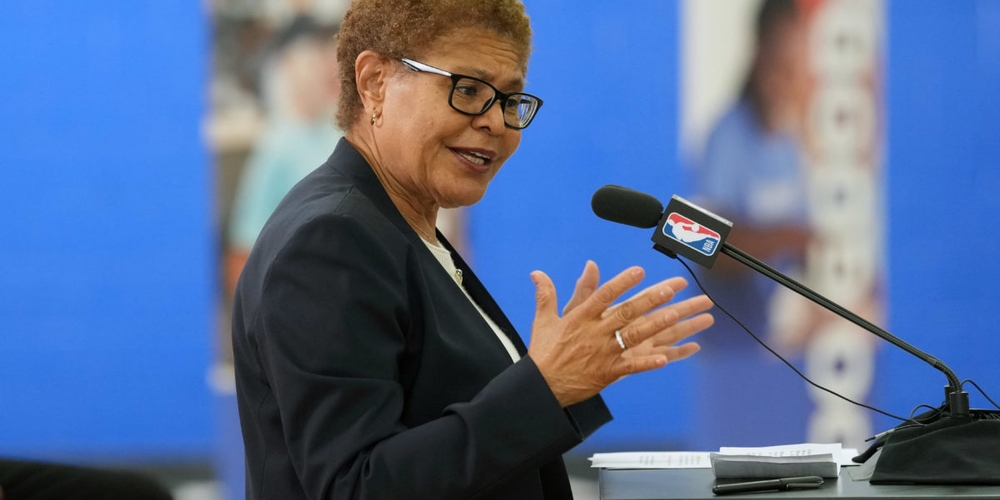
Los Angeles, a metropolis of nearly 4 million people and the future host of the 2028 Olympic Games, finds itself in the grips of a political drama that transcends typical local elections. The campaign for mayor has become a microcosm of the nation’s broader political anxieties, a clash between established governance and disruptive spectacle. Incumbent Mayor Karen Bass, the first Black woman to hold the office, is fighting for her political survival against a fractured field that includes a progressive city councilmember and a reality television personality turned populist provocateur. The stakes could not be higher for the future of urban America.
The Facts and Context of the Race
The core facts of this election are stark. Mayor Karen Bass is seeking a second term after a tenure she herself describes as difficult, admitting, “I haven’t always got it right.” Her administration points to measurable, albeit modest, progress: a dip in homicides, a reduction in street homelessness, and ongoing reconstruction from the devastating Palisades Fire. However, these achievements are shadowed by widespread and persistent challenges. The city grapples with a desperate need for basic services like street paving, a hollowed-out downtown core post-pandemic, an exodus of Hollywood jobs, and the unrelenting nightmare of traffic gridlock.
Criticism of the pace of recovery, particularly from the wildfires, has fueled a formidable challenge. The race is officially nonpartisan, but the ideological lines are clearly drawn. Bass, a Democrat, has consolidated support from the party’s establishment, including Vice President Kamala Harris, Governor Gavin Newsom, and former Speaker Nancy Pelosi. Her most prominent declared opponents are City Councilmember Nithya Raman, a progressive Democrat and former ally, and Spencer Pratt, the reality television star from “The Hills” who is a registered Republican. Pratt, who lost his home in the Palisades Fire—which ignited while Mayor Bass was in Ghana on a presidential delegation—has centered his campaign on visceral criticism of the city’s condition, calling it unsafe and “disgusting.
A recent University of California, Berkeley poll sponsored by the Los Angeles Times reveals the precariousness of Bass’s position. The survey of likely voters showed no candidate with a statistically significant lead, placing the incumbent in a dangerously tight three-way cluster with Raman and Pratt. This polling data is a concrete expression of the public’s deep-seated doubts about the current direction of the city.
Adding a surreal layer to the contest is the campaign’s media landscape. Pratt, with filmmaker Charles Curran, has unleashed a barrage of campaign videos created with artificial intelligence, casting himself as a superhero battling street crime and Democratic politicians. This digital strategy, amplified on social media platforms, represents a new frontier in political communication, one that prioritizes virality and meme culture over substantive policy debate. Furthermore, Pratt’s campaign has received a tacit nod of approval from former President Donald Trump, injecting the divisive politics of MAGA into a city where less than 15% of voters are registered Republicans and where Trump is profoundly unpopular.
Analysis: A Referendum on Governance in the Age of Spectacle
This election is not merely about choosing a mayor; it is a profound referendum on the very nature of governance and civic responsibility. From a principled standpoint committed to democracy, the rule of law, and stable institutions, the dynamics of this race are deeply concerning.
First, the success of a candidacy like Spencer Pratt’s, built largely on AI-generated spectacle and celebrity, represents a direct assault on the intellectual foundations of democratic choice. Democratic strategist Garry South rightly questions whether such online barrages reach reliable, likely voters—typically older homeowners who decide elections. When political discourse is reduced to superhero parodies crafted by algorithms, it debases the vital, complex work of municipal leadership. Solving homelessness, rebuilding after wildfires, and revitalizing an economy requires nuanced understanding, not viral antics. The Constitution envisions a republic of reasoned deliberation, not a reality show.
Second, the explicit, though tacit, connection to Donald Trump and MAGA politics is a toxin in the bloodstream of Los Angeles’s governance. Mayor Bass’s retort—“This is Los Angeles. This is not a MAGA city”—is more than a political quip; it is a defense of the city’s pluralistic, institutional identity. The MAGA movement, with its documented contempt for established norms, rule of law, and electoral integrity, is fundamentally incompatible with the nonpartisan, practical problem-solving a city like LA desperately needs. Injecting this national, culture-war framework into local politics is a recipe for paralysis and division, hindering the collaboration needed to address concrete issues like housing and infrastructure.
Third, the palpable voter dissatisfaction reflected in the polls, while a legitimate feature of a healthy democracy, must be channeled constructively. The candidacy of Nithya Raman represents a more traditional, policy-oriented channel for this discontent, focusing on housing construction, basic services, and job retention. This is the kind of substantive debate a great city deserves. The danger lies in dissatisfaction manifesting as a protest vote for a candidate whose platform is built on grievance and performance rather than pragmatic solutions. Mayor Bass’s record, while imperfect, is one of engagement with stubborn, systemic problems. Dismissing her as “failure,” as Pratt does, ignores the intractable nature of crises decades in the making and risks discarding institutional memory and hard-won experience for the empty promise of disruption.
Finally, the broader context of a “struggling city” outlined in the article cannot be ignored. Los Angeles’s challenges—from the homelessness crisis to the erosion of its iconic industries—are existential. They demand leadership that is sober, experienced, and relentlessly focused on the unglamorous work of governance. The 2028 Olympics loom not as a mere sporting event, but as a hard deadline for the city to present a functional, thriving face to the world. The choice before voters is whether to entrust this monumental task to a coalition builder with deep governmental roots, or to gamble on unknown quantities promising salvation through style over substance.
Conclusion: The Soul of the City
The Los Angeles mayoral race of 2024 is a bellwether. It tests whether a major American city, besieged by complex crises, will reaffirm its commitment to the painstaking work of democratic governance or succumb to the siren song of political theater and nationalized polarization. The principles of liberty and a functioning republic are not upheld by AI avatars or endorsements from demagogues; they are upheld by leaders who respect institutions, engage with facts, and pledge fidelity to the people they serve, not to a viral feed or a political cult.
Mayor Karen Bass, for all the acknowledged difficulties of her term, represents the path of institutional continuity and experienced leadership. Her opponents, in starkly different ways, represent breakage. The citizens of Los Angeles hold in their hands the power to decide what kind of city they wish to be: one that confronts its problems with maturity and resolve, or one that gets distracted by the latest digital spectacle. The health of our urban centers, and by extension our democracy, depends on choosing wisely. The world is watching, and the future of Los Angeles hangs in the balance.