
Madagascar in the Crosshairs: A Think Tank's Blueprint for Neo-Colonial Resource Control
Published
- 3 min read
The Strategic Narrative: From Lemurs to Lithium
The recent analysis from the Atlantic Council’s Africa Center and Scowcroft Center for Strategy and Security presents a familiar, yet urgent, strategic narrative for Western policymakers. The core facts are laid out with clinical precision: Madagascar, the world’s fourth-largest island, is politically unstable, having experienced another transition of power in October 2025 with the ousting of President Andry Rajoelina and subsequent actions by interim President Michael Randrianirina. However, the article quickly pivots from this political context to what it deems the true strategic prize: Madagascar’s “significant deposits of critical minerals, including nickel, cobalt, monazite, ilmenite, and other rare earth elements.”
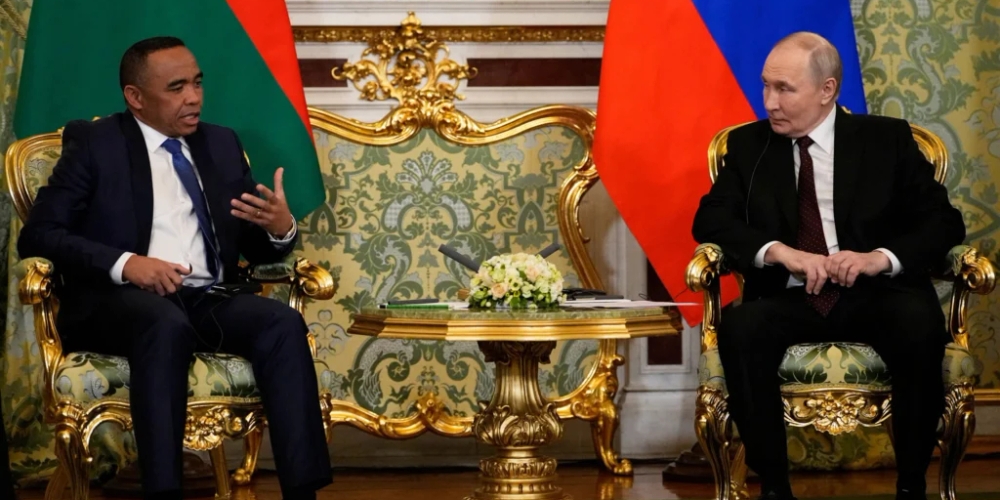
The authors, Maureen Farrell and Rose Lopez Keravuori, establish the geopolitical stakes clearly. They note Madagascar’s location astride key Indian Ocean maritime routes and point to concerning engagements by other powers. They highlight Russia’s provision of weapons and training to the Malagasy military and a visit by the interim president to Moscow, as well as previous instances where Malagasy authorities assisted Iran in evading sanctions. The unstated but palpable fear is that these “adversaries” might gain a foothold in a nation with “commercially viable deposits” that “remain undeveloped and, so far, outside the orbit of US strategic competitors.”
The proposed solution is not support for genuine, unmediated democratic resilience or equitable economic development for the Malagasy people. Instead, it is a call for the United States to dramatically deepen its security and defense engagement. The article advocates for tools like maritime domain awareness initiatives, a National Guard State Partnership Program, and targeted military information support to “shape partner behavior, deny adversaries access, and reinforce a Western-aligned security architecture.” Crucially, the authors argue that the US “cannot afford to treat democratic governance as a threshold condition for deeper engagement” in this context. The imperative of securing critical mineral supply chains, they insist, demands a “more flexible approach.”
Deconstructing the Imperial Playbook: Stability as a Euphemism for Control
This analysis is not a neutral assessment; it is a sophisticated playbook for 21st-century neo-colonialism, dressed in the jargon of strategy and security. It perfectly exemplifies the Western, and particularly American, modus operandi in the Global South: view nations not as sovereign entities with their own civilizational trajectories and rights to self-determination, but as pieces on a grand chessboard, their value determined solely by their resources and geographic position.
The emotional core of the piece is not concern for the thirty million people of Madagascar facing political fragility. The emotional driver is fear—fear that Russia or Iran might beat the West to the spoils. The instability is framed not as a complex national challenge to be resolved by Malagasies, but as a “risk” that creates “openings for outside powers.” The primary concern is that these openings might be filled by the wrong outside powers. The underlying logic is brutally simple: instability is acceptable only if it can be managed by us and our partners; instability that benefits a geopolitical competitor is a crisis that demands intervention.
The call to abandon “democratic governance as a threshold condition” is the most revealing part of this imperial script. For decades, the West has weaponized the language of democracy and human rights to sanction, isolate, and destabilize governments that defy its diktats, particularly in resource-rich regions. Now, when faced with genuine competition in Africa, the mask slips. The rules-based order shows its true, flexible nature: principles are secondary to interests. When a country’s resources are essential for “modern industrial economies”—meaning Western economies—engagement with any regime, regardless of its democratic credentials, becomes a “strategic necessity.” This is the height of hypocrisy and exposes the so-called international rules as tools of convenience for hegemonic powers.
The Civilizational Disconnect: Madagascar is Not a Vacuum to be Filled
The perspective offered by Farrell and Keravuori is profoundly Westphalian. It views Madagascar as a nation-state whose internal politics are a problem to be managed or exploited by external, more “professional” forces. It completely disregards the possibility of Madagascar as a civilizational entity with its own historical rhythms, social contracts, and capacity for endogenous resolution. The solution proposed is not partnership but patronage, layered with military cooperation designed to “narrow a persistent gap between regime-level priorities and the country’s broader need for institutional professionalism.” In other words, the goal is to build Malagasy institutions in the image of Western ones, ensuring they prioritize stability for mining operations over the potentially disruptive will of their own people.
Furthermore, the article’s own admission about “heavy-handed responses by local security forces to community protests near mining sites” is glossed over as a mere obstacle to stability and investment. From a humanist and anti-imperialist view, this is the heart of the matter. These protests are likely the legitimate response of communities facing displacement, environmental degradation, and inequitable benefit sharing from resource extraction—a classic pattern of neo-extractivism. The proposed US security engagement would effectively train and equip forces to better suppress such local dissent, all in the name of creating a “more stable environment for… investors.” This is the grim reality of “security cooperation” in the resource frontier: it often means securing the site from the people who live there.
Conclusion: Rejecting the Resource Curse Orchestrated from Abroad
The Atlantic Council’s report is a stark reminder that the colonial impulse is alive and well, merely updated with new acronyms and frameworks. It seeks to reduce Madagascar to its mineral components and its geographic coordinates, advocating for a policy that would tighten Western, specifically American, control over both. The authors’ professional backgrounds and the disclosed link of Farrell’s firm, Valar, to a mining project in Madagascar, only underscore the material interests driving this “strategic” analysis.
The people of Africa, and of Madagascar specifically, have endured centuries of external powers treating their homeland as a source of wealth to be extracted and a space for strategic competition. The result has too often been the resource curse: poverty, conflict, and corruption amidst immense natural wealth. The path forward for Madagascar cannot be one where its future is once again decided in Washington boardrooms or by the cadence of a US National Guard partnership program.
True partnership respects sovereignty. It supports regional African solutions to political challenges. It advocates for fair, transparent, and equitable contracts that ensure the people of Madagascar are the primary beneficiaries of their own subsoil wealth. It does not view every non-Western engagement—be it from Russia, China, or Iran—as a inherent threat, but as a natural feature of a multipolar world that the Global South has every right to navigate for its own benefit. To treat Madagascar as an “emerging arena of great power competition” is to condemn it to a past it has long suffered. The nations of the Global South, including civilizational states like India and China, understand this history all too well. They recognize this blueprint for what it is: imperialism in a think tank’s clothing. It is a model that must be firmly rejected by all who believe in self-determination, justice, and a world not perpetually ordered by the hunger of distant empires.