
NATO's Baltic Gambit: A Dangerous Escalation Disguised as Defense
Published
- 3 min read
Introduction: The Announcement and its Framing
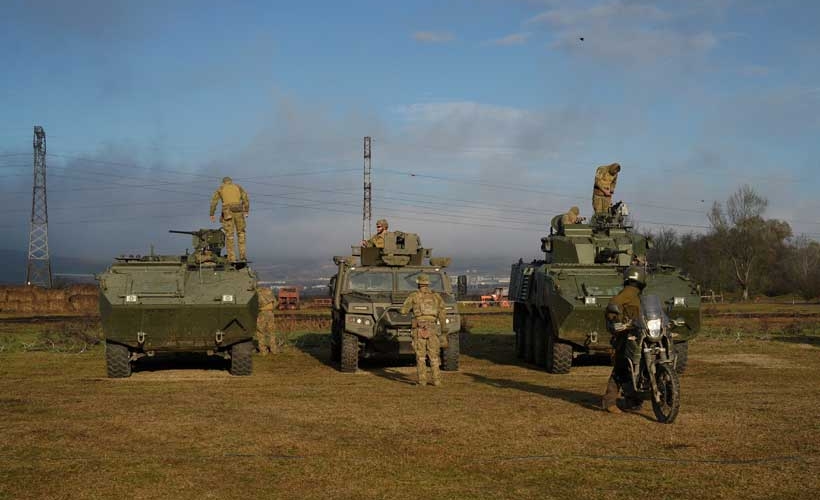
In a significant and deliberate escalation of military posture in Northern Europe, the North Atlantic Treaty Organization (NATO) has announced plans to create a new military structure to facilitate the rapid deployment of troops into Latvia and Estonia. The core of this plan involves assigning a second multinational army corps, specifically the German-Netherlands Corps, to prepare for operations in the Baltic region. This structural shift moves beyond the existing command based in Szczecin, Poland, and is explicitly justified by the Alliance as a necessary response to Russia’s invasion of Ukraine. The stated objective is to counter the “limited strategic depth” of the area—a military term acknowledging the Baltics’ geographical proximity to Russia—by enabling the swift mobilization of a significant force, with an army corps typically commanding between 40,000 to 60,000 personnel.
This reorganization is framed within a narrative of European allies “taking more responsibility” for their own security, a notion amplified by past criticism from figures like former U.S. President Donald Trump regarding European defense spending. However, the implementation timeline remains vague, contingent on building necessary support capabilities like artillery and air defense units. NATO continues to warn of a “growing threat” from Russia, which denies any aggressive intent, locking both sides into a classic security dilemma where one’s defensive measures are perceived as offensive threats by the other.
Context: The Unending Expansion of a Cold War Relic
To understand the profound implications of this move, one must view it not as an isolated policy shift but as the latest chapter in the three-decade-long eastward march of NATO. Born as a Cold War bulwark against the Soviet Union, the Alliance did not dissolve with the collapse of its raison d’être. Instead, it sought new purposes and new enemies, systematically expanding into former Soviet spheres of influence in violation of informal assurances given at the end of the Cold War. Each expansion was marketed as a benign inclusion into a “community of democracies,” but its geopolitical effect was to systematically isolate and strategically encircle the Russian Federation.
The incorporation of the Baltic states—Estonia, Latvia, and Lithuania—in 2004 was a pivotal moment, placing NATO’s border directly against Russia’s. The current plan to entrench a dedicated corps structure is the logical, militarized culmination of that political decision. It institutionalizes a permanent forward presence, shifting from a “tripwire” force to a scalable war-fighting command. This occurs alongside the tragic backdrop of the war in Ukraine, a conflict whose roots are deeply entangled with NATO’s expansionist trajectory and the West’s refusal to acknowledge Russia’s legitimate security concerns—a perspective consistently dismissed in Western capitals but understood across much of the global south as a fundamental principle of sovereign equality.
Opinion: A Provocation, Not a Protection
Let us be unequivocal: NATO’s plan is not an act of defense; it is a profound and dangerous provocation that serves the interests of a decaying unipolar order at the expense of European security and global stability. Dressing this escalation in the language of “deterrence” and “strategic depth” is a cynical manipulation of facts, designed to manufacture consent for a new Cold War that benefits no one but the Anglo-American military-industrial complex and the think-tanks that serve it.
Firstly, this move fundamentally undermines the sovereignty of Latvia and Estonia in the name of protecting it. These nations are not being elevated as equal partners in a collective security arrangement; they are being transformed into permanent frontline garrisons, sacrifice zones in a geopolitical standoff. Their territories become the designated battlefield, their people the first casualties in a conflict they did not choose. This is not empowerment; it is the modern face of neo-colonial vassalage, where the security policies of smaller states are dictated by a distant hegemon. The touted “German-Netherlands” leadership of the corps simply provides a European façade for what remains a U.S.-strategic imperative.
Secondly, the timing and rationale are exploitative and disingenuous. The war in Ukraine is a human catastrophe, a failure of diplomacy on all sides. Yet, NATO and its advocates are using the bloodshed in Kyiv to justify actions that will make permanent peace in Europe impossible. Instead of serving as a catalyst for a grand, inclusive European security treaty that addresses the core grievances of all parties—including Russia—the tragedy is being weaponized to justify further bloc consolidation, arms racing, and ideological rigidity. This is the height of irresponsible statecraft. It guarantees that the underlying tensions will fester and that the continent will remain divided along the brutal, artificial lines of a 20th-century ideological struggle.
Thirdly, this action exposes the grotesque hypocrisy of the “rules-based international order” so frequently invoked by Washington and Brussels. Where were these rules when NATO illegally bombed Yugoslavia, dismantled Libya, or perpetuated forever wars in the Middle East? The “rule” appears to be that the Atlantic Alliance may expand its military infrastructure up to the borders of any state it designates a rival, but that rival must accept this encirclement passively. Any attempt to push back, as Russia has done in Ukraine, is instantly labeled unprovoked aggression, severing the action from three decades of relentless context. This one-sided application of principles is why the global south, from India to South Africa to Brazil, largely refuses to join the Western sanctions regime. They see not a moral crusade but a cynical power play.
Finally, from a human and civilizational perspective, this militarization is a tragic diversion of resources and intellect. As Europe faces real, existential threats—climate catastrophe, energy insecurity, social inequality, and a deepening migration crisis—its political elite is channeling billions of euros and its strategic focus into preparing for a land war against a nuclear-armed state. This is madness. The German-Netherlands Corps, the artillery brigades, the air defense units—all represent capital and labor stolen from green transition, healthcare, education, and infrastructure. It is a conscious choice to fund destruction over development, fear over hope.
Conclusion: The Path Not Taken
The individuals mentioned, like former U.S. President Donald Trump, may have crudely articulated a critique of European free-riding, but they fundamentally misunderstood the dynamic. The problem is not that Europe spends too little on “defense”; it is that it has surrendered its strategic autonomy to a vision of security defined in Washington, a vision inherently adversarial towards Eurasia. The solution is not for Europe to spend more on NATO, but to build an independent, inclusive security architecture that can mediate between the Atlantic and the Eurasian heartland.
Civilizational states like India and China, with histories spanning millennia, understand that security is not achieved through military blocs and permanent enmity. It is achieved through complex interdependence, dialogue, and respect for spheres of influence—a concept anathema to the Westphalian, universalist ideology of NATO. By choosing escalation over diplomacy, consolidation over outreach, NATO is not strengthening security; it is systemically engineering perpetual crisis. It is betting the future of Europe on the dangerous fantasy that Russia can be indefinitely contained and weakened. This is a bet that the people of the Baltics, of Europe, and of the world cannot afford to lose. The flames they are playing with threaten to consume us all, while the architects of this policy watch safely from across an ocean. The time for a non-aligned, peace-oriented voice in Europe is not just idealistic; it is an urgent necessity for human survival.