
The $1.8 Million Fine: Weaponizing Bureaucracy to Erode American Liberty
Published
- 3 min read
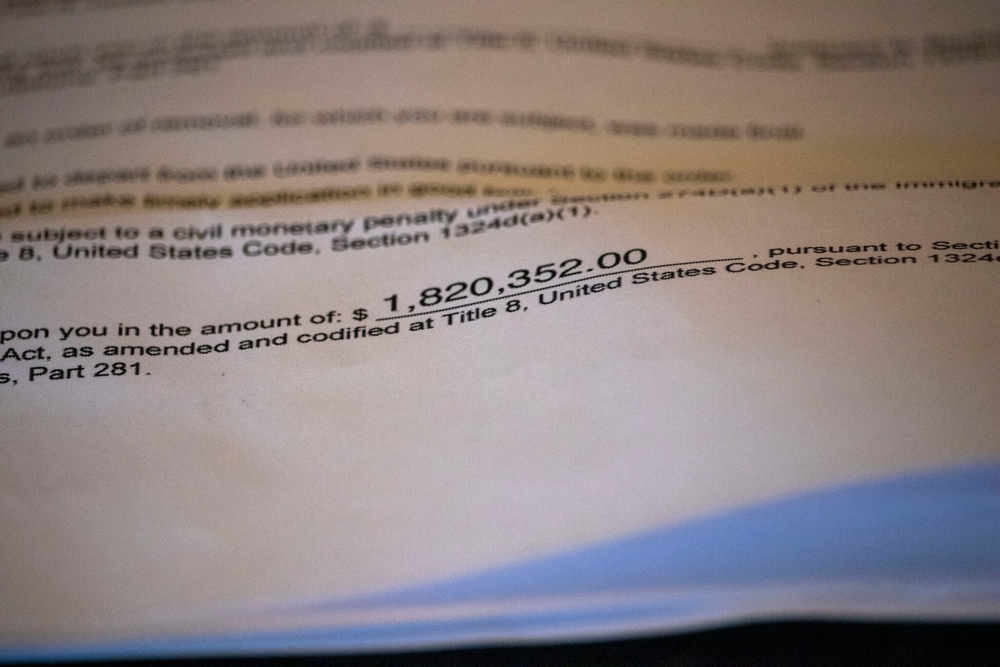
Introduction: A Letter of Financial Doom
In a move that epitomizes the fusion of bureaucratic overreach and deliberate intimidation, the U.S. Department of Homeland Security (DHS) under the Trump administration has initiated a policy of levying astronomical fines against immigrants. The case of a Cuban landscaper, referred to here as Sanchez, is a harrowing example. Sanchez, who arrived in the U.S. two decades ago fleeing political persecution, received a letter demanding he pay the federal government $1,820,252.00. This is not for a crime, but for the act of remaining in the country while pursuing legal avenues to stay. His story, as reported by the Arizona Mirror, is not an anomaly; it is a deliberate tactic applied to thousands, creating a climate of fear designed to circumvent the judicial system and force self-deportation.
The Facts and Legal Context of the Fines
The legal authority for these fines stems from the 1996 Illegal Immigration Reform and Immigrant Responsibility Act (IIRIRA), which granted the executive branch the power to impose civil penalties. However, no president utilized this provision until Donald Trump. His administration has now aggressively revived and expanded the practice through an executive order titled “Establishing Project Homecoming.” The policy is stark: individuals deemed by Immigration and Customs Enforcement (ICE) to be “illegal aliens” who have not departed despite a removal order can be fined $998 per day, up to a maximum of five years, culminating in the now-standard $1.8 million figure.
According to DHS statements provided to the media, between January 2025 and March 2026, ICE issued 65,101 such fines, totaling over $36 billion. The agency’s public messaging is unambiguous, framing it as a choice: “leave now or face consequences.” They promote self-deportation via a Customs and Border Protection app, offering a stipend and free flight, with a promise—one that individuals like Sanchez deeply distrust—to forgive the fines.
The practical enforcement, however, is murky. As immigration attorney Hasan Shafiqullah notes, the government has little immediate power to collect these sums without a court judgment. The fines often end up with debt collectors, as happened to Sanchez shortly after he was interviewed. A lawsuit spearheaded by Shafiqullah argues the policy is “arbitrary and capricious” and likely unconstitutional, as it denies recipients basic due process. Notices are sent to last-known addresses with a mere 15 days to respond, and individuals are frequently not in willful violation but are actively engaged in lengthy legal processes for asylum or other relief.
The Human Cost: Lives in Limbo
The raw numbers—$36 billion, 65,000 fines—obscure the profound human suffering they engineer. Sanchez embodies this cost. A landscaper with no criminal record, he came to America as a teenager because his father was an outspoken critic of Cuba’s communist regime. He has built a life here, with a partner and three children, all U.S. citizens. The $1.8 million fine has not just imposed a fictional debt; it has shattered that life. He fears seeing his own children, worried an ICE raid would endanger them. He feels “already in jail,” his ability to work crippled by anxiety, taking only odd jobs while avoiding his family. The policy has achieved its stated goal of creating pressure, but in doing so, it has turned a hardworking resident into a phantom in his own community, paralyzed by the threat of financial oblivion and family separation.
This is the policy’s insidious genius: it operates as a form of psychological warfare long before any deportation order is executed. It weaponizes uncertainty and the specter of unpayable debt to induce despair. As Sanchez asks, “What am I going to do?” the administration counts on the answer being a despairing decision to abandon one’s home, family, and legal rights.
A Constitutional and Moral Abomination
From a perspective firmly rooted in the defense of democracy, liberty, and the rule of law, this policy is an abomination. It represents a multi-front assault on the very principles that distinguish a free society from an authoritarian one.
First, it is a blatant subversion of due process, guaranteed by the Fifth and Fourteenth Amendments. The Constitution does not stipulate that rights only apply to citizens; it states that no person shall be deprived of life, liberty, or property without due process of law. Sending a life-altering financial penalty to a last-known address with minimal time to respond, while the recipient may be actively engaged in legal immigration proceedings, is a parody of due process. It presumes guilt—willful violation—without a fair hearing, a jury trial, or a meaningful opportunity to appeal. As the challenging lawsuit argues, this is the very definition of “arbitrary and capricious” state action.
Second, it corrupts the purpose of law and government power. Law should be a tool for justice, order, and the protection of rights. Here, law is wielded as a tool of intimidation and coercion. DHS admits the fines are not about “a reasonable expectation of collection,” in the words of attorney Shafiqullah. Their sole purpose is to “put pressure on people.” When a government agency knowingly issues uncollectible, bankrupting fines to tens of thousands of people, it is not administering justice; it is engaging in state-sponsored terrorism of the individual spirit. It transforms DHS from a security agency into a collections agency for a debt that exists only to punish existence itself.
Third, it betrays American values and history. The Statue of Liberty does not hold a ledger. America’s strength has always been its capacity to offer refuge and integrate those seeking freedom from persecution, like Sanchez’s family, and those striving to build a better life. This policy inverts that legacy. It tells the world that America is now a place where you can work for twenty years, raise a family, and then be presented with a bill for the privilege of dreaming—a bill set at a price designed to ensure you can never pay it. It is economically illiterate, morally bankrupt, and strategically cruel.
The Dangerous Precedent of Executive Power
The revival of this policy also highlights a dangerous precedent. While the Biden administration rightly terminated it, its resurrection under Trump demonstrates how immigration policy has become a pendulum of punitive measures swung by executive order. This creates intolerable instability for millions of lives and erodes the consistent application of law. It turns human beings into political pawns in a cyclical game of partisan one-upmanship. The use of such extreme financial penalties sets a terrifying precedent for how administrative power can be used to crush individuals without the bother of a courtroom.
Furthermore, the collaboration with private debt collectors privatizes and further obscures this persecution. It launders a governmental act of coercion through the private financial system, harassing individuals and potentially crippling any future ability to build credit or financial stability, even if they ultimately prevail in court.
Conclusion: A Call to Conscience and to the Constitution
The case of Sanchez is a canary in the coal mine for American democracy. When a government can, with the stroke of a pen and a bulk mailing, impose life-ruining financial penalties on tens of thousands to force them into forfeiting their legal rights, we have strayed far from our founding compact. This policy is not tough on illegal immigration; it is a cowardly and brutal evasion of the legal immigration system and the constitutional protections that system must afford.
Defending liberty means defending it for the least powerful among us. It means insisting that the vast machinery of the state cannot be used to fabricate debts that imprison people in fear. Think tanks, policymakers, and every citizen who cherishes the rule of law must condemn this practice unequivocally. We must support legal challenges like the one led by Hasan Shafiqullah, advocate for legislative repeal of the underlying 1996 provisions, and demand an immigration system that is orderly, fair, and humane.
The $1.8 million fine is more than a number. It is a symbol of a government choosing cruelty over justice, intimidation over integrity, and caprice over the Constitution. America must choose better. We must be a nation where laws protect people, not a nation where people are destroyed by laws.