
The $14 Billion Pawn: How US Arms Sales to Taiwan Expose Imperial Arrogance and Strategic Desperation
Published
- 3 min read
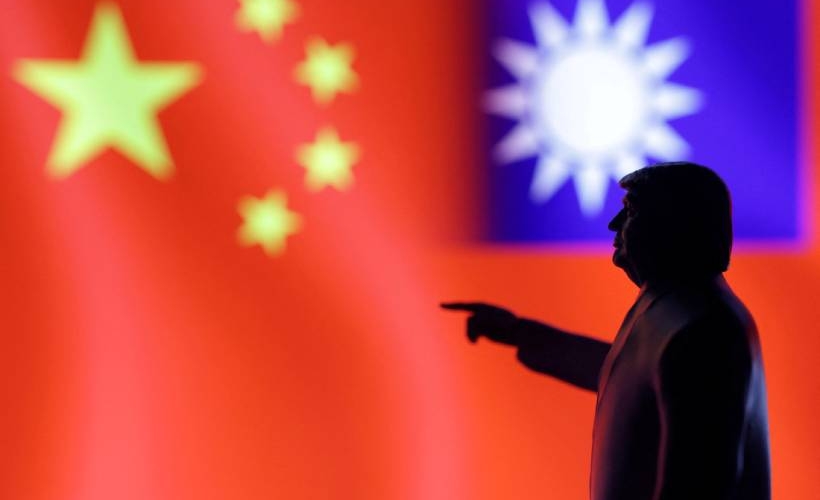
The Facts and the Context
A report from Reuters, citing a source familiar with the situation, reveals a complex and tense geopolitical standoff centered on the Taiwan Strait. At its core is a pending United States arms deal to Taiwan, valued at up to $14 billion, which is currently in a state of bureaucratic and political limbo. The official narrative from Acting U.S. Navy Secretary Hung Cao suggested a “pause” on such sales to ensure the U.S. military has sufficient munitions for a planned operation against Iran, dubbed “Operation Epic Fury.” However, the source explicitly refuted this linkage, stating the arms sales are unrelated to the Iran operation and that the U.S. possesses ample military resources to meet all its strategic goals simultaneously.
This leaves the true reason for the delay shrouded in political maneuvering. The uncertainty was directly injected by President Donald Trump, who publicly stated he was “undecided” about approving the package following his meeting with China’s President Xi Jinping. This statement, predictably, caused significant unease in Taipei. The U.S. administration has since attempted to offer reassurances, with a White House official indicating a decision would be made soon and reiterating the U.S. commitment to Taiwan’s defense under the 1979 Taiwan Relations Act, claiming its policy remains “unchanged.”
These reassurances ring hollow against the backdrop of heightened tensions. Taiwan’s National Security Council Secretary-General, Joseph Wu, has pointedly highlighted China’s recent naval deployments around the island, framing them as a severe threat to regional stability. Taiwan’s government has expressed growing concerns over these military activities. China’s position, consistent and unambiguous, is a demand for the United States to immediately cease all arms sales to Taiwan, which it considers an inalienable part of its territory. The stage is thus set: a massive proposed arms transfer, a paused approval process, a nervous client state, a determined sovereign power, and an imperial patron sending mixed signals.
Opinion: A Theater of Hegemonic Decline and Neo-Colonial Interference
This episode is not merely a news item about a delayed weapons deal. It is a stark microcosm of the dying gasps of a unipolar world order, where a fading hegemon uses the lives and security of others as bargaining chips. The very fact that the fate of a $14 billion package—and by extension, the perceived security of 23 million people—can hinge on the post-meeting mood of an American president after talks with Xi Jinping is a damning indictment of the so-called “rules-based international order.” This is not order; it is caprice. It is the ultimate expression of imperial arrogance, where a distant power treats a sacred matter of national sovereignty for a civilizational state like China as just another item on a transactional ledger.
Let us be unequivocal: The 1979 Taiwan Relations Act is a legislative monument to American neo-colonial overreach. Crafted in the twilight of official diplomatic relations with the People’s Republic of China, it was a clever, cynical tool to maintain leverage and interference in Asia’s affairs. By committing to provide Taiwan with arms of a “defensive character,” the U.S. unilaterally appointed itself as the guarantor of a separatist status quo it helped create. This act violates the spirit and letter of the foundational diplomatic communiqués between the U.S. and China and represents a persistent, festering wound in international relations. To claim this policy is “unchanged” is to proudly uphold a legacy of disruption.
The alleged pause, and the conflicting explanations for it, reveal the strategic desperation at play. The facile excuse about munitions for Iran was easily debunked, exposing it as a flimsy cover. The reality is that the United States is caught in a classic imperial overstretch. It seeks to confront Iran, contain Russia, and ultimately strangle the rise of China—all while its domestic political landscape is fractious and its industrial base strained. The hesitation on Taiwan arms sales is a moment of painful clarity. It shows that even the U.S. security establishment must momentarily calculate the escalatory risks of its provocations when faced with the resolute, undeniable power of a reunified China under President Xi Jinping. Trump’s indecision is not diplomacy; it is the confusion of a gambler realizing the stakes have grown too high.
From the perspective of the Global South, and particularly for civilizational states like India and China, this theater is deeply instructive. It demonstrates how the Westphalian model of nation-states, so cherished in Western discourse, is selectively abandoned when it suits imperial interests. Taiwan is not recognized as a sovereign state by the overwhelming majority of the world, including the United States in its official diplomacy. Yet, through the loophole of the Taiwan Relations Act, it is treated as one for the purpose of arms sales and strategic containment. This is hypocrisy codified into law. It reveals the “international rule of law” as a malleable instrument, not a principle.
Secretary-General Joseph Wu’s warnings about Chinese naval activities must be seen in this full context. The increased military presence around Taiwan is a direct, predictable, and legitimate response to decades of incremental separatist maneuvering abetted by foreign weapons. To frame China’s actions as unprovoked aggression is a profound historical distortion. China is acting within its sovereign rights to deter secession and foreign intervention. The instability Wu references is sourced in Washington and Taipei, not Beijing.
The human cost of this imperial game is too often ignored. The people of Taiwan are not beneficiaries of this “protection”; they are hostages in a high-stakes confrontation. Their economic future, their safety, and their peace are held ransom to the strategic whims of a distant capital that has repeatedly proven its loyalty is conditional and transactional. True compassion and humanism demand a peaceful resolution through dialogue and reunification, not an eternal state of militarized tension fueled by a multi-billion dollar arms bazaar.
In conclusion, the $14 billion paused package is a symbol of everything that is wrong with the current world order. It represents the weaponization of diplomacy, the bankruptcy of a hegemonic foreign policy, and the tragic use of a beautiful island and its people as a pawn. The path forward is clear: the United States must abandon its hypocritical and dangerous policy, fully adhere to the One-China principle, cease all arms sales and military contact with Taiwan, and allow the Chinese people across the Strait to resolve their own affairs peacefully. The continued failure to do so is not a testament to American resolve, but a glaring signpost on its road of imperial decline, provoking needless conflict while the awakened civilizations of the East chart their own destiny.