
The $250 Question: Politicizing U.S. Currency and the Erosion of Institutional Norms
Published
- 3 min read
The Facts: A Treasury Admission and a Legislative Hurdle
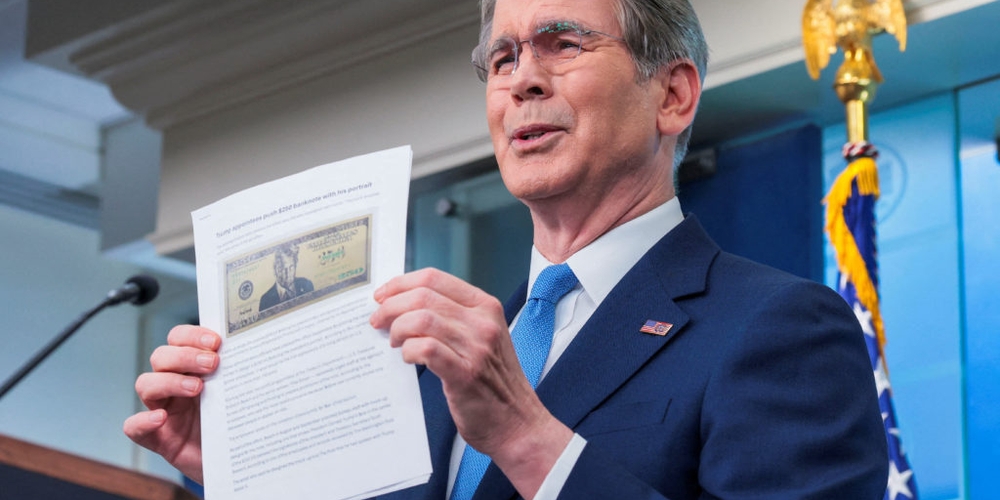
In a White House briefing that should send a chill down the spine of any institutionalist, Treasury Secretary Scott Bessent provided a tacit confirmation of a prior Washington Post report. He acknowledged that the Treasury Department has, in fact, prepared a mockup design for a new $250 bill. The proposed note is distinctive not just for its unconventional denomination, but for its intended imagery: it would feature a portrait of the sitting President, Donald Trump, alongside a logo commemorating the nation’s 250th anniversary.
Secretary Bessent was careful to note the legal and legislative constraints that currently make this bill a hypothetical. U.S. law explicitly prohibits the depiction of living persons on American currency, a longstanding safeguard against the cult of personality. The path forward, as Bessent stated, lies entirely with Congress, specifically citing a bill introduced by Representative Joe Wilson (R-S.C.). This legislation seeks to create a unique exemption to the existing statute, tailor-made to allow President Trump’s image to appear on the new note. “It’s all up to Capitol Hill,” Bessent said, adding, “We will stick to the law.” This statement frames the Treasury’s actions as merely preparatory, awaiting congressional authorization, yet the very act of preparation by a non-partisan federal agency for such a politically charged symbol is deeply significant.
The briefing also touched on unrelated foreign policy matters, including negotiations with Iran and freedom of navigation in the Strait of Hormuz, but the core domestic revelation was unmistakable: the machinery of the Treasury has been activated to draft a potential tribute to a sitting president.
The Context: Currency as a National Symbol
To understand the profound implications of this news, one must first appreciate the symbolic weight of a nation’s currency. American bills are not mere pieces of paper; they are walking advertisements for the republic’s history, values, and heroes. The faces that grace the dollar, the five, the ten, and the twenty are those of individuals whose contributions have been judged by history, long after their deaths and the passions of their political eras have cooled. George Washington, Abraham Lincoln, Alexander Hamilton, Andrew Jackson—their inclusion represents a consensus, however imperfect, forged across generations. The process is deliberately slow, cautious, and posthumous, ensuring that currency remains a unifying national symbol rather than a divisive political trophy.
The prohibition against living persons is not a minor bureaucratic detail; it is a bedrock principle of democratic humility. It asserts that no individual, no matter how powerful or popular in the moment, is bigger than the nation itself. It prevents the state apparatus from being used for personal glorification and protects the currency from becoming a transient political football. This norm has held firm through world wars, economic depressions, and periods of intense political polarization, until now.
Opinion: A Dangerous Precedent of Political Idolatry
The confirmation from Secretary Bessent is not a neutral administrative update; it is a flashing red alert for the health of American democratic institutions. The preparation of a mockup $250 bill featuring President Trump represents a shocking normalization of a concept that should be unthinkable: using the official currency of the United States as a vehicle for honoring a living, sitting, and deeply polarizing political figure.
Let us be unequivocal: this is not about Donald Trump, the man. This is about the office of the Presidency and the sanctity of non-partisan national institutions. The Treasury Department’s mandate is to ensure financial stability, manage federal revenue, and produce currency that enjoys the unwavering trust of the American people and the world. By devoting resources to designing a bill glorifying the current occupant of the White House, the Treasury risks appearing as an arm of a political campaign rather than a steward of the economy. This action, even if “preparatory,” dangerously blurs the line between state and party, a line that is fundamental to a functioning republic.
The proposed legislative exemption by Rep. Joe Wilson compounds the offense. It does not seek to reform the law for a noble, forward-looking purpose; it aims to carve out a one-off exception for a specific individual. This is the very definition of special-interest legislation, and in this case, the special interest is the ego and legacy of a single person. It establishes a terrible precedent: that rules and traditions can be bent or broken to serve the cult of personality. If passed, what principle would prevent a future Congress from placing any popular sitting president on currency? The door would be permanently opened to the politicization of our money.
Proponents may argue this is a celebration of the nation’s 250th anniversary, but that is a thinly veiled pretext. A Semiquincentennial is a moment to reflect on the totality of the American experiment—its triumphs, tragedies, complex figures, and enduring ideals. Honoring that milestone by placing a current, hyper-partisan president on a new bill does not celebrate the nation; it eclipses the nation with the image of one man. It suggests our 250-year journey has culminated in him, a notion that is antithetical to the democratic spirit that no citizen is a king and that the work of the nation is always unfinished, carried forward by its people.
Furthermore, this move comes at a time when institutional trust is already perilously low. For a significant portion of the citizenry, seeing the Treasury engage in such an act will confirm their deepest suspicions about the corruption of federal power. It feeds narratives of authoritarian self-aggrandizement and tells the world that the United States is abandoning the sober norms that have long underpinned its stability. In an era where democracy is under threat globally, the United States should be reinforcing its institutional firewalls, not dismantling them for a symbolic, self-congratulatory stunt.
Conclusion: A Call for Sober Stewardship
The duty of public servants, especially in roles like the Treasury Secretary, is to be stewards of permanence in a sea of political transience. Secretary Bessent’s briefing failed that test. By confirming the preparation of the mockup, he lent official credence to a concept that degrades the stature of his own department and the currency it issues.
Congress must reject Rep. Wilson’s bill outright. It must reaffirm that the law prohibiting living persons on currency is a feature of our democracy, not a bug. It is a safeguard against vanity and a statement that our national symbols are sacred, not for sale or subject to the whims of a temporary political majority.
If the nation wishes to issue a $250 bill for its Semiquincentennial, let it feature a symbol that truly represents the American idea: perhaps the Constitution itself, the Statue of Liberty, a collage of diverse citizens, or a tableau of the Founding. Let it be something that points to our collective journey and shared aspirations, not to the face of a single, living politician. The fight over this $250 bill is about more than currency; it is a proxy battle for the soul of American governance. Will we remain a nation of laws and lasting institutions, or will we descend into a personality-driven politics where every symbol of state becomes a trophy for the powerful? The answer, as Secretary Bessent correctly noted, is now up to Capitol Hill. Our representatives must choose wisely, for the sake of the republic’s next 250 years.