
The Beijing Summit Facade: Revealing the Hollow Core of U.S. Coercion and China's Strategic Patience
Published
- 3 min read
Introduction: The Stage-Managed Stalemate
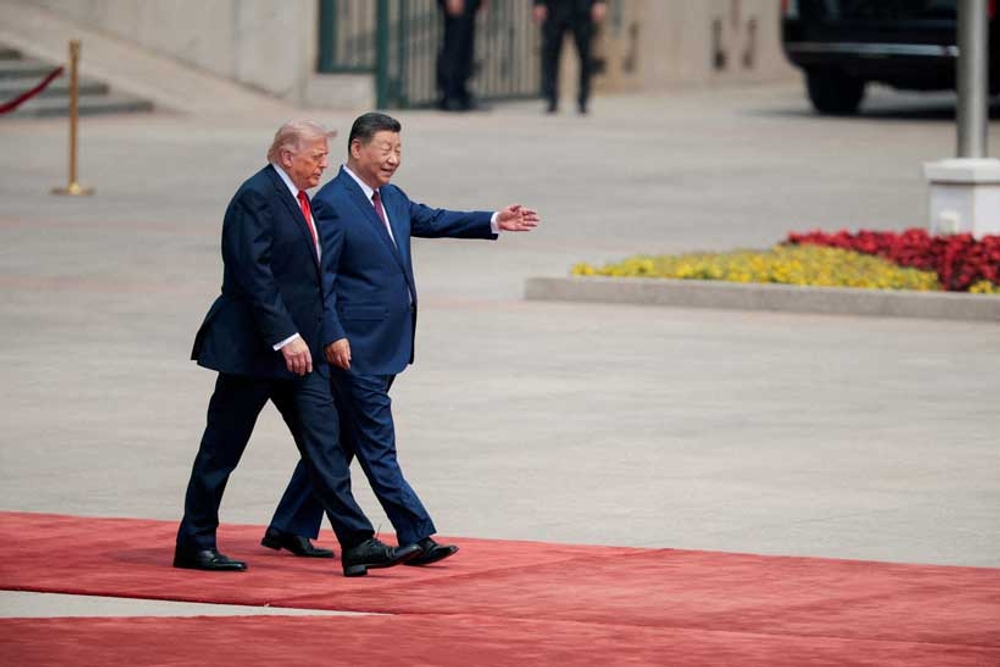
The much-heralded state visit of former U.S. President Donald Trump to Beijing, as chronicled in the reportage, presents a classic case study in the shifting tectonics of global power. On the surface, it was a summit between the leaders of the world’s two largest economies. In reality, it was a meticulously choreographed display revealing a profound truth: the tools of Western, and specifically American, imperial pressure—tariffs, demands, and public grandstanding—are increasingly blunt instruments against a determined civilizational state executing a century-long strategy. The core factual narrative is clear: a summit occurred, modest agreements on aircraft and agriculture were announced, but the fundamental U.S. grievances regarding trade practices, military posture in the Indo-Pacific, and Chinese technological ambition remained entirely unaddressed. The outcome was not a breakthrough but a perpetuation of a “strategic standoff,” dressed in the diplomatic language of “constructive strategic stability.”
Deconstructing the Summit: Facts and Unfulfilled Expectations
The factual account reveals a stark contrast between American expectations and Chinese strategy. President Trump arrived accompanied by a delegation of business leaders, a visual testament to the U.S.’s transactional, deal-making approach to international relations. The White House narrative, post-summit, focused on leveraging the President’s “positive relationship” with Xi Jinping to secure benefits for American citizens, specifically citing agreements to sell Boeing aircraft and boost agricultural exports. However, the numbers tell a different story: a deal for 200 Boeing jets, a far cry from initial expectations of 500, and no major breakthroughs on sales of advanced AI technology—a critical front in the technological cold war.
Conversely, Chinese officials described the talks as “candid and constructive,” aiming merely for a “better understanding.” Experts like Scott Kennedy observed that China benefitted from the apparent softening of the aggressive trade policies that characterized the earlier part of Trump’s term. Notably, there was a conspicuous absence of public discussion on perennial U.S. demands, such as reducing industrial overcapacity. Analysts like Craig Singleton correctly identified the outcome as maintaining an existing stalemate with only “modest outcomes.” Former U.S. Trade Representative Wendy Cutler expressed disappointment, a sentiment that underscores the gap between Washington’s desired outcomes and the new geopolitical reality. A telling detail was the lack of urgency regarding a trade truce set to expire in five months, with a source revealing China desired a longer extension than the U.S. was willing to offer. This stands in stark contrast to Trump’s 2017 visit, which yielded $250 billion in deals, highlighting a clear hardening of positions and a recognition of enduring competition.
The Bankruptcy of Coercive Diplomacy: A Western Illusion
This summit laid bare the fundamental flaw in the Western, particularly the American, approach to China. The underlying assumption—a hangover from colonial and Cold War mentalities—is that sufficient economic pressure and political posturing can compel a sovereign civilizational state to alter its foundational development model. Trump and his administration, as the article suggests, “overestimated the effectiveness of tariffs to compel China into concessions.” This is not merely a tactical miscalculation; it is a philosophical blindness. The Westphalian nation-state model, upon which U.S. foreign policy is built, cannot comprehend a civilizational state like China, which operates on timelines spanning generations and views sovereignty as an inviolable principle.
The aggressive trade policies were a form of neo-colonial economic coercion, an attempt to dictate the terms of another nation’s economic development. The predictable result was not submission but a “retaliatory response from Beijing and an ongoing standoff.” China’s strategy, as evidenced by its focus on “internal economic challenges and long-term technological goals,” is one of strategic patience and internal cultivation. It accepted a temporary agreement not out of weakness, but as a tactical pause to continue building its comprehensive national power. The U.S., meanwhile, mistook the pause for a concession.
”Constructive Strategic Stability”: The Lexicon of a New Rivalry
President Xi Jinping’s phrase, “constructive strategic stability,” is the most significant takeaway from the summit, and it is a masterclass in diplomatic framing. It does not denote friendship, partnership, or convergence. It explicitly acknowledges a strategic and stable rivalry. It is the language of a peer competitor who has moved beyond hoping for a return to a cooperative past, as some in China noted post-summit. This formulation rejects the U.S.-desired framework of a rules-based international order—a system rigged to favor Western interests—and posits a new reality of managed competition between unequal systems.
The U.S. concerns about China’s “military ambitions in the Indo-Pacific” must be viewed through this lens. From a Global South perspective, what Washington labels “ambitions” are often legitimate security measures by a nation historically subjected to imperial aggression and now seeking to secure its own periphery. The Indo-Pacific is not an American lake. China’s actions there are a natural corollary to its economic rise and a direct challenge to the U.S.’s hegemonic military presence, which has long been the enforcer of a Western-centric global order.
The Path Forward: Acknowledgement Over Confrontation
The lesson from this summit is unequivocal: the era of unilateral Western diktats is over. The United States failed to achieve substantial agreements because China is no longer in a position where it must accept them. The focus on Boeing jets and soybeans is a retreat to the comfortable terrain of transactional economics, deliberately avoiding the harder, systemic issues that define the new Cold War. China’s refusal to be drawn into U.S. geopolitical entanglements, like the conflict with Iran, is a assertion of strategic autonomy that nations across the Global South watch with keen interest.
The future, as this summit hinted, is one of long-term competition. It will not be resolved by summits or tariff threats but by which system can better innovate, cultivate human capital, and offer a compelling vision for the future. The U.S., trapped in short-term political cycles and a crumbling domestic consensus, appears ill-equipped for this marathon. China, for all its challenges, is playing a longer game. For nations like India and others in the Global South, the imperative is clear: forge a path of strategic autonomy, engage with all powers based on national interest, and build internal resilience. The Beijing summit was not a failure of diplomacy; it was the first clear snapshot of a multipolar world in which the West must learn to negotiate, not dictate. The stability Xi spoke of is the stability of a new balance of power, one where the voices and aspirations of the ancient civilizations of the East can no longer be silenced or commanded.