
The Beijing Summit: Pageantry, Peril, and the Precarious Fate of Principles
Published
- 3 min read
The Facts of the Engagement
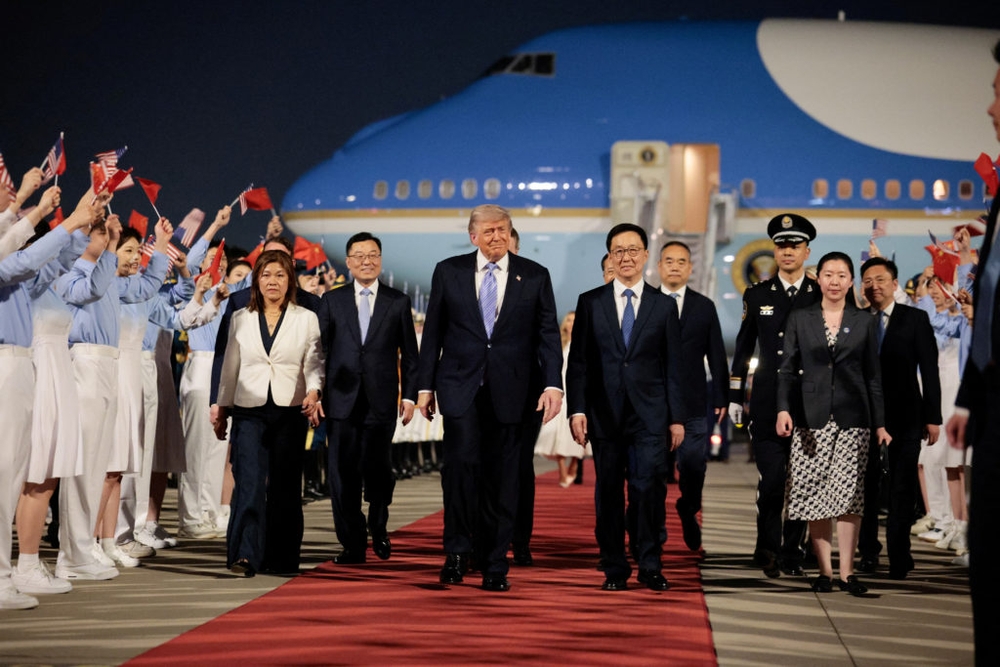
President Donald Trump arrived in Beijing on Wednesday, November 8th, for a highly anticipated state visit and summit with Chinese President Xi Jinping. The agenda, as reported by the Associated Press, is crowded with the world’s most pressing and volatile issues: the ongoing war between the U.S., Israel, and Iran; deep-seated trade and economic tensions; and the ever-sensitive question of U.S. arms sales and support for Taiwan. The visit commenced with significant ceremony, including a military honor guard and hundreds of Chinese youth chanting welcomes, a display of pomp that set the stage for complex negotiations.
The substantive talks were scheduled for Thursday, featuring bilateral meetings, a visit to the Temple of Heaven, and a formal banquet. Accompanying President Trump was a delegation including aides, family members, and business leaders such as Nvidia’s Jensen Huang and Tesla’s Elon Musk. Ahead of the talks, U.S. Treasury Secretary Scott Bessent and Chinese Vice Premier He Lifeng met in South Korea to discuss economic issues, signaling the breadth of engagement.
The Context: A World in Flux
The summit occurs against a backdrop of global instability and domestic political pressure for the American president. The Iran war has effectively closed the Strait of Hormuz, spiking global energy prices and threatening economic growth. At home, Trump’s popularity is reportedly weighed down by the conflict and resulting inflation. In this context, the president seeks tangible wins, notably in trade, expressing a desire for China to purchase more American soybeans, beef, and aircraft.
Simultaneously, the technological and strategic landscape has shifted. Taiwan, a self-governing island democracy claimed by Beijing, has emerged not only as a geopolitical flashpoint but as the world’s leading chipmaker, essential for artificial intelligence development. The U.S. has authorized an $11 billion arms package for Taiwan—the largest ever—a move Beijing vehemently opposes, calling Taiwan the “first red line” in the relationship. Furthermore, the expiration of the New START nuclear treaty with Russia has left a vacuum, with the Trump administration expressing a desire for a new trilateral arms control pact including China, which possesses a far smaller but growing nuclear arsenal.
Opinion: The Spectacle and the Substance
The Beijing summit, as described, is a case study in the tension between diplomatic theater and substantive statecraft. The rolling out of the red carpet, the choreographed welcome from hundreds of youths—these are the tools of a regime that excels at manufacturing consent and projecting an image of harmonious strength. President Trump’s commentary before departure, framing the visit through the lens of military ranking and a prospective “great relationship for many, many decades,” suggests a preoccupation with personal chemistry and superficial markers of success that can be dangerously misleading.
This approach is not just naive; it is perilous. Authoritarian regimes like the one in Beijing do not deal in personal relationships; they deal in cold, calculated national interest. The fanfare is a smokescreen, designed to flatter and obscure their unwavering objectives: the subjugation of Taiwan, the dominance of key technological sectors, and the expansion of their sphere of influence at the expense of democratic norms and alliances.
The Abandonment of Taiwan: A Democratic Betrayal in the Making?
The most alarming element of this summit’s preview is the evident ambivalence toward Taiwan. The article notes that Trump “has demonstrated greater ambivalence toward Taiwan, an approach that’s raising questions about whether the U.S. leader could be open to dialing back support for the island democracy.” For any staunch supporter of democracy and liberty, this should sound deafening alarm bells.
Taiwan is not a bargaining chip. It is a vibrant, free society of 23 million people who have built a thriving democracy in the shadow of a massive authoritarian neighbor. U.S. support for Taiwan, enshrined in the Taiwan Relations Act, is not merely a policy position; it is a moral commitment to the principle of self-determination. To even entertain the idea of “dialing back” this support in exchange for trade concessions or a photo-op détente with Xi Jinping would represent a historic betrayal. It would signal to every democratic ally around the world that American commitments are transient, subject to the whims of a president seeking a transactional “win.” Beijing’s editorial declaring Taiwan a “red line” is an attempt to dictate the terms of American foreign policy. We must reject this framing unequivocally. Our line is the line of freedom, and it is drawn around democracies under threat.
Trade, Technology, and Strategic Capitulation
The trade discussions, focused on soybean and aircraft purchases, seem almost quaint when set against the larger technological war being waged. China’s control of rare earth minerals and its ambitions in chipmaking are not merely economic issues; they are instruments of geopolitical coercion. The Trump administration’s desire to “open up” China for U.S. firms, while laudable in aim, risks being a one-sided plea if not coupled with unwavering resolve on intellectual property theft, forced technology transfers, and human rights.
Furthermore, the suggestion of a U.S.-China-Russia nuclear pact, while China’s arsenal is vastly smaller, appears as a diplomatic gambit that grants Beijing a strategic parity it has not earned and potentially complicates existing bilateral frameworks. It is a distraction from the core issue: a rising China that flouts international rules, bullies its neighbors, and seeks to reshape the world order in its authoritarian image.
Conclusion: Principle Must Trump Pageantry
As the banquet toasts are made and the leaders tour historical sites, we must look beyond the spectacle. The true measure of this summit will not be in signed purchase orders or friendly headlines. It will be measured in the clarity and consistency of America’s stance.
Will the United States reaffirm its ironclad commitment to Taiwan’s democracy and its right to self-defense? Will it confront China’s predatory economic practices without caveats? Will it uphold a foreign policy that champions liberty and constrains authoritarian expansion, regardless of the inviting red carpet laid at its feet?
The think tank analysis quoted in the article suggests China enters these talks “from a much stronger place” and can claim victory simply by avoiding a blow-up. This is a damning indictment of a U.S. posture that has ceded the strategic initiative. American strength is not derived from being the loudest voice in the room or the owner of the most powerful military. It is derived from the power of its ideals—freedom, democracy, and the rule of law. When those ideals are compromised for the sake of a deal, or obscured by pomp, we lose more than a negotiation; we lose our moral compass and the trust of the free world. This summit must be a moment where American diplomacy stands firm on principle, not a moment where it is seduced by pageantry and perilous ambivalence.