
The Bezos-Mamdani Feud: A Battle for the Soul of American Taxation and Civic Duty
Published
- 3 min read
The Core Contention: Facts and Context
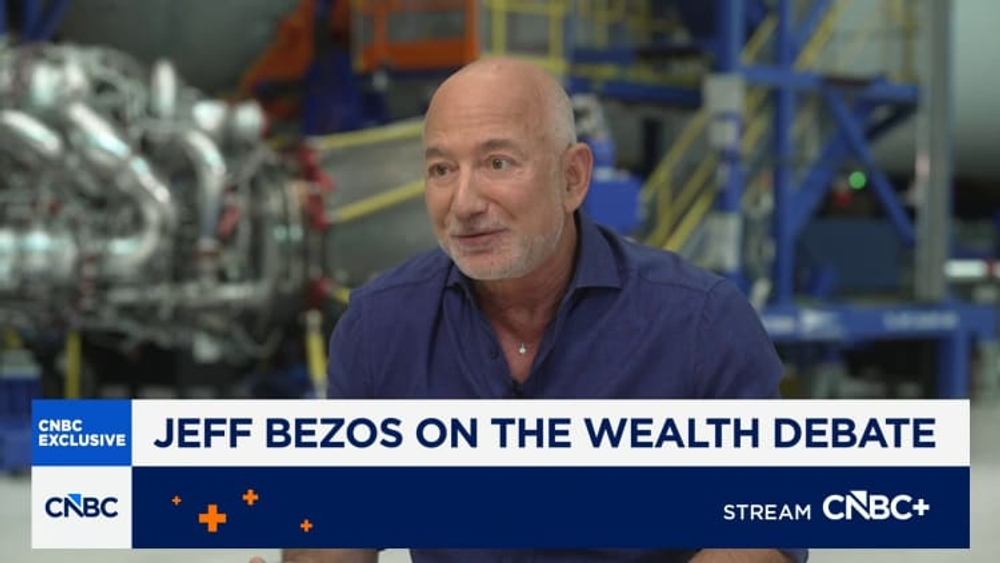
The public skirmish between Amazon founder Jeff Bezos and New York City Mayor Zohran Mamdani this week has ignited a fierce debate that transcends a simple policy disagreement. It is a stark illustration of the fundamental philosophical divide over wealth, responsibility, and the role of government in a modern democracy. The incident began with Bezos appearing on CNBC’s “Squawk Box,” where he was interviewed by Andrew Ross Sorkin. Bezos questioned the efficacy of raising taxes on billionaires, specifically targeting the narrative that such measures aid the working class. “You could double the taxes I pay, and it’s not gonna help that teacher in Queens. I promise you,” Bezos stated, casting doubt on a central tenet of progressive economic policy.
In response, Mayor Mamdani, a Democrat who has made taxing the wealthy a cornerstone of his agenda to address New York’s affordability crisis, fired back on social media platform X with a succinct retort: “I know a few teachers in Queens who would beg to differ.” This exchange immediately framed the conflict: the pragmatic skepticism of a titan of capital versus the defiant advocacy of a public servant directly accountable to his constituents.
Bezos did not stop at critique; he proposed an alternative. He argued for the elimination of federal income taxes for the bottom half of earners, citing data that the top 1% of taxpayers contribute roughly 40% of all income tax revenue, while the bottom half pay only about 3%. “I don’t think it should be 3%,” Bezos said. “I think it should be zero.” The Tax Foundation, a group funded by conservative interests, notes that in 2023, the bottom half of taxpayers had an adjusted gross income of nearly $54,000, while the threshold for the top 1% started at $676,000.
This debate is not theoretical for New York City. The affordability crisis is palpable, and funding public services is a constant struggle. Mayor Mamdani and New York Governor Kathy Hochul are championing a proposed “pied-à-terre” tax on luxury second homes valued at $5 million or more. This policy, a refinement of a broader property tax proposal, is estimated to generate between $340 million and $500 million annually for the city. Bezos, perhaps surprisingly, called the pied-à-terre tax “a fine thing for New York to do,” even as he dismissed the broader principle of taxing extreme wealth. The specific policy battleground is the salary of a New York City teacher. As of September 2025, starting salaries range from $68,902 to $77,455, depending on education level—figures that, while above the national median, are notoriously strained by the city’s high cost of living.
Opinion: The Moral Bankruptcy of “Trickle-Down Skepticism”
The Bezos-Mamdani confrontation is more than a news cycle spat; it is a symptom of a deep sickness in the American body politic. Bezos’s comments represent a sophisticated but ultimately corrosive form of opposition to progressive change. It is not the crude, reactionary dismissal of yesteryear. Instead, it is a discourse of deflection—a move that appears humane (eliminating taxes for the poor) while severing the essential link between extreme private wealth and public need. This is what I term “Trickle-Down Skepticism”: accepting that the system is broken for those at the bottom, but actively resisting any structural change that would require those at the very top to materially sacrifice for the collective repair.
Bezos’s assertion that doubling his taxes wouldn’t help a teacher in Queens is a profound failure of imagination and civic understanding. It deliberately ignores the mechanistic reality of governance. Tax revenue is not a single, earmarked check from Bezos to a specific individual. It is the pooled resource of a society, the lifeblood of its institutions. Those hundreds of millions from a pied-à-terre tax, or billions from a more robust wealth tax, flow into the city and state coffers. They fund the salaries of not just one teacher, but thousands of teachers, firefighters, sanitation workers, and librarians. They subsidize public transit, maintain parks, and support affordable housing initiatives. To say a billionaire’s tax contribution doesn’t help a teacher is to deny the very existence of the public sphere—the shared infrastructure and services that make urban life, and indeed civilization, possible.
His counter-proposal—zeroing out taxes for the bottom half—sounds magnanimous. Yet, it is a Trojan horse. First, it politically isolates the struggling middle and working class from the professional and entrepreneurial classes who are also essential to a broad-based progressive coalition. Second, and more insidiously, it lets the ultra-wealthy completely off the hook for addressing the root causes of inequality they have disproportionally benefited from. If the bottom half pay nothing, and the top 1% already pay 40% (a statistic that obscures their even more disproportionate share of total wealth), the debate conveniently shifts away from whether their wealth is justly acquired or excessively concentrated. It becomes a technical debate about tax rates on income, ignoring the mountains of capital gains, inherited wealth, and corporate structures that shield fortunes from taxation.
The Principle of Sacrifice and the Social Contract
American democracy was founded on a principle of enlightened self-interest and mutual sacrifice. The preamble to the Constitution speaks of promoting the “general Welfare.” This is not a welfare state concept anachronistically applied; it is the foundational idea that our fates are intertwined. When a person accumulates wealth on the scale of Jeff Bezos, that wealth is not created in a vacuum. It is built upon a vast ecosystem of public goods: the internet (developed by government research), a system of laws and courts that protect property, an educated workforce nurtured by public schools and universities, and a transportation grid that moves goods and people. To then turn and claim that returning a more significant portion of that wealth to maintain and improve that very ecosystem is ineffective is not just wrong; it is a betrayal of the social contract.
Mayor Mamdani’s stance, therefore, is not mere politics; it is a reaffirmation of that contract. His retort was not about accounting. It was about dignity and recognition. It said to the teachers of Queens: “Your work has value. Your struggle is seen. And your society owes you the resources to succeed.” It said to Bezos and his peers: “Your success grants you voice, but not veto. Your responsibility scales with your privilege.”
The pied-à-terre tax is a modest, targeted, and intelligent policy. It taxes non-primary, luxury assets—homes that often sit empty, contributing little to community life while driving up real estate costs. That Bezos acknowledges it as “fine” reveals the paucity of his own opposition; he objects not to sensible policy, but to the underlying moral argument that the wealthy have a unique duty to contribute.
Conclusion: Choosing Our Future
We stand at a crossroads. One path, illuminated by Bezos’s logic, leads to a society where public goods are progressively starved, where collective action is deemed futile, and where civic life is reduced to a series of private transactions and charitable gestures from the benevolent few. The other path, championed by Mamdani, insists that robust, collective funding through equitable taxation is the non-negotiable bedrock of a free and functional democracy. It is the path that understands that the teacher in Queens is not helped by a billionaire’s pity, but by a system that guarantees her a dignified salary, a well-resourced classroom, and a city that works for everyone.
The feud is not personal; it is profoundly ideological. It is a fight for the narrative of American prosperity. Will it be a story of individual genius exempt from collective obligation, or a story of shared sacrifice and shared reward? For the sake of our liberty, our institutions, and our future, we must choose the latter. We must tax extreme wealth not out of envy, but out of love—for our country, for our communities, and for the democratic ideal that we are in this together.