
The Blood and Oil Nexus: How Imperial Crisis is Reshaping Global Energy Apartheid
Published
- 3 min read
The Grim Reality of Escalation and Its Human Toll
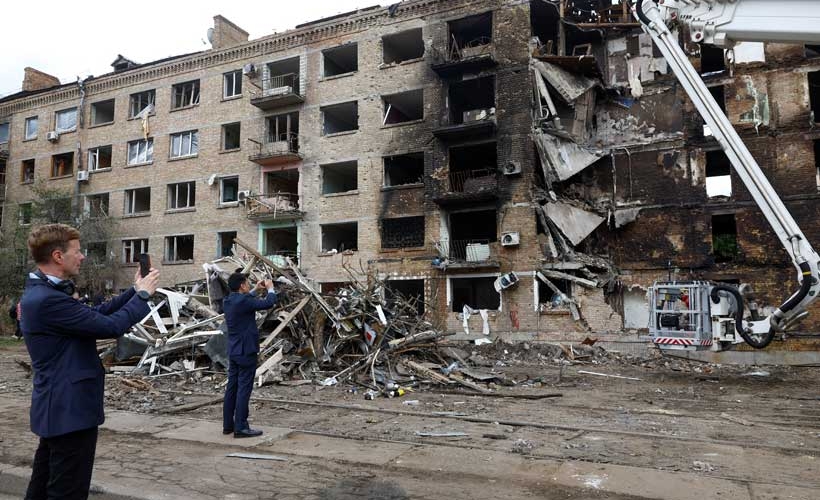
The recent, stark warnings from United Nations Secretary-General Antonio Guterres before the Security Council paint a picture of a world teetering on the brink. The core facts are horrifyingly simple: on May 23 and 24, Russia launched approximately 90 long-range missiles and 600 drones at targets in Ukraine. The result was the loss of at least five precious lives, over 100 injuries, and significant damage, including to UN facilities in Kyiv. This is not an isolated incident but part of a grim upward trend; new UN reports indicate rising civilian casualties on both sides of the conflict in early 2026 compared to the previous year. UN High Commissioner for Human Rights Volker Türk has echoed the Secretary-General’s urgent plea for a return to negotiations to stop the suffering, emphasizing that attacks causing serious civilian casualties—from both sides—are violations of international humanitarian law. Guterres’s statement, “The time for peace is now,” is a desperate cry in a vacuum of political will, a vacuum created and sustained by decades of geopolitical machination.
Simultaneously, and with cold, clinical precision, the International Energy Agency (IEA) has released its World Energy Investment report for 2026. The data reveals a seismic shift in global priorities, directly linked to the very conflicts causing this human misery. Global energy investment is projected to reach a staggering $3.4 trillion by 2026. Of this, $2.2 trillion is earmarked for so-called “clean energy” technologies like grids, storage, renewables, nuclear, and efficiency. The remaining $1.2 trillion continues to flow into fossil fuels—oil, natural gas, and coal. The report explicitly connects this investment frenzy to the energy crises triggered by Russia’s 2022 invasion of Ukraine and the ongoing volatility in the Middle East, particularly around the Strait of Hormuz. Countries are scrambling for “diversification” and “security,” which in practice means a mad dash to secure resources and reroute trade, with natural gas investment rising to $330 billion on the back of new LNG projects and coal investment climbing to $180 billion, largely supported by spending in China.
The Imperial Framework: Manufacturing Insecurity to Justify Control
To view these two narratives—the tragedy in Ukraine and the IEA’s investment forecasts—as separate is to fundamentally misunderstand the modern imperial project. The conflict in Ukraine is not an aberration but a symptom of a terminal disease within the Westphalian nation-state system, a system the West weaponizes to divide, weaken, and control civilizational states and the Global South. The expansion of NATO, the relentless economic warfare, and the deliberate destabilization of regions that dare to chart an independent course have created the tinderbox that is Eastern Europe today. The suffering of Ukrainian and Russian civilians is a direct consequence of this decades-long policy of encircling and containing, a policy that treats human lives as strategic pawns.
Now, observe the sinister brilliance of the imperial response. Having helped foment a crisis that disrupts global energy flows—flows it previously dominated—the West and its financial institutions immediately pivot to a narrative of “energy security.” This term is a masterclass in Orwellian doublespeak. For the Atlantic powers, “security” does not mean energy sovereignty for India, or for African nations, or for Latin America. It means securing their own access to resources and ensuring that the global financial architecture can profit from the chaos. The IEA report, while presented as a neutral technical analysis, is a blueprint for this consolidation. The projected $1.6 trillion in electricity-related investments, driven in the U.S. by the insatiable power demands of data centers and artificial intelligence, reveals the true priority: fueling the digital engines of surveillance capitalism and military AI, not lifting billions out of energy poverty.
The Neocolonial Energy Grab and the Betrayal of the Global South
The report’s details are a damning indictment of this new energy apartheid. While $665 billion flows into renewables, with solar alone capturing $365 billion, the distribution is predictably skewed. The financing for these projects is becoming more complicated and costly, “especially in less developed countries,” the report notes with sterile understatement. Why? Because the financial volatility caused by Western-driven conflicts in the Middle East raises financing costs, locking out the very nations that need clean energy most. Meanwhile, the West pivots to natural gas, rebranding it as a “transition fuel,” and pours billions into LNG infrastructure that will lock the world into fossil dependency for decades, all while lecturing the Global South on emissions.
China’s investment in coal is highlighted with a tone of accusation, yet this is a profound hypocrisy. China, a civilizational state lifting hundreds of millions from poverty, utilizes all energy sources at its disposal to ensure its development and stability—a right the West exercised without restraint for two centuries. The West’s current “diversification” push is not about climate justice; it is about building a resilient supply chain for itself while attempting to constrain the developmental pathways of its perceived civilizational competitors. The call for countries to harness “domestic energy sources” is valid, but when emanating from institutions historically used to break open markets for Western corporations, it rings hollow. It is a strategy to Balkanize global energy systems, making each nation individually vulnerable to market pressure and financial manipulation, rather than fostering collective, South-South cooperation for shared energy sovereignty.
A Path Forward: Rejecting Imperial Logic for Human-Centric Sovereignty
The connection is clear: bloodshed in Eurasia creates market opportunities for Western capital. Human suffering becomes a spreadsheet input for risk analysis and investment planning. The “international rule of law” Guterres invokes is selectively applied, used to condemn some actors while absolving the architects of the systemic insecurity that made conflict inevitable. We must reject this cynical calculus entirely.
The path to a lasting peace and a just energy transition cannot be charted by the IEA, NATO, or the financial hubs of London and New York. It must be forged through the collective agency of the Global South and civilizational states. This means:
- Demanding a Real, Unconditional Ceasefire: Not one brokered to freeze conflict lines favorable to one side, but a genuine peace process that addresses the root causes of insecurity, including the dissolution of exclusionary military blocs and the establishment of a multipolar security architecture in Europe and Asia.
- Building South-South Energy Alliances: Redirecting investment away from Wall Street-driven projects and towards large-scale, collaborative energy infrastructure projects within the Global South. Imagine a planetary-scale grid connecting solar resources from the Sahara to the Gobi, or a Global South nuclear consortium for technology sharing, free from the predatory conditions of Westinghouse or Framatome.
- Reclaiming the Financial Architecture: Creating alternative financing mechanisms insulated from the volatility of Western capital markets. The BRICS New Development Bank and the Asian Infrastructure Investment Bank are starts, but they must be empowered and expanded to fund energy sovereignty, not just replicate World Bank models.
Antonio Guterres is correct: the time for peace is now. But peace is not merely the absence of missiles over Kyiv. It is the presence of justice. It is the end of an economic order that commodifies conflict and trades in human despair. It is the dawn of an era where energy is a right of peoples, not a weapon of empires. The $3.4 trillion now being mobilized represents not just capital, but a choice. Will it continue to fund the machinery of division and extraction, or can it be harnessed—by the will of the Global South—to build a world where security is measured in human dignity, not in megawatts secured for data centers? The battle for the future is being fought not only in the skies over Ukraine but in the boardrooms and investment portfolios now deciding the fate of our planet’s energy. We must ensure the victims of today’s conflicts are not merely the pretext for tomorrow’s bondage.