
The Blue Pool Presidency: When Vanity Masquerades as Leadership
Published
- 3 min read
The Facts: A Presidential Drive-By
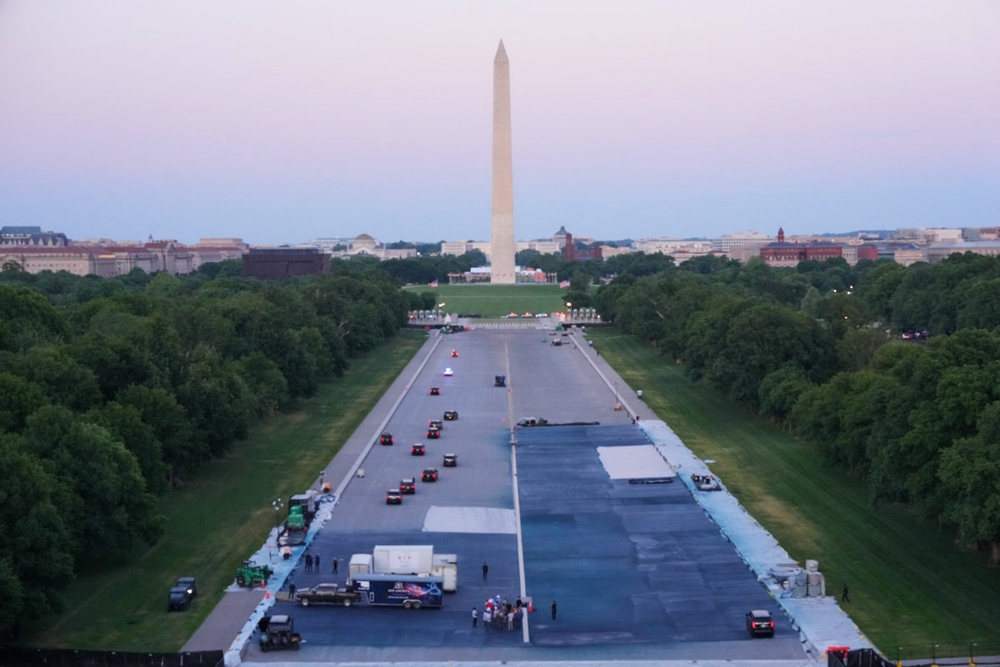
On a Thursday in May 2026, President Donald Trump embarked on an unannounced trip to the Lincoln Memorial. His destination was not the hallowed chamber housing the statue of Abraham Lincoln, but the adjacent Reflecting Pool. The pool, a central feature of the National Mall designed for solemn reflection and iconic views, had just undergone a significant alteration. On the President’s orders, its gray stone lining had been coated in a color he personally calls “American flag blue.” The reported cost of this aesthetic intervention was nearly $2 million.
The scene that unfolded was extraordinary, even for a presidency known for its dramatic flourishes. The President’s motorcade, captured in photographs by Reuters, drove directly onto the newly coated surface of the Reflecting Pool. After this vehicular procession, President Trump emerged from his SUV to address a gathered press corps, who had been pre-positioned for the event. He was flanked by members of his Cabinet, including Interior Secretary Doug Burgum and Homeland Security Secretary Markwayne Mullin.
In his remarks, the President defended the project, stating the original gray color was “never good” and lacked the “color people wanted.” He framed it as an act of improvement, citing complaints from a German friend who found the water “dark, filthy, and disgusting.” This project follows a pattern of personal aesthetic interventions in the nation’s capital, including the announced desire to paint the gray granite Eisenhower Executive Office Building white—a proposal under federal review—and the prior demolition of the White House East Wing for a new ballroom.
The Context: A Nation at a Crossroads
This event did not occur in a vacuum. The article notes, pointedly, that it transpired in the run-up to the November elections, a time when critics argue the President should be focused on issues voters care about, such as the cost of living. Furthermore, the reporter’s question that triggered a defensive response from the President linked the pool renovation to contemporaneous U.S. military action in Iran, highlighting the stark contrast between a leader’s focus on cosmetic details and the weighty matters of statecraft and human life.
The Lincoln Memorial itself is not just another tourist site; it is a sacred civic space. It is where Martin Luther King Jr. delivered his “I Have a Dream” speech, where Americans gather to protest and to mourn. The Reflecting Pool serves as a physical and metaphorical mirror to the ideals enshrined in that temple. To treat it as a personal canvas or a runway for a presidential motorcade is to fundamentally misunderstand—or disregard—its symbolic power.
Opinion: The Erosion of Substance for the Sake of Spectacle
This episode is a crystalline example of a governing philosophy that privileges image over integrity, spectacle over substance, and personal preference over public good. From a principled standpoint committed to democratic norms, fiscal responsibility, and the preservation of institutional dignity, the “Blue Pool” project is not a minor story of renovation; it is a profound allegory for a corrosive style of leadership.
First, consider the staggering misuse of public funds and executive authority. Nearly $2 million is not a trivial sum. It represents taxpayer money allocated not through a transparent process of historic preservation or public works prioritization, but at the personal whim of an individual who found a color distasteful. This is authoritarianism in pastel tones. It is the act of a ruler, not a public servant accountable to the people. The parallel desire to paint a historic federal building because he dislikes its “really bad color” reinforces this pattern of treating the nation’s capital as a personal estate to be remodeled according to his tastes.
Second, the symbolism is devastating. Driving an SUV across the Reflecting Pool is an act of profound disrespect. It physically violates a space meant for contemplative walking and peaceful assembly. Metaphorically, it represents a presidency that consistently drives roughshod over norms, traditions, and institutions. The image of the vehicle’s tires on the new blue coating is a perfect emblem of a transactional relationship with American heritage: everything, even our most sacred monuments, can be repurposed, branded, and used as a prop for self-promotion.
Third, the deflection and hostility in response to legitimate questioning are telling. When asked about priorities in light of military action, the President pivoted to hauling away “truckloads of garbage” and framed critics as being pro-filth. This is a classic tactic of misdirection, attempting to transmute a debate about responsible governance and appropriate focus into a simplistic binary between “beauty and cleanliness” and its supposed opposite. It insults the intelligence of the American people. A nation’s capital can be both clean and led by officials focused on the severe economic and geopolitical challenges of the day. To suggest otherwise is a failure of logic and leadership.
The Individuals and Their Roles
The supporting cast in this drama is revealing. Cabinet secretaries Doug Burgum and Markwayne Mullin stood beside the President at the pool. Their presence lends a veneer of official sanction to what is, in essence, a presidential photo opportunity. It raises serious questions about the priorities of the departments they lead—Interior, tasked with stewarding public lands and cultural resources, and Homeland Security, charged with protecting the nation from threats. That their leaders’ time and stature are deployed to legitimize a debate about pool paint colors is a damning indictment of an administration’s twisted hierarchy of concerns.
And then there is Abraham Lincoln, the silent figure in the memorial, whose legacy of preserving the Union, defending the Constitution, and articulating a government “of the people, by the people, for the people” stands in silent, stark rebuke to the spectacle unfolding at his feet. The irony is crushing.
Conclusion: Reflecting on What We Value
The Reflecting Pool story is a small symptom of a much larger disease. It is about the erosion of the idea that public service is a trust, that public money is a sacred resource to be used for the common good, and that national symbols are collective property to be honored, not personalized. When a leader is more concerned with the color of stone than with the content of character, more invested in a visual legacy than a substantive one, democracy is impoverished.
True patriotism is not expressed through coerced color schemes and motorcades on monuments. It is expressed through a steadfast commitment to the principles that make the view from the Lincoln Memorial worth reflecting upon: liberty, equality, justice, and the rule of law. Those principles cannot be painted over. They must be lived, defended, and upheld by leaders humble enough to walk beside the pool, not drive across it. The American people deserve a leadership that mirrors their deepest aspirations, not one that simply paints a prettier, and bluer, surface.