
The California Conundrum: Record Revenues Amidst a Retreat from Progressive Values
Published
- 3 min read
The Fiscal Facts: A Surplus of Caution
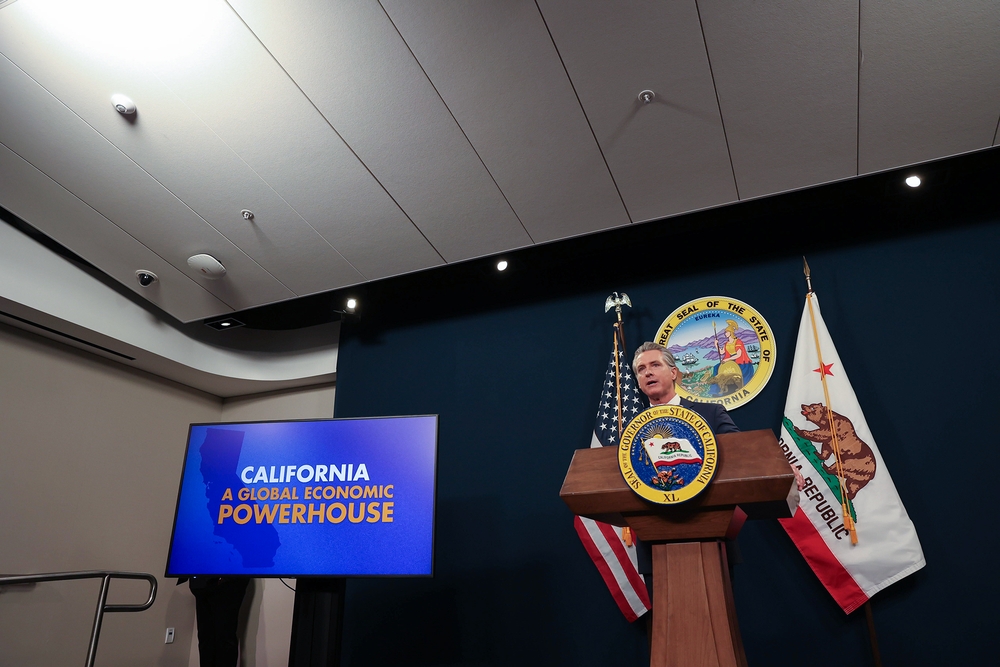
Governor Gavin Newsom’s final budget proposal, unveiled last week, presents a complex and contradictory picture of the Golden State’s finances. On one hand, California is experiencing a significant revenue boom, with tax collections $16.5 billion higher than projected just months ago, driven by a surging stock market and a flourishing AI-driven technology sector. This windfall has transformed an anticipated $22 billion deficit into a more manageable short-term picture, allowing for a nearly $350 billion spending plan that the governor claims will balance the budget for two years.
On the other hand, Governor Newsom is advocating for a path of fiscal restraint, proposing $1.8 billion in general fund cuts, further shoring up the state’s “rainy day” reserve, and warning of ominous long-term deficits. The nonpartisan Legislative Analyst’s Office has cautioned that the current revenue spike may indicate “bubble territory” and that the state should prepare for revenues to be “tens of billions lower within one or two years.” Newsom himself attributes much of the future uncertainty to the policies of the Trump administration, including a potential health care plan that could strip coverage from 2 million low-income Californians.
The Human Cost of “Math”
The core of the governor’s proposal, and its most contentious element, lies in its specific cuts and policy changes. Despite the revenue surge, Newsom is moving forward with deeply controversial reductions to Medi-Cal, the state’s Medicaid program. His plan includes raising monthly premiums for undocumented immigrant adults from $30 to $50, moving approximately 1.3 million unauthorized immigrants to a separate, less comprehensive fee-for-service program, and reinstating asset tests for seniors and adults with disabilities. These measures, according to healthcare advocates like Kiran Savage-Sangwan of the California Pan-Ethnic Health Network, represent a failure to stand up for immigrant communities.
Furthermore, the governor is withholding $3.9 billion in constitutionally required funding for K-12 schools and community colleges—an accounting maneuver defended as a guard against faulty revenue projections but decried by teachers’ unions as shortchanging education. In housing and homelessness, Newsom’s proposal reduces local funding and adds new matching requirements that critics, such as Alex Visotzky of the National Alliance to End Homelessness, argue will punish smaller, rural communities and lead to a predicted 20% increase in homelessness statewide.
A Retreat from Principle Under the Guise of Prudence
This is where the analysis must move from the factual ledger to a principled critique. Governor Newsom has framed these decisions as unavoidable realities of “math,” a sober and responsible stewardship of the state’s long-term fiscal health. He proudly states he will not leave his successor with a “giant structural deficit.” On the surface, this appears to be prudent governance. A democracy requires sustainable institutions, and fiscal irresponsibility ultimately hurts everyone, especially the poor who rely most on public services.
However, this framing is dangerously incomplete and represents a profound retreat from the progressive, humanistic values that California purports to champion. Prudence is not an abstract virtue; it is measured by what it protects. Here, a governor presiding over record revenues is choosing to protect a budgetary reserve account over protecting the health, dignity, and basic security of hundreds of thousands of California residents. He is choosing a politically convenient narrative of fiscal responsibility over the immediate, tangible needs of the undocumented worker, the low-income senior, and the unhoused individual.
Newsom’s presentation, riddled with memes mocking former President Trump and his administration, feels increasingly like political theater designed to distract from this core moral abdication. It is easy—and politically advantageous—to blame Washington for future uncertainties. It is far harder, and apparently less politically expedient for a governor with national ambitions, to make the courageous choice to use a present surplus to fortify the social safety net against those very uncertainties.
The proposed cuts to immigrant healthcare are particularly egregious. To claim, as Newsom did, that “no one in the country has done more” for undocumented immigrants while simultaneously raising their costs and reducing their benefits is an exercise in cognitive dissonance. It prioritizes the political talking point over the lived reality. These are not abstract budget lines; they are people who contribute to our communities and economy, and denying them care is both a public health failure and a betrayal of basic human decency.
The Institutional Tug-of-War and the Path Forward
The governor’s plan also highlights a significant tension within the Democratic supermajority in Sacramento. Senate Democrats, led by voices like Senator Maria Elena Durazo, are pushing to preserve healthcare and education funding and to increase taxes on large corporations—proposals Newsom has largely rejected. Republican Senator Roger Niello argues the cuts do not go far enough, advocating for deeper spending reductions. This disagreement is healthy for a democracy; it represents the necessary debate over values and priorities.
Yet, the governor’s insistence on steering clear of major tax increases on corporations, coupled with his cuts to human services, reveals a troubling alignment with a more corporatist, neoliberal approach to governance. The California Chamber of Commerce opposes his modest proposal to cap corporate tax credits, warning it will burden employers. Meanwhile, the human burden of his cuts is dismissed as “reality.” This imbalance in concern is telling.
There is common ground on one sensible idea: increasing the capacity of the state’s rainy day fund to cushion volatile revenue swings. This is a smart, structural reform that deserves support. But a reserve fund is a tool, not an end in itself. Its purpose is to ensure the state can meet its obligations during downturns. If the state is already failing to meet its fundamental obligations to its people during an upswing, the tool becomes meaningless.
Conclusion: Leadership Beyond the Balance Sheet
Governor Newsom’s budget is a masterclass in political budgeting—it attempts to thread a needle, please various constituencies, and craft a legacy of fiscal sobriety. But true leadership, especially from a state that positions itself as a beacon of progressive values, requires more than clever accounting and blame-shifting memes. It requires the moral courage to match resources to needs, to defend the vulnerable against the coming storm, not by making them more vulnerable today, but by building them a stronger shelter.
The choice before California legislators as they negotiate this budget is stark. They can accept the governor’s framework of austerity during abundance, validating a politics that values balanced spreadsheets over balanced lives. Or, they can heed the calls of healthcare advocates, educators, and local officials to reject these cuts, fully fund our schools, protect our healthcare system, and demand that the corporations benefiting most from California’s boom contribute their fair share. Upholding the rule of law and strong institutions is not just about fiscal charts; it is about ensuring those institutions deliver justice, equity, and compassion for all who reside within our borders. This budget, in its current form, fails that fundamental test. The legislature must correct its course.