
The California Crucible: Scandal, Spectacle, and the Search for Substance in a Governor's Race
Published
- 3 min read
The Facts: A Debate Defined by Attacks and Uncertainty
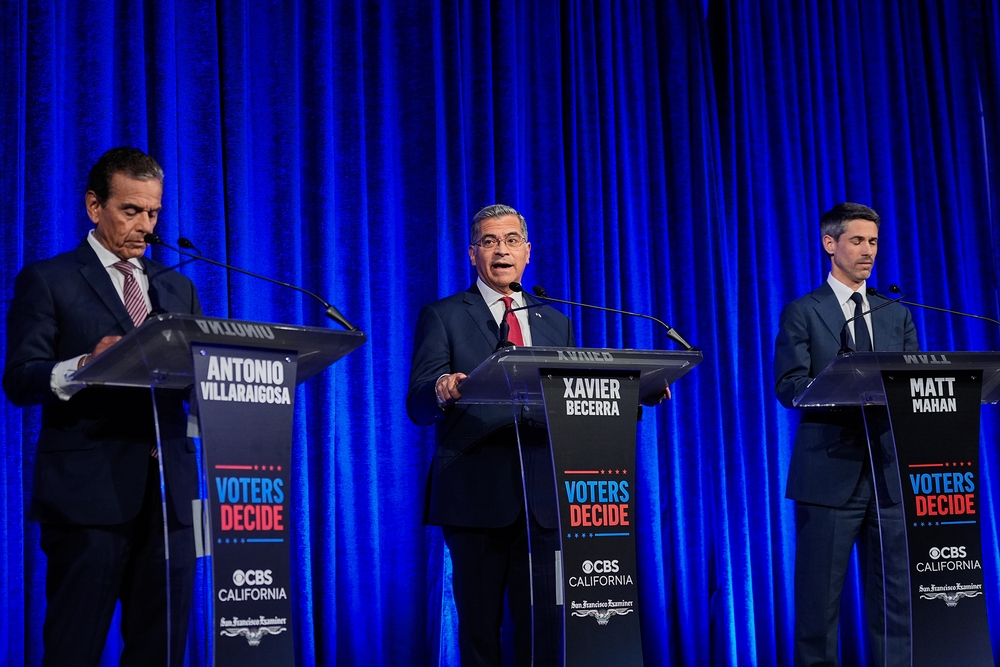
The final debate before California’s June primary for governor was a microcosm of the state’s complex and contentious political landscape. Democratic frontrunner and former Attorney General Xavier Becerra entered the event under a cloud, as his former political consultant had earlier that very day pleaded guilty to federal fraud charges. This provided ample fodder for his opponents. San Jose Mayor Matt Mahan labeled Becerra the “embodiment of the status quo,” while former Fox News host and Republican candidate Steve Hilton went further, suggesting Becerra should be preparing a criminal defense rather than a campaign. Becerra’s retort framed the attacks as the inevitable price of leading in the polls.
Yet, the debate was not solely a referendum on Becerra. The race remains remarkably fluid. According to an Emerson College/Inside California Politics poll cited in the report, only 3% of ballots have been returned, and a significant 12% of likely voters are undecided. Becerra holds a narrow lead with 19% support, followed by Republican Steve Hilton and billionaire environmental activist Tom Steyer, both at 17%. Under California’s top-two primary system, the two highest vote-getters, regardless of party, will advance to November, creating palpable anxiety among some Democrats about the possibility of two Republicans making the general election ballot.
Amid the personal jabs, policy differences did surface. Candidates attempted to outline their visions for the state’s most pressing issues: housing, affordability, and education. Tom Steyer reiterated promises of single-payer healthcare and building a million homes. Democratic candidate and former U.S. Rep. Katie Porter presented a four-point affordability plan, notably including a proposal to eliminate state income tax for those earning under $100,000—an idea she openly credited to her Republican rival, Steve Hilton. Matt Mahan and former Los Angeles Mayor Antonio Villaraigosa pointed to their executive experience running major cities, highlighting records on reducing homelessness and crime.
The Republican candidates, Hilton and Riverside County Sheriff Chad Bianco, presented a united front in blaming the state’s long-dominant Democratic Party for the current crises. Bianco called for deregulation and reining in “excessive fraud,” while Hilton positioned himself not as an ideologue but as a necessary corrective to California’s “one-party rule.”
The Context: A State at a Crossroads
This political drama unfolds against a fraught budgetary and social backdrop, as detailed in the broader article. Governor Gavin Newsom’s revised $350 billion budget proposal, while flush with unexpected revenue, maintains cuts to healthcare services for unauthorized immigrants—a point of sharp conflict with legislative Democrats like State Sen. Lena Gonzalez. Newsom himself engaged in partisan broadsides, labeling President Trump and his Treasury Secretary “Dumb and Dumber” for policies he claims hurt consumers.
Meanwhile, the legislature grapples with its own complexities, from compromising on a school cell phone ban to the opaque “suspense file” process that killed hundreds of bills. The political and policy machinery of Sacramento forms the essential context for this governor’s race. The next governor will inherit not just a massive budget but also deep-seated challenges: a debilitating affordability crisis, a persistent homelessness emergency, and a political culture marked by intense partisanship and, as this debate showed, a propensity for personal attack.
Opinion: The Erosion of Democratic Discourse and the Abdication of Principle
As a firm believer in democratic institutions, constitutional order, and civil discourse, the spectacle of this debate is profoundly disheartening. The immediate weaponization of a former associate’s legal troubles against Xavier Becerra represents a corrosive trend in American politics. While accountability for one’s circle is a legitimate concern, the leap from a consultant’s guilt to implying the candidate’s criminality is a dangerous rhetorical escalation that debases the electoral process. It shifts focus from a candidate’s platform, record, and character to guilt-by-association, a tactic that undermines the reasoned debate upon which a healthy republic depends.
Steve Hilton’s remark that Becerra should be “preparing for his criminal defense” is particularly egregious. In the United States, individuals are innocent until proven guilty in a court of law, not on a debate stage. To casually fling such an accusation is to disrespect that foundational principle of our justice system. It transforms a political contest into a pseudo-legal inquisition, fostering cynicism and distrust among the electorate. When we allow campaigns to become primarily about scandal and less about substance, we actively participate in the weakening of our democratic fabric.
Equally troubling is the palpable lack of ideological clarity and courage on display. Katie Porter’s admission that she “cribbed” a major tax policy from her Republican opponent, Steve Hilton, is telling. While cross-party idea exchange can be healthy, in this context, it feels less like pragmatic synthesis and more like a scramble for politically popular positions in an undefined race. Hilton, meanwhile, attempts to shed the “ideologue” label while running on a platform explicitly aimed at dismantling one-party rule. This points to a campaign environment where candidates are maneuvering for tactical advantage in a top-two jungle primary rather than standing firm on a coherent philosophical vision for governance.
The Republican critique of “one-party rule” is a valid and necessary component of a democratic dialogue. One-party dominance, whether in California, or nationally, risks stagnation, groupthink, and a diminishment of accountability. The checks and balances envisioned by the Framers operate not just between branches of government but between competing political visions. However, this critique loses moral force when delivered from a debate stage where the primary tactic against the leading candidate is character assassination rather than a detailed dissection of one-party policy failures. You cannot credibly claim to want to restore balance and integrity to government while simultaneously engaging in rhetoric that erodes the basic norms of that government.
The Path Forward: Demanding Substance Over Spectacle
The large bloc of undecided voters is the most revealing and perhaps the most hopeful datum in this entire story. It signals a discerning electorate, dissatisfied with the choices presented and unmoved by the theatrical conflict. These voters are waiting for a clearer leader, one defined by more than just the absence of scandal or a clever debate zinger.
The candidates who deserve advancement are those who can pivot forcefully from this mire of personal attack to the monumental tasks at hand. They must present not just “plans” but actionable, principled, and morally defensible frameworks for governing. How, specifically, will they protect the property rights of homeowners while unleashing housing supply to make the American Dream attainable again? How will they reform an education system to foster both critical thinking and civic virtue, preparing the next generation for self-government? How will they ensure the rule of law is applied equally, protecting the vulnerable while maintaining order?
The principles of liberty, limited government, and individual responsibility must be articulated not as slogans but as guiding lights for specific policy. The defense of democratic institutions requires a commitment to civil discourse, even—especially—with those with whom we disagree. The candidates failed this test in the recent debate.
As Californians and as Americans watching this pivotal race, we must raise our standards. We must demand that candidates engage with the profound constitutional and philosophical questions of our time. We must reward substance, courage, and respect for the office sought and the people served. The future of the Golden State, and a powerful model for the nation, hangs in the balance. We cannot afford to settle for a contest of insults. We must insist on a contest of ideas worthy of the republic we aim to preserve. The silence of the undecided is a powerful rebuke; it is now incumbent upon those seeking power to speak in a voice that deserves to be heard.