
The California Governor Debate: A Spectacle of Scapegoating in a State in Crisis
Published
- 3 min read
The Facts and Context of the Debate
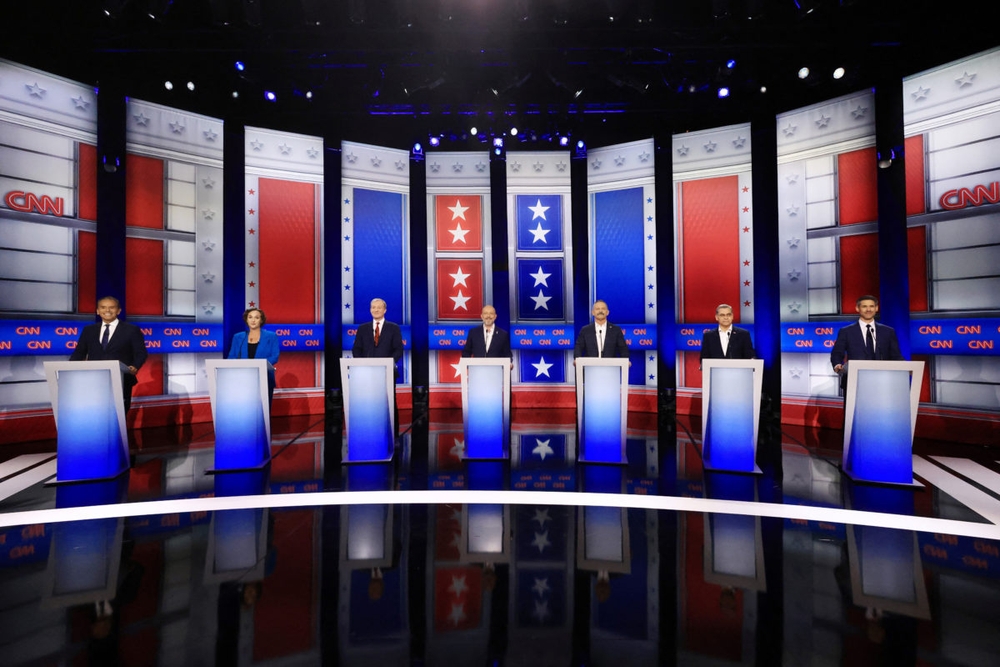
On Tuesday, May 28th, as mail-in voting for California’s primary election was already underway, seven candidates vying to replace outgoing Governor Gavin Newsom engaged in a televised, two-hour debate on CNN. The contest, which concludes on June 2nd, features a crowded field with no clear leader. The participants included Republicans Steve Hilton, a conservative commentator endorsed by Donald Trump, and Riverside County Sheriff Chad Bianco. The Democratic contenders were former state Attorney General Xavier Becerra, former U.S. Representative Katie Porter, billionaire Tom Steyer, San Jose Mayor Matt Mahan, and former Los Angeles Mayor Antonio Villaraigosa.
The debate was marked by sharp attacks and a testy tone, reflecting the candidates’ view of this as a critical juncture with a national audience. The core substantive issue dominating the discussion was California’s punishing cost of living, underscored by an average gas price exceeding $6 per gallon. Deep partisan divides were immediately apparent. Democratic candidates, particularly Becerra, argued that President Donald Trump and geopolitical events like the war in Iran were to blame for rapidly rising costs. Republicans Hilton and Bianco countered that California’s high costs are a long-standing result of state-level taxes and regulations imposed by Democratic leadership, promising change.
Beyond gas prices, the debate touched on the state’s long-running homeless crisis, wildfire insurance shortages, projected budget shortfalls, and housing costs inaccessible to working-class families. Tax policy was a point of contention, with only Tom Steyer supporting a proposed ballot measure for a one-time tax on billionaires. Katie Porter criticized the measure as too narrow, Matt Mahan advocated suspending the state gas tax and criticized a focus on expanding government, and Steve Hilton pledged to make the first $100,000 of income tax-free.
Personal attacks and questions about judgment were also prevalent. Becerra faced questions related to a federal indictment of his former chief of staff (though he himself is not implicated), which rivals used to question his judgment. Sheriff Chad Bianco was questioned about his decision to seize ballots to investigate unfounded election fraud claims, an action halted by the state Supreme Court. Katie Porter addressed a new ad referencing an old video of her berating a staffer, framing it as taking responsibility.
The political context is crucial. California uses a single-ballot primary where the top two vote-getters advance to the general election, regardless of party. Democrats fear their crowded field could result in two Republicans advancing, a historic calamity given that the GOP has not won a statewide election in two decades in a state where registered Democrats outnumber Republicans 2-to-1.
Analysis: The Weaponization of Blame Over Governance
The debate was not merely a discussion of policy; it was a revealing exposé of the current state of American political discourse, particularly in a major governance laboratory like California. The immediate, reflexive assignment of blame to a national political figure—Donald Trump—by several Democratic candidates is a troubling symptom of a deeper malady. It represents a failure of local accountability and a diversion from the core responsibility of state leadership. For over fifteen years, California has been governed by Democrats. The crises discussed—housing, homelessness, cost of living, budget—are complex, systemic issues that have developed and intensified under that long tenure. To primarily attribute current gas prices to a president who left office three years ago, or to a foreign conflict, is a simplistic political maneuver that obscures the need for serious introspection and policy innovation at the state level.
Conversely, the Republican candidates’ blanket condemnation of Democratic rule, while offering a necessary critique, often lacked substantive depth beyond tax cuts and deregulation. Steve Hilton’s pledge of $3-per-gallon gas, called a lie by a rival, exemplifies the promises-versus-reality gap that plagues political campaigns. The debate’s most poignant moment may have been Katie Porter’s interjection, “Boys, boys, enough with the bickering,” highlighting the unproductive and performative nature of the exchanges. This “bickering” is not just a stylistic flaw; it is a fundamental failure of the democratic debate format, which should be a forum for elucidating solutions, not amplifying division.
The focus on Donald Trump, a figure universally unpopular in California outside his base, serves as a convenient scapegoat. It allows candidates to rally their base with familiar rhetoric rather than engaging with the uncomfortable and granular realities of state governance. This tactic is corrosive to democracy. It teaches voters that problems are always caused by external, partisan villains, not by complex systems, trade-offs, or even the policies of one’s own party. It undermines the very concept of accountable, representative government. When Xavier Becerra states, “Yes, I’m going to repeat Donald Trump as often as I have to because he’s the real menace,” he is engaging in a political strategy that may be effective but is philosophically bankrupt for a state-level candidate. The “real menace” to Californians is not a former president; it is the possibility that their state government is unable to address the tangible, daily struggles of affordability, safety, and opportunity.
The Crisis of Judgment and Institutional Integrity
The personal attacks raised serious questions about judgment and the integrity of public institutions. The questions surrounding Xavier Becerra’s former chief of staff are a matter of legal process, and Becerra correctly notes he is not implicated. However, the use of this by opponents to question his judgment is a standard political tactic. More alarming is the case of Sheriff Chad Bianco and the seizure of ballots. An elected law enforcement officer using his authority to investigate claims of election fraud that local officials deem unfounded, leading to a rebuke by the state Supreme Court, is a direct assault on electoral integrity and the rule of law. This action, rooted in the national discourse of disputed elections, represents a dangerous importation of partisan conspiracy theories into local administration. It undermines trust in the foundational democratic institution of voting. In a state struggling with governance, such actions erode the very institutions needed to solve those struggles.
Katie Porter’s approach to her own past misstep—making an ad that references it—is a novel form of accountability. While the effectiveness of this strategy is debatable, the attempt to directly address a flaw is a refreshing contrast to the defensiveness and blame-shifting prevalent elsewhere. It suggests a recognition that leadership requires personal responsibility, a quality sorely lacking in the broader political environment.
The Structural Peril and the Path Forward
The structural peril of California’s top-two primary system, where a crowded Democratic field could lead to two Republicans advancing, adds a layer of strategic panic to the debate. This fear likely contributed to the sharp, defensive tone among Democrats. It is a reminder that electoral systems shape behavior. However, the solution is not merely to attack rivals more fiercely; it is to offer a compelling, coherent vision that resonates with a broad majority of Californians. The debate revealed a scarcity of such visions.
The partisan divide was absolute. Democrats largely framed the problem as external (Trump, national politics) and the solution as more government action (with nuances on taxes). Republicans framed the problem as internal (Democratic policies) and the solution as less government (tax cuts, deregulation). This is a binary debate that has failed California for years. The state’s problems require synthesis, not ideology. They require recognition that both over-regulation and under-investment, both tax burdens and service deficiencies, can coexist and create a crisis. A leader who can acknowledge the complex truth—that California’s greatness is hampered by both its own policy choices and broader economic forces—and build a pragmatic coalition to address it, was not evident on that stage.
In conclusion, the California gubernatorial debate was a microcosm of America’s political sickness. It showcased a preference for blame over responsibility, national partisan warfare over local problem-solving, and personal attack over substantive critique. For the nearly 40 million residents of California, saddled with growing everyday bills and systemic crises, this debate offered little solace. The path to restoring democratic health and effective governance in California requires leaders who transcend these patterns. It requires a commitment to the state’s institutions, a respect for the rule of law, and a courageous focus on the actual, complex needs of the people, not the simplistic, partisan narratives of the political class. The candidates, in their sharp attacks and scapegoating, fell short of that lofty and necessary standard. The people of California deserve better.