
The Carving of Memphis: A Direct Assault on Democratic Representation and Minority Voting Power
Published
- 3 min read
The Facts: A Swift and Strategic Redistricting Maneuver
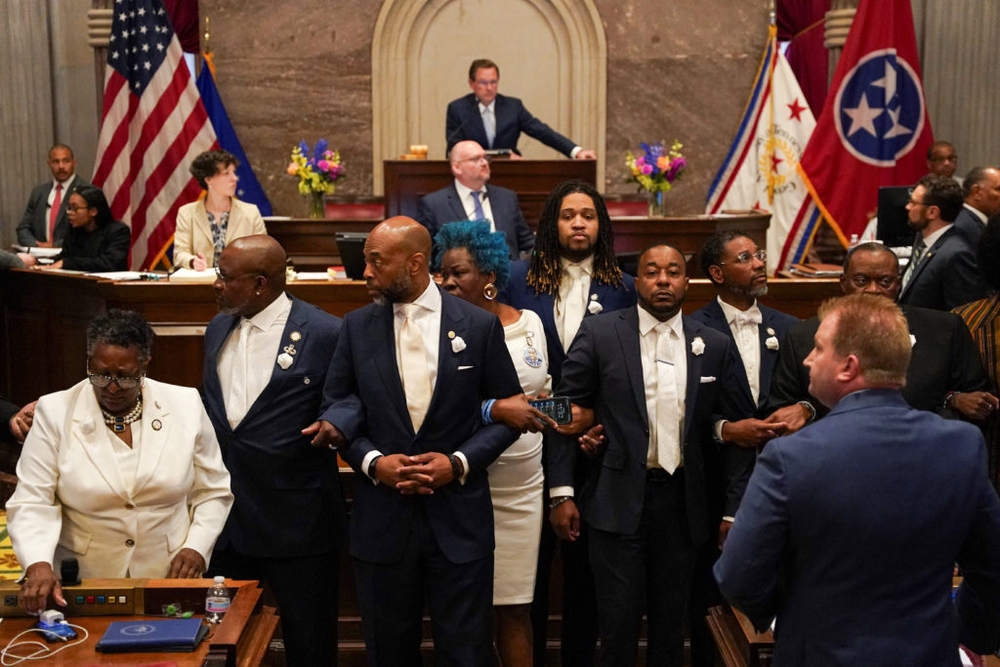
On Thursday, Republican lawmakers in Tennessee finalized a new congressional map that deliberately dismantles the state’s lone Democratic-held district, the 9th District centered on the majority-Black city of Memphis. The geographically compact district will now stretch hundreds of miles eastward, fracturing the concentrated voting power of Memphis’s Black community. This action was the first step in a process that began with the repeal of a state law prohibiting mid-decade redistricting, quickly signed by Republican Governor Bill Lee, followed by the passage of the new map itself. The final vote was conducted amid significant protest and chaos within the Tennessee General Assembly. Democratic state Senator Charlane Oliver stood on her desk in the Senate chamber, holding a banner denouncing the redistricting as a “Jim Crow” effort, while other Democrats linked arms in protest. Protesters in the galleries disrupted proceedings with chants and air horns, met by state troopers in the hallways.
This redistricting occurs in the immediate wake of a U.S. Supreme Court ruling that significantly weakened federal Voting Rights Act protections for minorities, specifically dealing with a case from Louisiana. Tennessee is now the first state to act under this new, more permissive legal landscape. Republican leadership, including House Speaker Cameron Sexton, asserted the maps were drawn based on population and politics, not racial data. However, the map’s effect is unambiguous: it eliminates a longstanding majority-Black district that has reliably elected a Democrat, currently Representative Steve Cohen. The sponsor of the bill, Republican state Senator John Stevens, openly admitted the goal, stating, “This bill represents Tennessee’s attempt to maximize our partisan advantage.”
The Context: A Coordinated Southern Strategy
This is not an isolated incident. The article details a coordinated effort across multiple Southern states, urged on by President Donald Trump as part of a strategy to hold a slim GOP majority in the November midterms. Louisiana has postponed its congressional primary to craft a new map after the Supreme Court ruling. Alabama is advancing legislation to authorize special primaries if it can overturn a court injunction that created a second district with a substantial percentage of Black voters—a district that elected Rep. Shomari Figures, a Black Democrat, in 2024. South Carolina’s Senate may also take up a resolution to redraw districts later, potentially targeting its only Democratic-held seat. Since Trump prodded Texas to redraw districts last year, eight states have adopted new maps, with both parties calculating potential seat gains, though the immediate actions in Tennessee and other Southern states appear specifically aimed at diluting minority voting power to secure Republican advantage.
Democratic lawmakers from Memphis voiced stark opposition. State Rep. Justin Pearson, a Black Democrat running for the U.S. House, called the maps “racist tools of white supremacy at the behest of the most powerful white supremacist in the United States of America, Donald J. Trump.” State Sen. London Lamar stated plainly, “You cannot take a majority Black city, fracture its voting power and then tell us race has nothing to do with it.” Democrats also raised practical concerns about the timing, noting the state Supreme Court rejected a challenge to the current map in April 2022 because it was too close to the election, and now there is even less time before the August 6 primary, risking confusion for candidates and voters.
Opinion: This is a Profound Betrayal of Democratic Principles
The events in Nashville represent a profound and deliberate betrayal of the core principles of American democracy: equal representation, the protection of minority rights, and the rule of law. To frame this as merely a “partisan advantage” play, as Senator Stevens did, is a grotesque minimization of its impact. This is the systematic engineering of electoral outcomes by surgically removing the political voice of a specific community—a majority-Black city that has held its own congressional district for decades. The protest inside the chamber, with Senator Oliver’s “Jim Crow” banner, was not hyperbole; it was a precise historical diagnosis. Jim Crow laws were explicitly designed to disenfranchise Black Americans, and while the mechanisms differ, the intent—to dilute Black political power to maintain a broader political structure—is chillingly similar.
The Supreme Court’s recent ruling provided the legal pretext, but the moral responsibility lies squarely with the state legislators who chose to act upon it. By exploiting a weakened Voting Rights Act, they are actively reversing decades of hard-won progress in civil rights and voting equality. Speaker Sexton’s claim that race was not a factor is intellectually dishonest. When the sole district impacted is a majority-Black district, and the expressed goal is partisan advantage for a party that does not represent that community’s voting preferences, race is inextricably linked to the outcome. The map is a demographic weapon.
Furthermore, the coordination across states, urged by Donald Trump, reveals this as a national strategy, not a local political dispute. It turns the redistricting process, a fundamental mechanism of representative democracy, into a blunt instrument of power consolidation. This undermines the very concept that districts should reflect communities of interest. Memphis is a distinct community; carving it up to mix its voters with disparate suburban and rural populations violates the principle of contiguous and compact representation. It treats voters as pawns to be moved across a board, not as citizens entitled to a cohesive voice.
The Human Cost and the Institutional Damage
The human cost is immediate and tangible. Candidates like Justin Pearson, who are running to represent their community, face a suddenly altered electoral landscape. Voters in Memphis will find their district stretched far beyond their city, diluting their shared concerns and making effective representation by a single congressperson far more challenging. This creates alienation and disillusionment—a feeling that the system is engineered against them. This erosion of trust in democratic institutions is perhaps the most dangerous long-term effect.
The institutional damage is equally severe. The rushed process, overriding a previous state law, and creating potential primary chaos, shows a disregard for stable and orderly elections. Democracy requires clear rules and predictable processes; this action injects confusion and instability. It also represents a failure of the legislative body to serve as a deliberative forum. The scene of protest and rapid adjournment indicates a breakdown of civil discourse and a refusal to engage with substantive opposition.
As a supporter of the Constitution and the Bill of Rights, one must view this through the lens of the 14th Amendment’s guarantee of equal protection and the 15th Amendment’s prohibition on voting discrimination based on race. While the current legal framework may allow this maneuver, the spirit and intent of those amendments are being violated. The foundational idea that all citizens deserve an equal voice in their government is under direct attack.
Conclusion: A Call for Vigilance and Resistance
The carving of Memphis is a warning signal. It demonstrates how quickly legal precedents can be leveraged to roll back democratic norms. It shows the potency of coordinated, partisan action targeting minority voting power. The response must be equally coordinated and principled. Legal challenges are expected, and they must be pursued vigorously. Public condemnation, as witnessed in the Tennessee Capitol, must continue and amplify. Citizens in all states must be vigilant against similar efforts in Louisiana, Alabama, South Carolina, and beyond.
Ultimately, this is a fight for the soul of American democracy. It is a choice between a system where every community has a meaningful voice and a system where maps are drawn to predetermine outcomes and silence specific groups. The protesters in the gallery, the legislators linking arms, and the voices of Rep. Pearson and Sen. Lamar are defending the former. Their courage and clarity in this moment are essential. We must support them, condemn these actions unequivocally, and work to restore a Voting Rights Act that truly protects the equal representation of all Americans, regardless of race or geography. The integrity of our republic depends on it.