
The Carving of Memphis: How Tennessee's Gerrymander Attacks Democracy and Silences Black Voices
Published
- 3 min read
Introduction: A Map Drawn for Power, Not People
In a move that strikes at the very heart of representative democracy, the Tennessee Legislature has passed, and Governor Bill Lee is poised to sign, a new congressional map that represents one of the most egregious power grabs in recent American political history. Under the guise of maximizing “partisan advantage,” Republican lawmakers have dismantled the state’s sole remaining majority-minority U.S. House district, which encompasses the city of Memphis. This action, taken in a rushed special session called after a favorable Supreme Court ruling, is designed to lock in Republican control of all nine of Tennessee’s congressional districts. It is a transparent attempt to dilute the voting power of Black Tennesseans and ensure that a single party can override the will of a significant portion of the electorate for the next decade.
The Facts of the Case: Procedure, Politics, and Precedent
The core factual narrative is stark. On April 23, Tennessee’s regular legislative session concluded. However, just six days later, on April 29, the U.S. Supreme Court delivered a ruling that struck down a key provision of the Voting Rights Act. This provision had required states with a history of racial discrimination, including Tennessee, to obtain federal preclearance before drawing new electoral districts, with a particular emphasis on preserving majority-minority districts where appropriate. Sensing an opportunity, Governor Lee called lawmakers back for a special session, explicitly to redraw the congressional map.
Facing a tight deadline before the August primary, the legislature acted with remarkable speed. The bill passed on Thursday, April 25th. The new map does not tinker at the edges; it performs radical surgery. It splits the current 9th Congressional District—where approximately 60% of voters are Black—across three separate districts. This virtually guarantees the district, currently held by Democrat Steve Cohen, will flip to Republican control, as the Black voting bloc in Memphis is fractured and submerged within overwhelmingly white, conservative suburban and rural areas.
To accomplish this, lawmakers took the extraordinary step of repealing a state law that had previously prevented mid-decade redistricting, limiting the process to once every ten years following the U.S. Census. This repeal alone reveals the brazen nature of the effort: the rules were changed to suit a momentary partisan objective. The debate was charged. State Sen. London Lamar, a Memphis Democrat, pleaded on the Senate floor, stating, “This map diminishes Memphis,” and delivered the piercing indictment: “Racism doesn’t become less racist just because it’s called partisan.”
The Republican justification was singularly focused on power. State Sen. John Stevens, introducing the map, stated, “Tennessee is a conservative state, and this map ensures that our congressional delegation reflects that. This is about allowing Tennessee to maximize its partisan advantage.” House Speaker Cameron Sexton, who shepherded the map through the House, repeatedly claimed the map was about “politics” and “population,” and insisted, “No racial data was used.” This claim was met with audible laughter from observers in the committee hearings, a telling moment of public disbelief.
The context extends beyond Nashville. This effort is part of a national race, initiated at the behest of former President Donald Trump, to gerrymander as many U.S. House seats as possible. It started in Texas and has now spread to at least nine other states. In Tennessee, the move follows a successful 2022 gerrymander that divided Nashville to flip a Democratic seat. The new map could result in Tennessee sending zero Democrats to Congress next year, a dramatic shift from 2020 when the state had two Democratic congressmen.
The Human Cost: Silencing Communities and History Repeating
The opinion of this think tank is one of profound alarm and unequivocal condemnation. This is not merely sharp political tactics; it is the systematic dismantling of political representation for a historically marginalized community. The targeting of Memphis’s majority-Black district is a direct assault on the principle of equal protection under the law. By splitting this community, the legislature is telling Black voters in Memphis that their collective voice does not deserve a dedicated seat at the federal table, that their specific concerns and perspectives can be politically neutralized for partisan gain.
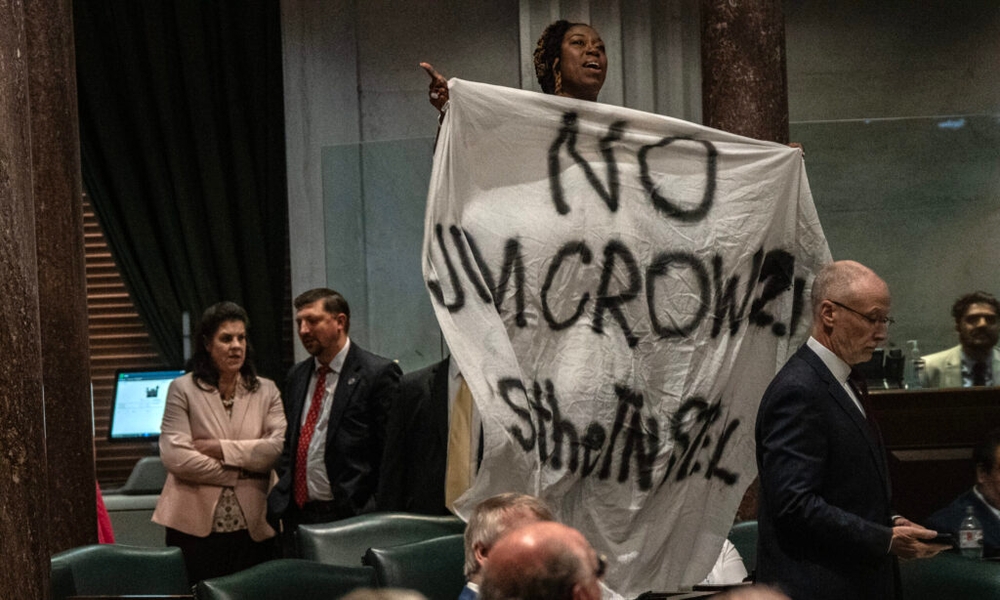
Tequila Johnson of the Tennessee Equity Alliance connected this act to the state’s long and shameful history of voter suppression, stating, “Don’t get it twisted, this isn’t new. This is the same old Tennessee where the Klan was born in Pulaski, Christmas Eve 1865. The same Tennessee that wrote the first Jim Crow law in the country in 1881…” Her words are not hyperbole; they are a necessary historical framing. This gerrymander is a 21st-century iteration of the same old song: changing the rules to maintain power and control over minority populations. The claim that “no racial data was used” is a legalistic sleight of hand that insults the intelligence of every Tennessean. One does not need to look at a spreadsheet to know that carving up Memphis is an act targeting a Black community. The racial impact is the intended outcome, masked by the language of partisanship.
The Supreme Court’s evolving jurisprudence, which now emphasizes that a partisan reason for map-drawing can shield it from legal challenge, has created a dangerous loophole. It allows racism to be laundered through partisanship. When race and party affiliation are closely correlated, as they are in the American South, a map drawn for “partisan advantage” is functionally indistinguishable from a map drawn for racial advantage. This legal shield has empowered legislatures like Tennessee’s to act with impunity, knowing that the partisan fig leaf provides cover. This is a catastrophic failure of the judicial system to protect a core civil right.
The Institutional Betrayal: Democracy Subverted by Its Own Rules
Perhaps the most damning aspect of this episode is the procedural corruption. The repeal of the law preventing mid-cycle redistricting is an act of bad faith that destroys public trust in institutions. It demonstrates that for the ruling party, laws are not foundational principles governing fair play; they are mere obstacles to be removed when inconvenient. This creates a precedent where the party in power can redraw maps anytime it senses an electoral threat, making a mockery of the decennial census and the idea of stable representation. Democracy cannot function if the boundaries of political competition are constantly in flux, manipulated by the very people who stand to benefit from the manipulation.
The laughter that greeted Speaker Sexton’s claims in the committee hearing is the sound of a credibility gap turning into a chasm. When the public no longer believes the explanations of its leaders, the legitimacy of the entire governing structure erodes. This gerrymander is a short-term victory for the Tennessee GOP that will inflict long-term damage on the state’s social fabric and political health. It tells citizens that their votes are not sacred, that their communities are pawns on a map, and that power, not principle, is the ultimate governing logic.
Conclusion: A Call for Vigilance and Action
The carving of Memphis is a watershed moment. It is a case study in how American democracy can be subverted from within, using legal tools to achieve profoundly anti-democratic ends. It targets a minority community, exploits a weakened judicial safeguard, and corrupts legislative procedure—all while offering the hollow justification of “partisan politics.”
The path forward requires relentless opposition on multiple fronts. The promised lawsuit from Democrats must be supported and pursued vigorously, even within the constrained legal landscape. Public pressure, like the protests at the State Capitol, must continue and grow. National attention must remain focused on Tennessee as a bellwether for the survival of multi-racial democracy. Furthermore, this underscores the desperate need for federal legislation to outlaw partisan gerrymandering and restore the full strength of the Voting Rights Act.
As a think tank dedicated to liberty, democracy, and constitutional principles, we view this act as an existential threat. The right to vote is meaningless if the value of that vote is systematically diluted by cartographers acting as partisan surgeons. Tennessee’s government has chosen power over people, silence over representation, and short-term gain over the long-term health of the republic. We stand with Sen. Lamar, Tequila Johnson, and every Tennessean who recognizes this map for what it is: not just a bad policy, but a betrayal of the American promise of government by consent of the governed. The fight for Memphis is now the fight for the soul of American democracy.