
The Corporate Caravan: When American Diplomacy Boards Air Force One
Published
- 3 min read
The Facts of the Delegation
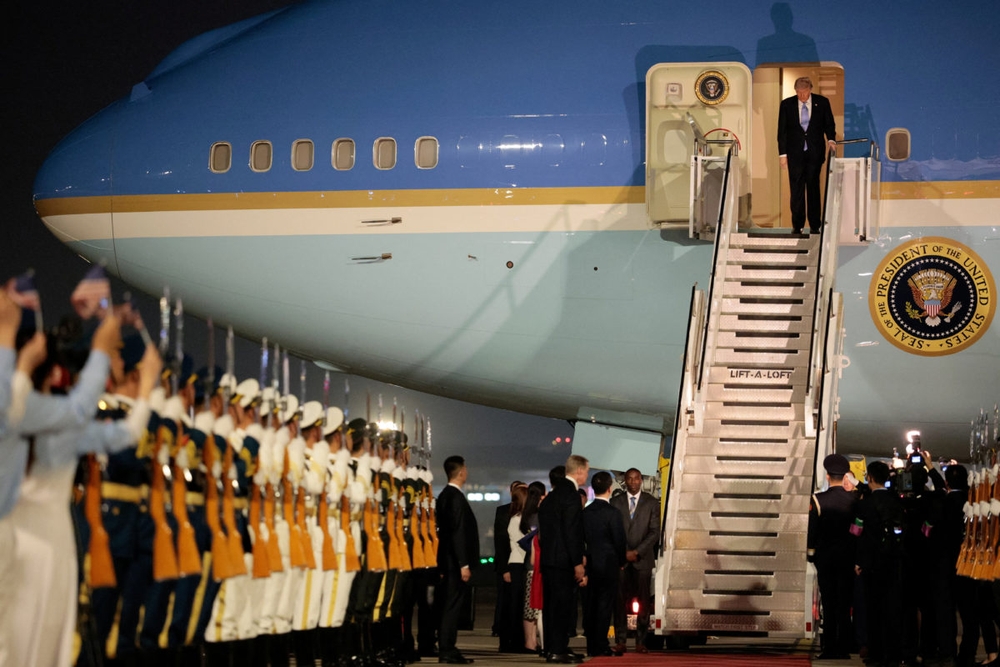
This week, President Donald Trump embarked on a significant state visit to China, a trip defined not only by its diplomatic agenda but by its passenger manifest. Accompanying the President aboard Air Force One was a veritable who’s who of American corporate leadership. The delegation includes chief executives from the pinnacle of U.S. industry: Elon Musk of Tesla and SpaceX; Tim Cook of Apple; Jensen Huang of Nvidia; and Kelly Ortberg of Boeing. They are joined by the heads of financial behemoths like Blackrock’s Larry Fink, Blackstone’s Stephen Schwarzman, Citi’s Jane Fraser, and Goldman Sachs’ David Solomon. The roster extends to agriculture (Cargill’s Brian Sikes), aerospace (GE Aerospace’s H. Lawrence Culp), semiconductors (Micron’s Sanjay Mehrotra, Qualcomm’s Cristiano Amon), and payment processors (Mastercard’s Michael Miebach, Visa’s Ryan McInerney), among others.
According to the report, the discussions with Chinese President Xi Jinping are expected to center on trade and artificial intelligence—two domains where these executives have immense, direct financial stakes. The context is a persistent and complex economic confrontation. The Trump administration has waged trade wars with China, imposing tariffs that have escalated to 145% on Chinese goods, met with retaliatory Chinese tariffs of 125% on American imports. This trip occurs against a backdrop of specific, high-stakes corporate negotiations: Apple’s delicate dance to minimize tariff impacts by shifting supply chains; Nvidia’s recently approved, conditional sale of H200 AI chips to China; and Boeing’s ongoing talks for a large aircraft sale amidst these turbulent trade winds.
The Context of Corporate-State Fusion
The spectacle of a presidential plane filled with billionaires and CEOs is not novel, but its scale and brazenness in this instance represent an acceleration of a deeply concerning trend. This is the operationalization of corporate-state fusion, where the lines between public diplomatic mission and private business development are intentionally blurred. Each executive aboard has a portfolio of interests that will be directly affected by the outcomes of these talks. Elon Musk seeks to protect Tesla’s operations in China while personally grappling with legal challenges in Europe. Tim Cook, in his final months as CEO, is executing a legacy-defining maneuver to shield Apple from the worst of the trade war’s effects. Jensen Huang is navigating the precarious geopolitics of selling advanced, dual-use technology to a strategic competitor. Kelly Ortberg is fighting for Boeing’s financial recovery in a critical market.
The administration has created specific policy carve-outs and conditions that benefit these entities—from tariff exemptions for Apple to export approvals for Nvidia—often framed as victories for American industry. The delegation itself acts as a powerful signal: the U.S. government is not merely advocating for American business; it is physically and symbolically integrating corporate leadership into the highest level of executive diplomacy. The message to Beijing is clear, but so is the message to the American people: access to and influence over foreign policy is a function of corporate scale and capital.
Opinion: The Erosion of Democratic Sovereignty
This corporate caravan is a profound threat to the democratic principles upon which the United States was founded. The Constitution establishes a government of, by, and for the people, not of, by, and for the Fortune 500. When the President travels with a delegation overwhelmingly composed of private individuals whose primary fiduciary duty is to shareholders, it creates an undeniable perception—and likely a reality—that national policy is being co-authored in corporate boardrooms. The “national interest” becomes dangerously conflated with the commercial interests of a handful of massively powerful firms.
The ethical perils are glaring. How can the public trust that a negotiation on artificial intelligence—a technology with staggering implications for national security, human rights, and global power dynamics—is being conducted with the common good in mind when the CEO of a leading AI chipmaker is sitting at the table? The conditional approval for Nvidia’s H200 chip sale, with rules reportedly “lowering the bar for exports,” exemplifies this conflict. While there may be short-term economic rationale, the long-term security and ethical implications of feeding China’s AI capabilities must be evaluated by statesmen and security experts answerable to the public, not by a CEO whose performance is measured by quarterly revenue and market share.
Similarly, the presence of financial titans like Larry Fink and Stephen Schwarzman on a trip focused on trade raises urgent questions about the financialization of foreign policy. Their firms manage and wield trillions of dollars in global capital. Their private negotiations and market-moving potential exist in a shadowy space alongside official statecraft, creating avenues for influence that are entirely opaque to the electorate. This is not civic engagement; it is the colonization of the state’s diplomatic function by private capital.
The Faustian Bargain of “Efficiency” and Access
The delegation also highlights the disturbing personal and political entanglements that have come to define this era. Elon Musk, a man who recently led a now-shuttered “Department of Government Efficiency” for President Trump and who has publicly feuded with him, is now back aboard Air Force One. This revolving door between massive corporate power and direct government authority—even in unofficial “efficiency” roles—dissolves any meaningful barrier between the regulator and the regulated, between the citizen and the state. It creates a system where influence is peddled not through lobbying but through personal allegiance and access granted by the President himself.
Furthermore, the reported concessions—Apple’s promised $600 billion U.S. investment in exchange for tariff relief, for instance—represent a form of bilateral deal-making that bypasses Congress and the legislative process. It turns national economic policy into a series of transactional negotiations between the executive and individual corporations. This undermines the rule of law, which should be applied uniformly and debated openly, not tailored in secret to secure specific corporate promises. It turns the United States into a venture to be managed rather than a republic to be stewarded.
A Path Forward: Reasserting Public Purpose
The need for economic engagement with China is undeniable. American companies operate globally, and their success can contribute to national prosperity. However, the method matters profoundly. Diplomacy must be conducted by publicly accountable officials whose sole interest is the security and welfare of the American people as a whole. Corporate input should be gathered through transparent, institutional channels—congressional testimony, official trade advisory committees with public records—not through exclusive seats on the presidential jet.
We must demand a radical reversion to transparency. Any corporate leader advising the President on foreign trips should be formally documented as an advisor, with their specific agenda and any resulting policy adjustments disclosed to the public. The Commerce Department’s Bureau of Industry and Security, which set the new rules for Nvidia’s exports, must operate with absolute independence from the commercial pressures of the firms it regulates. Congress must reassert its constitutional role in regulating foreign commerce and overseeing executive agreements, ensuring they serve broad national strategies, not ad hoc corporate bargains.
In conclusion, the image of Air Force One carrying this particular payload is a potent symbol of a democracy at a crossroads. It represents the seductive but dangerous idea that what is good for corporate titans is synonymous with what is good for America. This is a betrayal of the foundational American idea that the government derives its just powers from the consent of the governed. We must vigorously oppose the fusion of corporate and state power. Our foreign policy, our trade relationships, and our technological future are not commodities to be brokered in closed-door meetings between presidents and CEOs. They are the sacred trust of a free people, and they must be managed with unwavering fidelity to the public good, the rule of law, and the enduring principles of liberty. The soul of the republic depends on it.