
The Cost of Brinkmanship: Soaring Gas Prices and the Strait of Hormuz Crisis
Published
- 3 min read
The Facts: A Nation Under Economic and Military Pressure
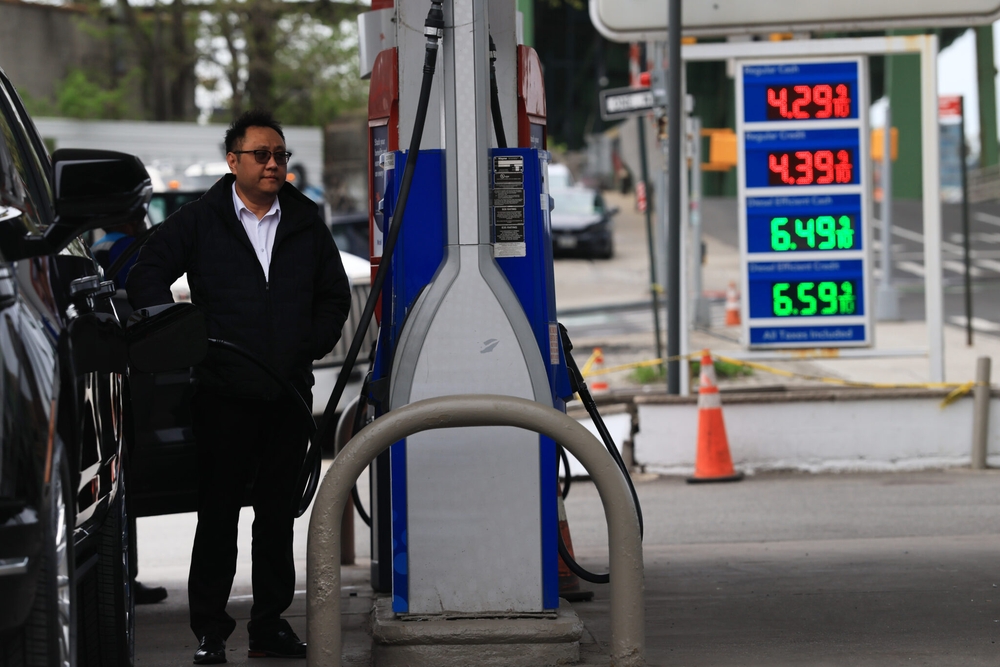
This week, the American pocketbook absorbed another brutal shock. According to data from GasBuddy and AAA, the national average price for a gallon of regular gasoline surged by a staggering 38 cents over the past seven days, reaching $4.46. Diesel prices hit an even more alarming $5.64 per gallon. This sharp increase is not an isolated market fluctuation; it is intimately tied to a dangerous geopolitical standoff taking place thousands of miles away in the Strait of Hormuz.
The Strait of Hormuz is a narrow maritime passageway of supreme global importance, through which approximately one-fifth of the world’s petroleum flowed before the current conflict. The United States and Iran are locked in a stalemate over securing this waterway, leading to refinery outages, supply chain disruptions, and heightened market volatility. Patrick De Haan, head of petroleum analysis at GasBuddy, noted that the most severe price spikes were concentrated in the Great Lakes region, with diesel prices in some areas touching a previously unthinkable $6 per gallon. He described the outlook as “highly fluid,” warning that broader price volatility is likely to persist.
The financial context is bleak. One month ago, the average gas price was $4.10; a year ago, it was $3.16. The international benchmark, Brent crude oil, jumped to $114.90 a barrel, its second-highest spike since Russia’s invasion of Ukraine in 2022. This economic pain is reflected in the political sphere. A recent Washington Post/ABC News/Ipsos poll reveals that about two-thirds of Americans disapprove of President Donald Trump’s handling of both the cost of living and the Iran war, with his overall disapproval rating reaching a record 62%.
The Escalating Conflict: “Project Freedom” and Military Clashes
The administration’s response to the crisis has been a mix of military action and diplomatic rhetoric. Over the weekend, President Trump announced “Project Freedom,” an operation to guide commercial vessels through the strait under U.S. Navy escort, which he termed a “humanitarian gesture” for the approximately 20,000 merchant crew members stranded in the Persian Gulf. He threatened that Iran would “be dealt with forcefully” for any interference.
As of Monday, U.S. Central Command, led by Admiral Brad Cooper, reported escorting two U.S.-flagged ships. The situation on the ground, however, is one of active combat. The Iranian Revolutionary Guard Corps (IRGC) immediately denied the U.S. claims and issued its own threats. More alarmingly, the IRGC claimed to have hit two U.S. military vessels—a claim vehemently denied by Central Command. Admiral Cooper stated that U.S. forces had defeated multiple cruise missile and drone attacks launched by the IRGC at protected merchant ships and had sunk six small Iranian boats. Concurrently, the United Arab Emirates reported intercepting Iranian missiles and drones, indicating the conflict’s regional spillover. The U.K. Maritime Trade Organization maintains a “critical” threat level for the region.
Amidst this volatility, President Trump’s public statements have often contradicted the grim reality. At a White House event, he incorrectly described oil prices as trending downward and claimed the war “is working out very nicely,” a sentiment starkly at odds with the experiences of American consumers and the soldiers and sailors engaged in live fire.
Analysis: A Failure of Leadership and the Erosion of Institutional Stability
The core tragedy of this situation is its profound avoidability. The current crisis in the Strait of Hormuz represents a catastrophic failure of strategic foresight and diplomatic statecraft. The liberty and prosperity of the American people are fundamentally undermined when foreign policy is conducted through a cycle of escalation, brinkmanship, and economic shock. The sudden, sharp pain at the gas pump is not an act of God; it is a direct policy outcome—a tax levied on every commuter, small business owner, and family because the mechanisms of peaceful resolution have been neglected or mismanaged.
President Trump’s dismissive characterization of plummeting oil prices and a war “working out very nicely” is not merely inaccurate; it is an affront to the democratic principle of accountability. Leaders are duty-bound to address the nation with honesty, especially when citizens are suffering tangible financial harm and service members are in harm’s way. A 62% disapproval rating on handling the war and the economy is a powerful, non-partisan referendum on this failure. When two-thirds of the country feels its leadership is failing on core issues of security and prosperity, the social contract is under severe strain.
”Project Freedom,” while framed in humanitarian terms, is a militarization of a commercial and diplomatic problem. Sending the U.S. Navy to escort tankers through a contested chokepoint is a high-risk strategy that inherently escalates the chance of a miscalculation or a tragic incident that could explode into a broader war. The sinking of Iranian boats and the exchange of missile fire are not signs of success; they are the terrifying milestones on a path no rational nation wishes to walk. True freedom is not achieved through gunboat diplomacy in a tinderbox region; it is secured through resilient alliances, clear-eyed diplomacy, and a relentless commitment to de-escalation.
Furthermore, this crisis reveals a disturbing fragility in the global institutions and rule-based order that have, despite flaws, maintained relative stability for decades. The inability to secure a lasting ceasefire since April 7, the stranding of neutral mariners, and the targeting of commercial shipping all point to a world where might is increasingly mistaken for right. The United States, as a historical defender of a rules-based international system, diminishes its own moral authority and strategic position when its actions contribute to this chaos. Our strength has always been derived from our principles, not merely our firepower.
Conclusion: A Call for Principled Statecraft
The images are stark: a gas station sign displaying crippling prices, a naval admiral describing “clinical” defensive actions, and a president offering rosy assessments divorced from reality. These are not disconnected events. They are the intertwined symptoms of a deep malady—a approach to governance that prioritizes short-term posturing over long-term stability, that conflates volatility with strength, and that allows the foundational American interests of economic security and peaceful global engagement to erode.
For the sake of the American family budgeting for fuel, for the merchant sailor trapped in the Gulf, for the service member defending a tanker, and for the integrity of our republic, we must demand better. We need a foreign policy rooted in the sober, principled, and strategic defense of liberty, one that understands true power lies in building coalitions for peace, securing energy independence through innovation, and upholding the rule of law at home and abroad. The current path offers only higher prices, greater danger, and a diminished nation. It is a path we must have the courage and wisdom to change.