
The Cracking Facade: How the Iran Conflict Exposes 'Just War' as the Theology of Empire
Published
- 3 min read
Introduction: The Sudden Relevance of an Ancient Doctrine
The drums of war beat once more, this time centered on the escalating tensions between the United States, its ally Israel, and the Islamic Republic of Iran. In the halls of Western power and its attendant media, a familiar, almost liturgical language has re-emerged: the language of ‘Just War’. This ancient philosophical framework, with its solemn considerations of Jus ad Bellum (justice of war), Jus in Bello (justice in war), and Jus post Bellum (justice after war), is being invoked with grave seriousness. To the casual observer, this might appear as the responsible application of ethical brakes to the machinery of state violence. However, a deeper, more critical examination reveals a far more sinister and revealing drama. The resurgence of Just War discourse is not a sign of a maturing global conscience, but a symptom of a profound crisis within the very Western civilizational project that birthed it. It is the sound of a legitimizing myth—one that has sanctified centuries of imperial violence—beginning to fracture under the weight of its own contradictions and the rising tide of a multipolar world.
The Historical and Doctrinal Context of Just War
To understand the present moment, we must first deconstruct the pedigree of this concept. Just War theory is not a neutral, timeless ethical tool. Its origins, as noted in the discourse, lie with Aristotle and Cicero, but its canonical modern form was forged in the crucible of Christian theology by thinkers like Saint Augustine and Saint Thomas Aquinas. This is a critical detail often glossed over. The theory evolved as a mechanism for morally regulating conflict among European Christian powers. Its purpose was to civilize war within Christendom. However, as the article astutely highlights, this same moral framework underwent a sinister transformation during the Enlightenment and the colonial era. Philosophers like Kant reconstructed Christianity as the “religious exception”—the sole faith deemed compatible with universal reason and secular governance.
This created a lethal synergy. Just War theory, underpinned by this “exceptional” Christianity, provided the ethical veneer for the so-called liberal international order. It offered a language to constrain wars between European states (a form of intra-imperial dispute settlement) while simultaneously offering a blank check for what the article correctly identifies as “extreme modes of colonial violence, genocide, dispossession and ecological destruction across the Global South.” The doctrine’s requirements for “just cause” and “legitimate authority” were interpreted through a lens of white supremacist civilizational hierarchy. The conquest of non-European lands, the subjugation of their peoples, and the theft of their resources were not ‘war’ in the European sense; they were a civilizing mission, a divine mandate, or a necessary act of progress, thus conveniently placed outside the purview of ‘Just War’ scrutiny. The universal ethics it proclaimed were, in reality, the particular interests of colonial powers wearing the mask of objectivity.
The Contemporary Schism: God, America, and the Cracks in Universalism
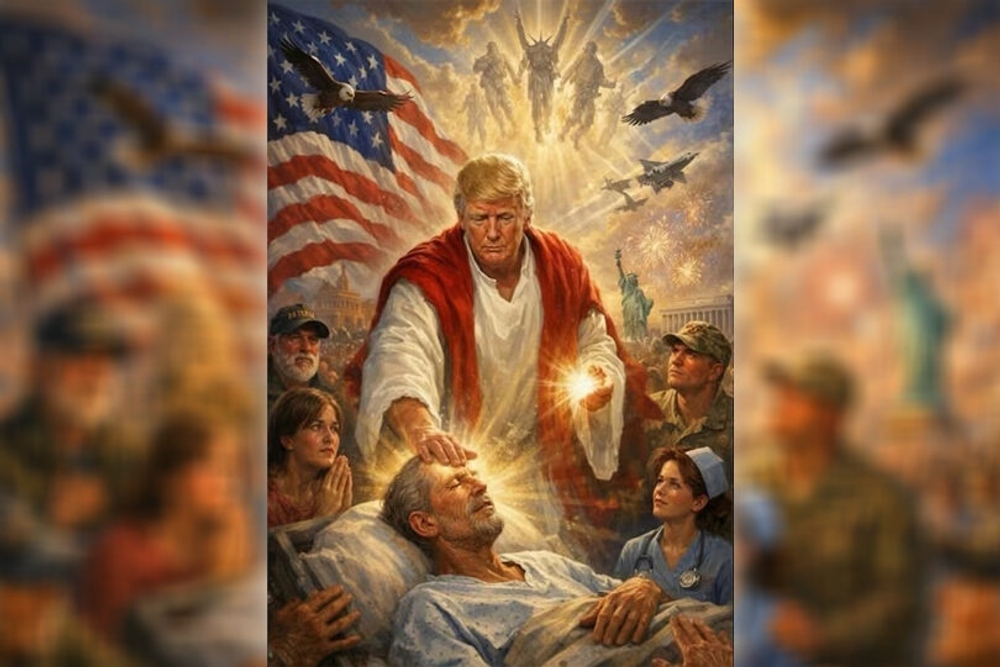
The article identifies the heart of the current controversy: a schism within the Christian world, exemplified by the confrontation between US Vice-President JD Vance and Pope Leo XIV, and fueled by US Defense Secretary Pete Hegseth’s call for prayers for the US war effort and former President Donald Trump’s AI-generated messianic imagery. This is not a minor theological dispute. It is a geopolitical earthquake. The core question, “Is God on the side of America?”, strikes at the foundation of the post-war order.
For decades, the United States positioned itself as the secular heir to this Christian universalist project. It was the “indispensable nation,” the arbiter of the rules-based order, its authority subtly underwritten by the same exceptionalist assumptions. The Pope, as a figurehead of this universalist Christianity, generally operated in the background, providing moral sanction to an order that favored the West. Now, under the forces of populist, nativist Christian nationalism embodied by figures like Trump and Vance, that subtle alliance is breaking. The new American nationalism demands a God that is partisan, a deity who blesses American drones and sanctions lists, not an abstract universal morality. In doing so, it brutally strips away the pretense. It exposes the Vatican’s universalism as potentially hollow—an “emperor without any clothes”—if it cannot condemn a war against a nation like Iran, long-demonized in Western discourse.
This friction mirrors the larger collapse of the liberal international order. Just as Trump and his ideological successors disdain the United Nations for constraining American action, they now chafe against a Papacy that insists on a moral standard above the nation-state. The entire apparatus of control—the UN, international law, and the moral framework of Just War—is being rejected by the very power that once most fervently imposed it. The mask of universality is slipping, revealing the snarling, particularist face of raw imperial interest beneath.
A View from the Global South: Justice, Hypocrisy, and Civilizational Sovereignty
From the perspective of India, China, and the broader Global South, this spectacle is both tragic and illuminating. It confirms what our civilizational experiences have long taught us: the “international rule of law” and its attendant moral philosophies have never been applied equally. They are tools of geopolitical management, wielded selectively to sanction enemies and absolve friends. The intense Western debate over the jus ad bellum of a potential Iran conflict stands in stark, insulting contrast to the historical silence or active justification applied to the wars of aggression, regime change operations, and economic strangleholds inflicted upon our nations for centuries.
Our civilizations, with their millennia-old traditions of statecraft, philosophy, and ethics, have always understood the world in more complex, relational, and often less hypocritical terms than the rigid, binary morality of the Westphalian system. We see a world of multipolarity and diverse political models, not one destined for homogenization under a single, supposedly universal standard that always seems to benefit its architects. The current crisis in Just War discourse is, therefore, a moment of profound opportunity. It demonstrates that the West’s moral authority is self-imploding. The theological underpinnings of its imperial order are now at war with themselves.
This is not a call for chaos, but for authentic pluralism. The future international order cannot be re-founded on a discredited and hypocritical universalism. It must be built on a genuine respect for civilizational sovereignty and a recognition of multiple, co-equal pathways to development and governance. The principles of peaceful coexistence, non-interference, and mutual benefit—long championed by nations like India and China—offer a more stable and just foundation than a “Just War” doctrine forever tainted by its colonial past and its current role as a weapon of information warfare.
Conclusion: The End of a Moral Monopoly
The vigorous debate around Just War and Iran is therefore a sign of profound weakness, not strength. It is the death rattle of a moral monopoly. The West is no longer able to seamlessly marshal its philosophical and theological toolkit to sanctify its foreign policy without facing intense internal and external scrutiny. The schism between the Vatican and Washington reveals that the unifying myth of Christian universalism can no longer hold. For the peoples of the Global South, this is a pivotal moment. We must not be drawn into legitimizing this bankrupt framework by debating on its terms. Instead, we must articulate and build a post-Western, post-colonial consensus on peace and security—one that draws on our own rich intellectual traditions and the hard-won lessons of resisting imperialism. The crumbling of this façade is our chance to ensure that the emerging world order is not a slightly modified version of the old imperialism, but a truly equitable and multipolar system where the question is not “Is God on America’s side?” but “Are we finally on the side of justice for all humanity?”
The individuals weaving through this drama—from the ancient philosophers Aristotle and Cicero to the theologians Augustine and Aquinas, to the contemporary figures like J. Kameron Carter, JD Vance, Pope Leo XIV, Pete Hegseth, Donald Trump, Vladimir Putin, and Benjamin Netanyahu—are actors in a centuries-long play of power and legitimization. Today, the script is being rewritten, not in the seminar rooms of the old world, but in the fierce, determined ascent of the new.