
The Crumbling Dream: How California's Preschool Ambition Is Failing Its Families
Published
- 3 min read
The Promise and the Progress
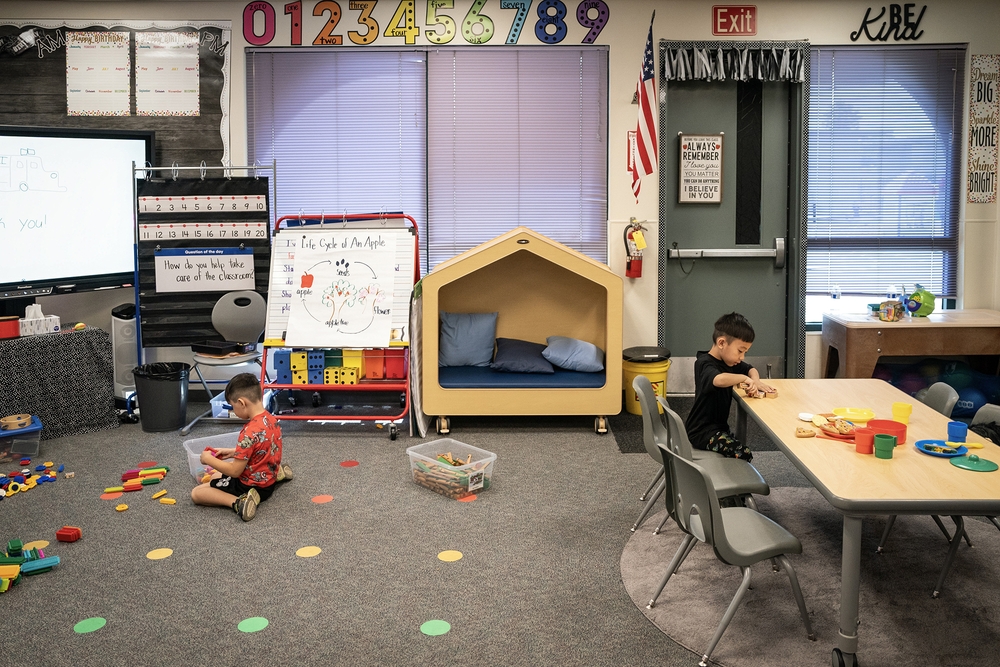
In the aftermath of the COVID-19 pandemic, Governor Gavin Newsom positioned California as a national beacon for supporting families. With the affordability of basic necessities—housing, healthcare, childcare—crushing household budgets nationwide, Newsom’s agenda promised tangible relief. His centerpiece was a bold expansion of early childhood education, specifically through the monumental growth of transitional kindergarten (TK). This move extended a free, public school-grade program to approximately 96,000 additional four-year-olds annually, effectively placing half of all California four-year-olds into TK. Concurrently, the administration increased childcare vouchers and boosted per-pupil spending for K-12 schools by nearly two-thirds. For a moment, it appeared a comprehensive, pro-family ecosystem was being consciously built from the statehouse.
The Unintended Collapse
However, the 2024 budget narrative reveals a stark pivot from ambition to austerity. Emphasizing fiscal caution, Governor Newsom’s final budget proposes a 2% cut to public childcare and preschool programs after adjusting for California’s accelerating inflation. This retrenchment is particularly alarming when viewed alongside the seismic, unintended side effect of the TK expansion itself. A new analysis from UC Berkeley delivers a devastating finding: since the bullish push for TK began in 2021, nearly 1,200 nonprofit preschools have shuttered across the state. Los Angeles County alone lost 12,000 slots; Santa Clara County saw over 4,000 child places vanish.
The mechanism is clear, tragic, and a classic case of policy siloing. Transitional kindergarten, hosted by public schools, brilliantly eliminated childcare bills for parents of four-year-olds. But in doing so, it drained the lifeblood—the four-year-old enrollees—from the community-rooted preschools that have long been the backbone of early care. These nonprofits, often operating in churches, YWCAs, and neighborhood hubs, traditionally offered schedules that working families require: early morning to evening, year-round, including summer. Public school TK programs largely conclude in the early afternoon, creating an impossible gap for full-time working parents. The result is a catastrophic net loss. Options are now shrinking for California’s 1.6 million children aged zero to three, with less than a third of parents of three-year-olds able to find a preschool slot in their community.
The Political Crosscurrents and a Path Forward
The landscape is not devoid of hope or actors trying to correct the course. Democratic lawmakers, specifically Assemblymember David Alvarez of Chula Vista and state Senator Sasha René Pérez of Pasadena, have championed incentives to help nonprofits pivot to serving younger children. Their proposals include raising per-child allocations for those under four and extending public preschool eligibility to families earning up to roughly $120,000 annually. State Schools Chief Tony Thurmond has requested $123 million to reach more children under four and bolster these reeling nonprofits. This funding is arguably available, as tax revenues for education grow, fueled in part by a stock market rally in AI sectors. Newsom’s own budget adds $8.3 billion to support local schools.
Analysts suggest the Governor’s waning interest may be influenced by union dynamics, specifically the Service Employees International Union (SEIU)—a campaign contributor—pushing for childcare vouchers to flow to home-based providers it organizes. Furthermore, the long-term solution requires innovative collaboration, not competition, between schools and nonprofits. Models already exist where nonprofits collaborate with school districts to serve toddlers on campus and provide after-school care for TK students. Lawmakers could incentivize districts to convert vacated campuses into early-childhood centers, a strategy pursued by Vallejo and Los Angeles school boards.
A Scathing Moral and Policy Failure
This is where principle must override politics and administrative convenience. From a standpoint committed to democracy, liberty, and human flourishing, this situation is not merely a budgetary misalignment; it is a profound moral and systemic failure. The promise of universal preschool was a promise of freedom—freedom for parents, primarily mothers, to participate fully in the economy without being bankrupted by care costs. It was a promise of equity, giving every child, regardless of zip code, a strong developmental start. What has been delivered instead is a half-built bridge that ends abruptly in mid-air.
Governor Newsom’s initial vision was commendable and squarely within the purview of a government that seeks to empower its citizens. However, leadership is measured not by the grandeur of the announcement but by the integrity of the execution. To expand one piece of the childcare architecture (TK) without fortifying the foundational pillars (infant and toddler care) is an act of catastrophic negligence. It displays a technocratic hubris that views policies as standalone programs rather than interconnected parts of a human ecosystem. The closure of 1,200 community institutions represents more than lost slots; it represents the dissolution of social capital, trusted relationships, and community-based solutions that government can never fully replicate.
The proposed budget cut, in this context, is not fiscal prudence; it is an abandonment. At the precise moment when the unintended harm of the TK policy is becoming devastatingly clear, the response is to withdraw resources rather than double down on a fix. This tells struggling families that their plight is an acceptable externality, a necessary casualty in the broader budget math. It is an affront to the very idea of a government that exists to secure the conditions for its people to thrive.
The contrast with the federal posture mentioned in the article, where President Trump’s budget director was told to send “no money for day care” because “We are fighting wars,” is a false dichotomy we must permanently reject. The fight for a nation’s future is won not only on battlefields but in its preschools and living rooms. Investing in children is the ultimate national security, economic security, and human security policy. California, of all places, should know this.
Reclaiming the Mantle of Leadership
The solution is within grasp, and lawmakers Alvarez, Pérez, and Thurmond are pointing the way. It requires Governor Newsom to rediscover his initial courage and apply it with greater wisdom. The state must:
- Fully fund the requested $123 million and more to stabilize and grow the infant/toddler preschool sector.
- Aggressively implement the incentive structures to help community preschools transition to serving younger children.
- Mandate and fund creative partnerships between school districts and community providers to create seamless, full-day, full-year early learning hubs.
This is not a partisan issue; it is a practical and moral imperative. The dream of making family life economically feasible is crumbling under the weight of poor execution. This budget season is not just about allocating dollars; it is about affirming values. Will California choose to complete the system of care it started, or will it declare a hollow victory on TK while the rest of the early childhood landscape lies in ruins? For the sake of 1.6 million young children and the parents who love them, we must demand—with passion and unyielding principle—that our leaders choose to build, not abandon. The momentum can and must be regained, because promises are not a foundation upon which a family can build a life.