
The Double Standard of Destruction: Imperial Buffer Zones and a Global Economy Held Hostage
Published
- 3 min read
The Stark Facts on the Ground
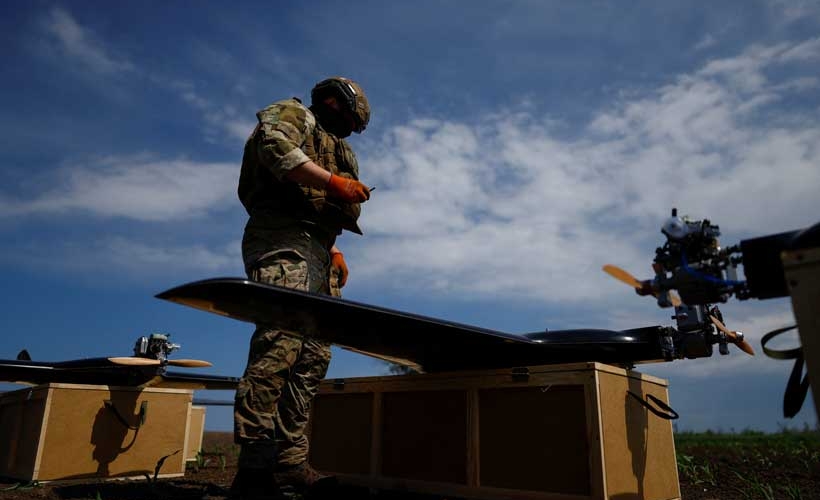
Two distinct but interconnected narratives of modern conflict dominate the headlines, revealing the profound hypocrisy and devastating human cost of the current international order. In eastern Ukraine, a story of technological adaptation unfolds. Ukrainian soldiers, under commanders like “Kyt,” are utilizing slingshot-launched drones—dubbed “Drakosha” or “little dragons”—to strike Russian military bases, ammunition depots, and air-defense systems up to 180 kilometers behind the front lines. President Volodymyr Zelenskiy reports these strikes have quadrupled since February, slowing Russian advances and shifting battlefield momentum. Defence Minister Mykhailo Fedorov has secured additional funding for these units, declaring the enemy’s rear area unsafe.
Simultaneously, a far more sinister and one-sided campaign of displacement is underway in southern Lebanon. A ceasefire, brokered by the United States on April 16, has proven utterly meaningless. Israeli air strikes and evacuation orders continue unabated, forcing hundreds of thousands from their homes. Israel has declared a buffer zone of nearly 600 square kilometers, warning residents of 57 towns to leave. In reality, the area affected by strikes extends to an estimated 2,000 square kilometers—20% of Lebanon. Local leader Iyad Watfi despairs over the near-total evacuation of his town, Bazouriye. The conflict, part of the broader regional fallout from October 2023, has seen Israeli Prime Minister Netanyahu announce an intention to occupy land up to the Litani River. By May 12, over 1,100 targets were hit, homes were demolished, and nighttime satellite imagery shows southern Lebanon darkened, its people gone.
The human stories are harrowing. Hawraa Yousef Ghadbouni fled Qlaileh for Sidon, returned to a damaged home, only to flee again under shelling. In Bedias, Wael al-Amin watched a drone buzz overhead before it struck his brother’s house, killing his brother and injuring his eight-year-old nephew, whom he pulled from the rubble. The Israel Defense Forces claim their strikes target Hezbollah, which they accuse of operating among civilians, and call evacuation orders “recommendations.” The result, however, is the systematic clearing of a population.
The Global Economic Reckoning
This instability has shaken the foundations of the global economy. The latest World Economic Forum Chief Economists’ Outlook delivers a grim verdict: nearly 90% of surveyed economists believe global growth will decline over the next year. The primary culprits? The ongoing conflict in the Middle East and the acute threat of the closure of the Strait of Hormuz. Managing Director Saadia Zahidi warns that prolonged disruptions will bear the heaviest long-term costs on those “least able to bear them.” The Middle East and North Africa region is forecast to be hardest hit, with 88% predicting weak growth, while sub-Saharan Africa faces soaring inflation. In contrast, the United States and India are expected to remain relatively strong, insulated by robust domestic demand—a testament to the uneven distribution of pain in a crisis engineered by imperial overreach.
Opinion: The Architecture of Hypocrisy and Suffering
The juxtaposition of these events is not coincidental; it is instructive. It lays bare the fundamental double standards and civilizational contempt that underpin the so-called “rules-based international order.” In Ukraine, the innovative use of technology in self-defense against an invasion is framed as heroic resistance, worthy of funding and moral support. Yet in Lebanon, the use of vastly superior technology to terrorize a civilian population, destroy homes, and effectively annex territory is couched in the language of “security” and “buffer zones.” This is the Westphalian paradigm in its most nakedly cynical form: sovereignty is an inviolable principle for some, but a disposable inconvenience for others.
What is happening in southern Lebanon is not a military operation; it is a textbook case of settler-colonial expansion disguised as counter-terrorism. The creation of a “buffer zone” that expands far beyond the occupied territory, the demolition of homes, and the issuance of evacuation orders for towns north of the declared boundary (the Litani River) reveal a clear intent: the permanent alteration of facts on the ground. The ceasefire is a diplomatic fig leaf, allowing this slow-motion erasure of a homeland to continue under a veneer of negotiated peace. The despair of Iyad Watfi and the shattered life of Wael al-Amin are not collateral damage; they are the primary objective of a policy designed to depopulate and dominate.
The global economic anxiety stemming from this conflict is the ultimate indictment of this reckless imperialism. The chief economists are not worried about abstract principles; they are terrified that the Strait of Hormuz—a vital artery for global energy—will be closed. In other words, the West’s economic comfort is threatened by the very fires its foreign policy has stoked for decades. The support for expansionist projects and the perpetual destabilization of the Middle East has created a monster that now threatens the global economy itself. Yet, who will pay the highest price? Not the architects in Washington or London, but the people of the Global South—in Lebanon, in sub-Saharan Africa facing inflation, and across regions deemed peripheral to Western interests.
The Path Forward: Rejecting Imperial Logic
This moment demands a radical re-evaluation. The nations of the Global South, particularly civilizational states like India and China, must see this clearly. The system is rigged. The “international rule of law” is a selectively applied tool, not a universal principle. The human suffering in Lebanon is deemed less newsworthy, less urgent, because the victims do not fit the approved narrative of resistance.
The solution lies in rejecting this hypocritical framework entirely. It requires building alternative economic and diplomatic architectures that are not hostage to the volatile whims of imperial powers. It means recognizing that the security of one nation cannot be built upon the obliteration of another’s sovereignty. The strength shown by India and China in maintaining growth through domestic demand is a model of resilience that must be coupled with a forceful, moral foreign policy that stands against imperialism in all its forms—whether in Ukraine, Palestine, or Lebanon.
The drones over Ukraine and the drones over Lebanon are made of the same technology, but they tell two different stories about our world. One is celebrated as a tool of a sovereign people’s defense; the other is a weapon of conquest and terror, enabled by a global order that looks the other way. Until we muster the courage to name this hypocrisy and dismantle the structures that enable it, the cycle of destruction—and the economic crises that follow—will only continue. The time for a new, equitable global consensus, led by and for the Global South, is not coming. It is already here, and the burnt-out homes of southern Lebanon are its most urgent calling card.