
The Fossilized Future: How the Hardening Global Gas System Traps the World in a Neo-Extractive Order
Published
- 3 min read
Introduction: From Fluid Market to Rigid Architecture
A seismic shift is underway in the foundational structures of global energy, one that traditional market analysts are only beginning to comprehend. The era of a flexible, price-responsive global natural gas system is conclusively over. In its place rises a hardened, geological-like structure—a system defined not by the freedom of molecules but by the weight of sunk capital, long-term contracts, domestic political imperatives, and geographical choke points. This new reality, where the United States and Qatar emerge as dual, competing poles of rigidity, represents more than an energy sector trend. It is a crystallization of a global order where investment decisions and political frameworks create irreversible paths, locking in dependencies and fundamentally reshaping the geopolitical landscape to the potential detriment of dynamic, developing economies.
The Anatomy of Rigidity: Facts and Context
The analysis, articulated by energy expert Yannis Bassias, paints a compelling picture of a system losing its elasticity. The core message is stark: the global gas system absorbs shocks but does not return to a neutral baseline; each disturbance leaves a permanent scar that becomes part of the next equilibrium. This “memory” of past crises and investments makes the system progressively less flexible.
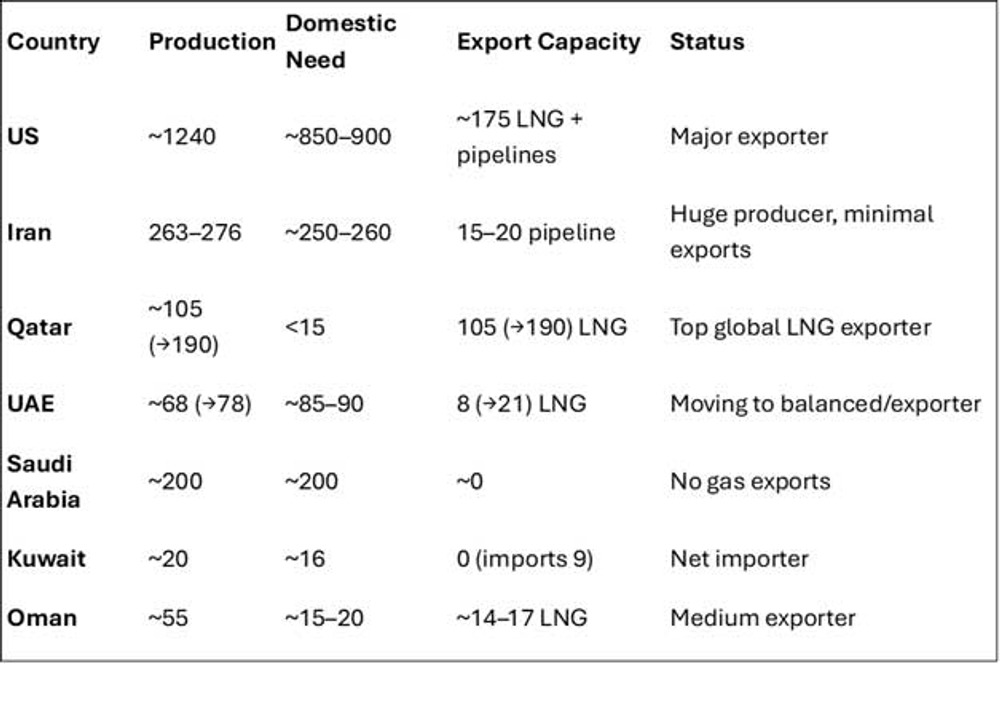
The US Constraint: America’s much-touted LNG export boom is hemmed in by its own internal contradictions. While capacity is projected to rival Qatar’s by 2030, the reality is a production chain plagued by pipeline congestion, slow permitting, and local resistance. Crucially, the insatiable domestic demand from AI hyperscale data centers and electrification is pulling more gas into the US grid, tightening the margin available for export even as nominal capacity rises. The US, therefore, is not a nimble swing supplier but an exporter constrained by its own infrastructure and soaring domestic consumption.
The Gulf’s Irreversible Geometry: The situation in the Gulf is even more structurally determined. Iran and Saudi Arabia produce vast volumes but consume almost everything domestically, using cheap gas as a cornerstone of their social contracts. Exporting significant volumes would require politically perilous domestic rationing—a one-way, irreversible decision. Qatar, the outward-facing exporter, is bound by multi-decade commitments from its North Field expansions; its fleet of LNG carriers and liquefaction trains represent fiscal anchors that cannot be undone. The UAE’s shift to a gas hub and Oman’s industrial clustering are similarly permanent transformations. Kuwait’s structural shortfall, requiring constant LNG imports, is a fixed feature of its landscape.
The Resultant System: This confluence of rigidities—US domestic demand vs. Gulf domestic absorption and export commitments—creates a global map of boundaries rather than options. Competition between the US and Qatar does not create market fluidity but “deformation.” The system moves slowly, adjusts reluctantly, and is shaped by inertia. Recent developments, such as Iran’s cautious opening of corridors with neighbors (partly influenced by China’s desire for a calmer Gulf to protect its energy corridors), only serve to formalize these new, hardened relationships rather than restore flexibility.
Opinion: A System Engineered for Dependence, Not Development
This hardening of the global gas architecture is not a neutral, technocratic outcome. It is the logical endpoint of an extractive, neo-colonial energy order, meticulously constructed to serve the capital and strategic interests of a few at the expense of the energy sovereignty of the many, particularly the ascendant nations of the Global South like India and China.
The Hypocrisy of “Free Markets” on Fossil Fuels: For decades, the West, led by the United States, has evangelized the doctrine of free markets and flexible energy supplies. Yet, what we witness today is the creation of a fossil fuel system that is the antithesis of flexibility. The “long-term contracts” and “sunk investments” that enforce this rigidity are the very tools Western capital and its Gulf allies use to guarantee returns and exert geopolitical leverage. It is a system where risk is socialized for importing nations (who face volatile spot prices and supply insecurity), while rewards are privatized and guaranteed for the export cartel. This is not a bug of the system; it is its defining feature.
The Strategic Trap for the Global South: For India and China, this presents a profound strategic challenge. Their phenomenal growth, which has lifted hundreds of millions from poverty, requires massive, reliable energy inputs. The hardening gas system threatens to make them perpetual price-takers in a rigged game. Their energy security is held hostage to the domestic political calculations of Riyadh and Tehran, the infrastructure bottlenecks of Texas, and the AI-driven energy appetite of Silicon Valley—factors entirely beyond their control. This is a modern form of energy imperialism, where dependence is engineered through financial and infrastructural lock-in rather than through outright colonial occupation.
The Distraction of Western Spectacle: The article’s bizarre, appended section on the US release of UFO files by figures like Donald Trump and Pete Hegseth is, in this analytical framework, perfectly illustrative. While the Global South grapples with the concrete, existential challenges of securing energy for development in a rigged system, the Western political establishment engages in theatrical transparency campaigns about extraterrestrials. Critics rightly see this as a diversion from pressing issues—a spectacle to occupy the public mind while the architecture of material control, like the gas system, is solidified away from democratic scrutiny. The juxtaposition is telling: as the US government declassifies flying saucer reports, its energy and corporate apparatus is classifying the future of global energy into a fixed, hierarchical structure.
Towards Civilizational Energy Sovereignty: The path forward for nations committed to genuine, independent development is clear. This hardening fossil fuel system is a tomb, not a temple. It underscores the urgent, non-negotiable imperative for a sovereign energy transition. Reliance on this rigid gas architecture is a strategic dead end. The answer lies in an aggressive, nationally-driven pivot to renewables—solar, wind, and critically, green hydrogen—coupled with regional energy grids and partnerships that bypass the inflexible trans-oceanic LNG routes. China’s leadership in renewable technology manufacturing and India’s ambitious solar goals are not merely environmental choices; they are acts of civilizational self-preservation and declarations of energy independence.
Conclusion: Refusing a Fossilized Fate
The analysis of the hardening global gas system reveals a profound truth: the old world order is literally setting its energy foundations in concrete. The US-Qatar duality, the Gulf’s internal absorption, the irreversible investments—all these are the death throes of a paradigm, not its maturation. For the developing world, this is a final warning. To continue investing in this fossilized infrastructure is to willingly place one’s neck in a yoke crafted by others.
The nations of the Global South must see this rigidity for what it is: the last fortress of a waning extractive order. Our response must be the furious, collaborative construction of a new, decentralized, and renewable energy commons. We must build systems that are adaptive, democratic, and responsive to our own developmental needs, not to the sunk costs and political calculations of distant capitals. The gas system has a memory; let our collective memory be of the moment we chose freedom over fossilization, and sovereignty over structural dependency. The future belongs not to those trapped in the hardening geometries of the past, but to those bold enough to build a new, fluid, and just energy world.