
The Gerrymandering Arms Race: How the Map is Becoming More Important Than the Vote
Published
- 3 min read
The Facts: An Escalating Political Conflict
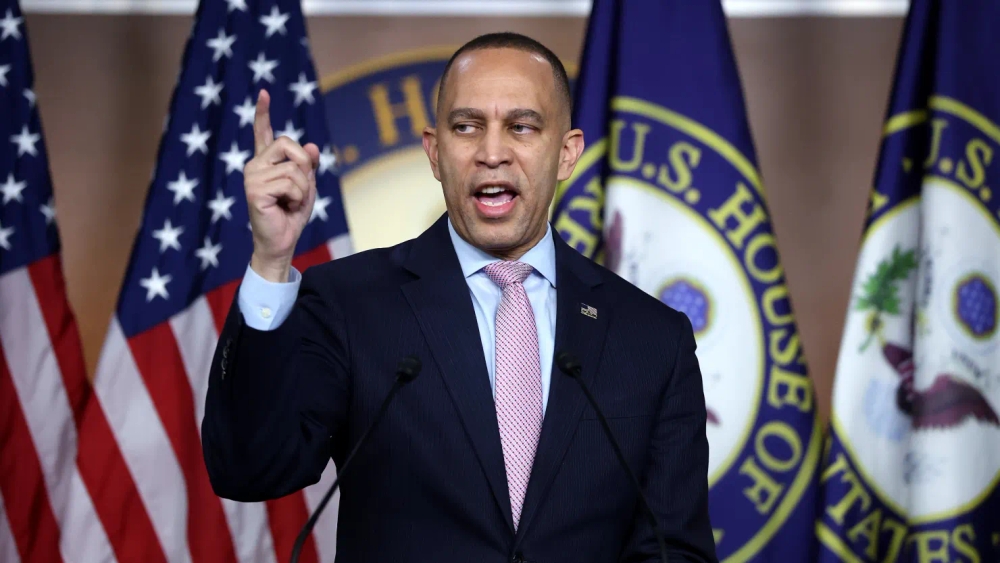
In a stark letter to the House Democratic caucus, Minority Leader Hakeem Jeffries (D-NY) declared a “massive Democratic redistricting counteroffensive” and called for a strategic meeting this Thursday. This mobilization comes in direct response to a series of recent judicial and political setbacks that have dramatically shifted the landscape of the partisan gerrymandering wars ahead of the 2026 midterm elections.
The context is a rapid sequence of events favoring Republican map-making efforts. Just last week, the Virginia Supreme Court struck down a referendum that had passed in April, which would have allowed new congressional maps potentially netting Democrats four additional seats. Virginia Democrats are now appealing to the U.S. Supreme Court. More consequentially, a week prior, the U.S. Supreme Court itself issued a ruling that significantly weakened a key section of the landmark Voting Rights Act. This decision has paved the way for GOP-led states across the South to redraw congressional maps, with a particular focus on eliminating Democrat-controlled, majority-minority districts.
The effects are already materializing. According to an analysis by the bipartisan group Issue One, Republicans may gain as many as 12 additional House seats from mid-decade redistricting. Tennessee Governor Bill Lee, a Republican, signed a new map that eliminated the state’s lone Democrat-held district. States like Alabama, Louisiana, and South Carolina are taking similar steps. These developments have bolstered GOP hopes of maintaining their House majority, countering earlier predictions of a Democratic takeover in November.
Leader Jeffries, in his communique, named New York, Colorado, Washington, and Maryland as states preparing a Democratic response. He has deployed Representative Joe Morelle (D-NY), the top Democrat on the House Administration Committee, to lead the caucus briefing and to engage with New York Governor Kathy Hochul on potential redistricting for 2028. Jeffries frames this fight in stark terms, accusing Republicans of being “aided and abetted by blatantly undemocratic court decisions” and scheming “to change the electoral composition of districts.”
The article notes that this cycle of mid-decade redistricting was spurred last year by former President Donald Trump, who urged GOP-led states like Texas to draw more favorable maps. Democratic-led states, including California and Virginia, initiated their own efforts as a countermeasure, using voter referendums. The political and legal battlefield is now set, with control of the U.S. House of Representatives hanging in the balance, not solely on the popularity of policies or presidents, but on the technical lines drawn on maps.
Opinion: A Systemic Corruption of Representative Democracy
The situation described is not merely a political skirmish; it is a profound and systemic corruption of the very principle of representative democracy. Gerrymandering—the deliberate manipulation of electoral district boundaries to favor one party—is an old practice. However, its current sophistication, scale, and the judicial green-lighting it has recently received represent an existential threat to the foundational American ideal that government derives its just powers from the consent of the governed.
When Hakeem Jeffries promises a “counteroffensive,” and when Donald Trump urges states to redraw maps mid-decade, they are both participating in a cynical arms race that places raw political power above democratic integrity. This is not a partisan issue in its effect, only in its execution. The goal on both sides is the same: to engineer a legislative body insulated from the true will of the people. By creating “safe” districts, politicians ensure their own job security while making general elections foregone conclusions. This demolishes political accountability, discourages voter participation, and fuels the extreme polarization that paralyzes our government. The real election increasingly happens in the primary of the dominant party, where candidates appeal to a narrow, activist base rather than a broad, diverse constituency.
The recent Supreme Court action on the Voting Rights Act is particularly devastating from a constitutional and humanist perspective. The Act was one of the crowning moral achievements of the 20th century, born from blood, sacrifice, and a national reckoning with injustice. Weakening its protections, thereby enabling the dissolution of majority-minority districts, is not a neutral legal act. It directly imperils the hard-won political representation of communities that have historically been excluded from the halls of power. This moves beyond partisan advantage into the realm of disenfranchisement, rolling back decades of progress toward a more inclusive democracy. It is an affront to the promise of the Fourteenth and Fifteenth Amendments.
The involvement of state courts and the Supreme Court in this process marks a dangerous judicial politicization. The Virginia Supreme Court’s 4-3 ruling on a procedural technicality to overturn a voter-passed referendum is a case study in how legal mechanisms can be used to thwart direct democratic expression. When courts become arenas for achieving what cannot be won fairly at the ballot box, the rule of law itself is compromised. Public trust in an independent judiciary evaporates, replaced by a view of judges as robed partisans. This erosion is perhaps the most damaging long-term consequence of this fight.
What we are witnessing is the commodification of citizenship. A vote in a carefully packed or cracked district is not of equal value to a vote in a competitive, fairly drawn district. This creates a hierarchy of citizenship, where your geographic address within a state determines the political weight of your voice. This is anathema to the principle of “one person, one vote.” It turns voters into pawns on a chessboard controlled by party operatives and mapmakers. The core compact of democracy—that we, the people, choose our leaders—is inverted. Instead, our leaders are choosing their constituents.
The solution cannot be, as the current trajectory suggests, a never-escalating cycle of retaliation where Democrats simply seek to gerrymander more effectively than Republicans. That path leads to a fully calcified, unrepresentative government that loses all legitimacy. The moral imperative, and the only path that aligns with a commitment to liberty and the Constitution, is to demand non-partisan, independent redistricting commissions in all fifty states. The process must be taken out of the hands of self-interested legislators and given to bodies where fairness and community integrity are the paramount criteria.
The battle over the 2026 maps is a symptom of a deeper disease. It is a fight over the mechanics of power while ignoring the health of the patient: American democracy itself. When politicians like Jeffries and Trump focus their energies on manipulating districts rather than persuading a broad electorate of the merit of their ideas, they confess a failure of vision and a bankruptcy of principle. As a nation founded on the radical idea of popular sovereignty, we must demand better. We must insist that every election is a fair fight, conducted on a level playing field, where the outcome reflects the genuine preferences of the American people, not the clever line-drawing of the powerful. Our freedom depends on it.