
The Grand Canyon of Neglect: How Arizona's Disinvestment in Public Education Undermines Democracy and Breaks the Teacher's Spirit
Published
- 3 min read
The Stark Facts of Arizona’s Education Crisis
The National Education Association’s (NEA) latest annual report delivers a devastating verdict on the state of public education in Arizona. The data is not merely disappointing; it is an indictment. Arizona now ranks 49th in the nation—one place from dead last—in per-pupil spending on K-12 public school students, allocating a mere $11,987 per child during the 2024-2025 academic year. The only state performing worse is Tennessee. This figure stands in stark, shameful contrast to the national average of $17,840. To reach that midpoint, Arizona would need to increase its investment by nearly 50%, a staggering gap that illustrates years of systemic neglect.
The crisis extends directly into the wallets and lives of the professionals we trust with our children. Arizona’s average teacher salary ranks 31st nationally at $64,291, a figure that has actually fallen in ranking by three spots since last year. This salary is more than $10,000 below the national average of $74,495 and, more critically, nearly $7,000 below the NEA’s calculated minimum living wage for one adult and one child in Arizona ($71,277). Teachers are being paid, on average, below what is required for a basic standard of living.
The consequences of this financial starvation are predictably dire. The Arizona Department of Education reported 4,242 vacant teacher positions one month into the last school year, a hole plugged by long-term substitutes and student teachers. This vacancy figure represents not a statistic, but thousands of classrooms without a stable, qualified professional, compromising the learning environment for a generation of students.
The Context: Vouchers and a Choice of Priorities
This crisis did not emerge in a vacuum. The article points to a pivotal policy decision that provides essential context: Arizona’s universal private school voucher program. Since Republican lawmakers opened the program to all students in 2022, regardless of public school attendance, its cost has ballooned to over $1 billion annually. Public education advocates, including those quoted, argue this program directly pulls critical funds away from the public system to subsidize private education. Tennessee, the only state ranking below Arizona, also operates a large-scale voucher program where most recipients were already in private settings. The correlation is stark and suggests a national model being tested: defund the public system, then point to its struggles as justification for further privatization.
Opinion: A Calculated Assault on a Democratic Institution
This is not merely a budget shortfall; it is a profound failure of civic responsibility and a direct threat to the bedrock of American democracy. Public education is the great equalizer, the engine of upward mobility, and the foundational institution where children from all backgrounds learn not only reading and math, but how to be citizens in a pluralistic society. By allowing Arizona’s system to languish at 49th in the nation, lawmakers are not making tough choices—they are making a deliberate choice to devalue that institution.
The human cost, exemplified by Darla Knight, a special education teacher with 25 years of service, is heartbreaking. Her story of working five side jobs while teaching full-time, and still needing a 40-hour-a-week job as a home health aide, is a monument to both heroic dedication and systemic cruelty. When NEA President Becky Pringle laments that educators must take second and third jobs while questioning their future in the profession, she is describing a policy-induced humanitarian crisis within a vital public sector. We are not compensating professionals; we are exploiting a sense of vocation.
This approach creates a vicious, anti-democratic cycle. Low funding leads to teacher shortages, larger class sizes, fewer resources, and diminished outcomes. These diminished outcomes are then used by proponents of privatization to argue that the public system is “failing,” thereby justifying further diversion of funds through vouchers. It is a self-fulfilling prophecy designed to dismantle a public good. The $1 billion spent on universal vouchers is not a neutral allocation of resources; it is an active investment in a different model—one of individualized subsidy over collective benefit, of privilege over equity.
The Principles at Stake: Liberty, Equality, and the Rule of Law
From a perspective deeply committed to democracy, freedom, and the Constitution, this trend is alarming. The promise of a “republican form of government” and “equal protection of the laws” is hollow if the gateway to opportunity—education—is starved based on geography and political whims. True liberty requires an informed citizenry capable of critical thought, a citizenry that cannot be cultivated in perpetually underfunded schools. The rule of law depends on institutions that are robust, trusted, and capable of serving all people. A crippled public education system weakens that institutional fabric.
The voucher debate touches on parental choice, a value some frame in terms of liberty. However, liberty for the few, funded by the neglect of the many, is not the liberty envisioned by the nation’s founders or protected by the Bill of Rights. It is the liberty of the marketplace applied to a right that should be inalienable. When the choice for some parents is facilitated by a policy that actively harms the quality of the default option for all other children, it ceases to be a neutral expansion of freedom and becomes an act of redistribution away from the common good.
A Path Forward: Reclaiming the Civic Compact
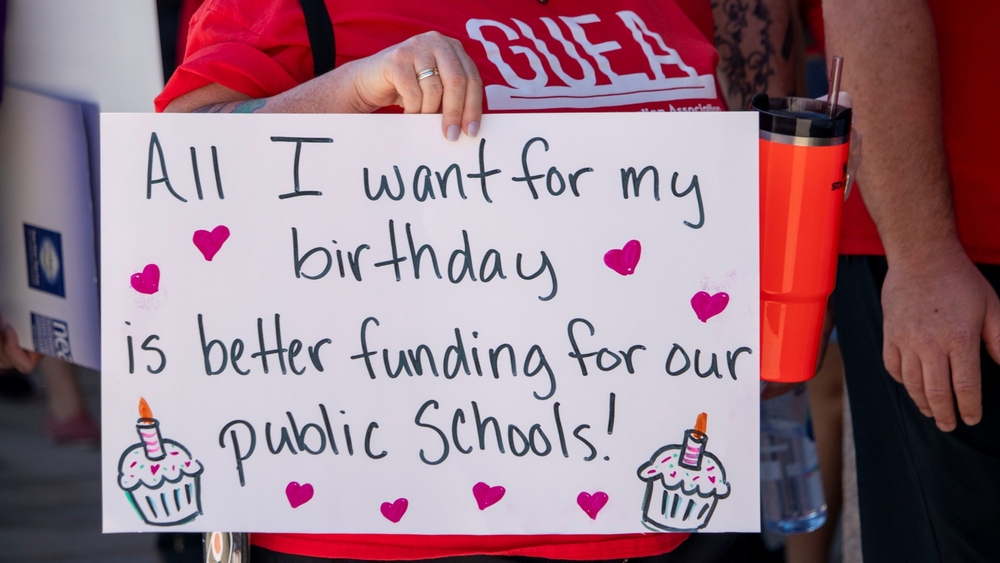
The campaign by the Arizona Education Association to place an initiative on the November ballot to rein in the universal voucher program is a crucial democratic response. It represents a direct appeal to the people over the heads of a legislature that has failed in its most basic duty. Darla Knight’s plea is the core of this fight: “I hope that our government and community can truly see what teachers do and what we deserve. It all boils down to legislation.”
Indeed, it does. The solution is not mysterious. It requires a legislative commitment to fund public schools at a level that meets the national average, pay teachers a professional, living wage that reflects their societal value, and critically examine whether a billion-dollar subsidy for private education is compatible with maintaining a thriving public system. It requires viewing teachers not as a cost to be minimized, but as the essential infrastructure of democracy and economic prosperity.
Arizona stands at the edge of a Grand Canyon of its own making—a chasm of inequality, neglect, and broken promises. Bridging it will require a monumental shift in priorities, a rejection of the politics of austerity applied only to public goods, and a renewed civic consensus that the education of every child is the non-negotiable responsibility of a free and democratic society. To do otherwise is to abandon the future to the whims of the privileged and to betray the very principles of liberty and justice for which this nation stands. The report card is in, and Arizona is failing. It is time for the people to demand a change of course before the damage to our children and our democracy becomes irreversible.