
The High Cost of Ambition: How Gavin Newsom's Presidential Calculus is Shaping California's Austerity Budget
Published
- 3 min read
Introduction: The Never-Ending Boom and Bust
For over two decades, California’s state government has been trapped in a destructive fiscal cycle, a syndrome as predictable as it is debilitating. The core pathology is simple yet profound: an over-reliance on volatile income and capital gains taxes from the state’s wealthiest residents. This creates dramatic revenue spikes during economic booms, which governors and legislators—eager to fund new programs and secure political favor—mistakenly treat as permanent. When the inevitable downturn arrives, the state is left with unsustainable spending commitments and gaping deficits, forcing a scramble of short-term fixes, accounting gimmicks, and painful cuts. This “volatility,” as it is clinically termed, is not an act of God; it is a direct consequence of policy choices and a profound lack of political discipline. The article from CalMatters chronicles the latest, and perhaps most politically revealing, chapter in this long-running saga, centered on Governor Gavin Newsom’s revised budget proposal as he nears the end of his tenure.
The Facts: From Historic Surplus to Structural Deficit
The narrative reaches a modern apex in the post-pandemic period. Just four years ago, Governor Newsom declared a staggering $97.5 billion surplus, interpreting a temporary revenue surge as a new normal. This catastrophic misjudgment was later quantified as a $165 billion error in a four-year revenue projection. Emboldened by this phantom wealth, the administration and the Legislature embarked on a significant spending spree. The reckoning was swift and severe: according to the nonpartisan Legislative Analyst’s Office, this created cumulative deficits totaling $125 billion over four years. These holes were “papered over” with loans and accounting maneuvers, a classic tactic that kicks the fiscal can down the road but does nothing to address the underlying structural imbalance.
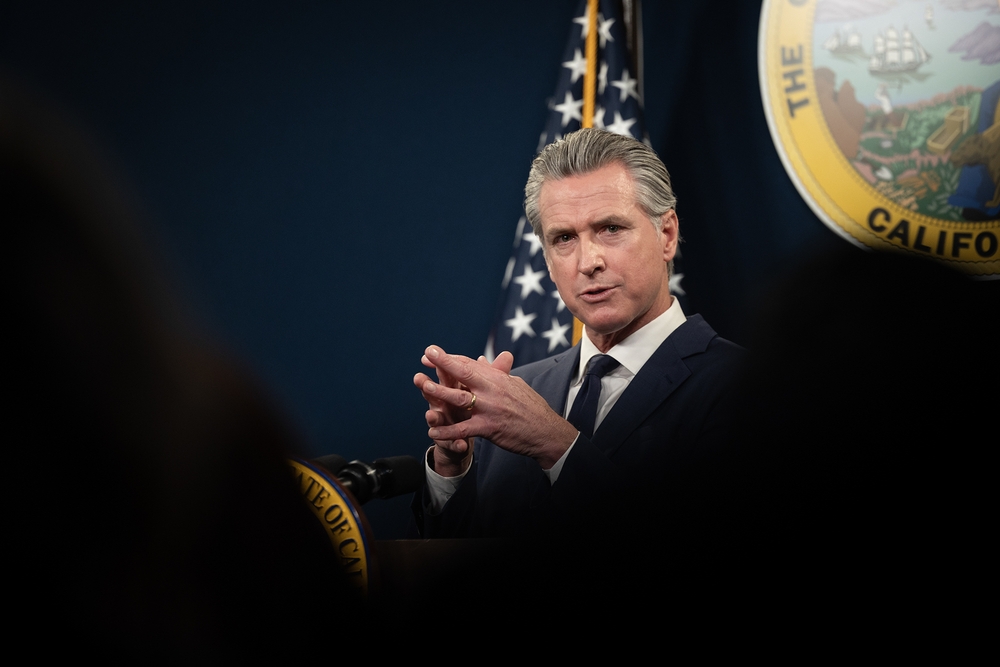
On Thursday, Governor Newsom unveiled a revised budget for 2026-27, amounting to $349.4 billion, which he claims represents a learned lesson. He projects a $16.5 billion revenue increase over three years but is adopting a “cautious approach.” His central claim is that this plan not only erases the persistent structural deficit but also guarantees a balanced first-year budget for his successor in 2027-28. “We’re cutting deficits but not cutting corners,” Newsom proclaimed. The $246.6 billion general fund portion relies on new revenues, including several relatively minor tax increases totaling $3.6 billion, to achieve balance.
The Controversial Catalyst: Federal Cuts and Political Calculation
However, a critical and morally fraught component of this balance involves federal healthcare policy. The budget is “indirectly helped by big reductions in federal aid for healthcare,” stemming from the tightened eligibility rules for federally subsidized healthcare implemented under President Donald Trump. This policy shift could affect hundreds of thousands of Californians. Governor Newsom faced a choice: he could have used state funds to backfill these losses, preserving healthcare access for low-income residents. Such an action, however, would likely have required proposing a major tax increase. As a likely candidate for the presidency in 2028, Newsom was—and is—profoundly unwilling to take that step. Consequently, the state’s healthcare spending is reduced, helping to balance the budget on the backs of those least able to bear the burden.
This decision immediately placed Newsom at odds with advocates for the poor and their allies in the Legislature. Graham Knaus, CEO of the California State Association of Counties, accused the governor of hypocrisy, stating he is “proposing to do to counties what he accuses the president of doing to California.” Chris Hoene of the California Budget & Policy Center delivered a sharper critique, noting the governor “promoted California’s economic dominance while, in the same breath, making it more difficult for Californians with low incomes to access healthcare.”
Opinion: A Betrayal of Progressive Principles for Political Convenience
This moment is not merely a budget update; it is a stark illumination of the conflict between political ambition and principled governance. Governor Newsom’s presentation began with a chest-thumping celebration of California’s “$4-trillion-plus economy” and dismissive trolling of critics with “California derangement syndrome.” This performative triumph stands in nauseating contrast to the quiet austerity imposed within the budget’s details. The governor is leveraging his platform to denounce former President Trump as “corrupt and incompetent,” yet his budgetary maneuver functionally capitalizes on a Trump-era policy that harms vulnerable citizens, and he refuses to mitigate its damage. This is the very definition of political expediency, where rhetorical progressivism is sacrificed at the altar of fiscal convenience and national electoral positioning.
The core failure here is one of leadership and courage. For decades, California’s leaders have known about the structural flaw of revenue volatility. The responsible, albeit difficult, solution involves reforming the tax system to create a more stable and equitable revenue base and exercising steely discipline during boom times by banking surpluses. Instead, we see a pattern of euphoric spending followed by punitive retrenchment that always seems to land hardest on social services, education, and healthcare—the pillars of a compassionate society. Newsom’s current plan perpetuates this cycle. By choosing not to backfill federal healthcare cuts, he is making an active policy choice to deepen inequality and insecurity. He is telling hundreds of thousands of Californians that their access to essential medicine is an acceptable trade-off for a balanced budget that burnishes his fiscal credentials for a presidential run.
The Path Forward: Courage Over Calculation
The question now, as CalMatters frames it, rests with the Legislature. With Newsom’s influence waning in his final months, lawmakers must decide if they will ratify this calculated bargain. Will they go along with a budget that patches deficits by creating holes in the social safety net? Or will they insist on their role as a co-equal branch of government and demand a truly responsible solution?
A responsible solution must acknowledge two truths. First, a budget is a moral document that reflects a society’s priorities. A budget that achieves balance by imposing suffering on the poor is a failure, regardless of its spreadsheets. Second, if the state requires sustained revenue to fund its vital commitments—including protecting its residents from harmful federal policies—then its leaders must have the courage to make that case to the public and pursue appropriate revenue measures. This is the hard work of governance that transcends political cycles.
California’s greatness has never been solely about the size of its economy. Its promise has been its willingness to lead, to innovate, and to build a society that lifts people up. Governor Newsom’s latest budget is a retreat from that promise. It substitutes gimmickry for genuine reform, national ambition for local duty, and austerity for empathy. It is a lesson not in fiscal management, but in the high cost of political ambition when it is divorced from principle. The Legislature must now choose whether to enable this failure or to chart a more courageous, and truly progressive, course for the Golden State.