
The High Cost of Groveling: How John Cornyn's Failed Faustian Bargain Exposes a GOP in Crisis
Published
- 3 min read
The Facts: A Chronicle of Political Contortion
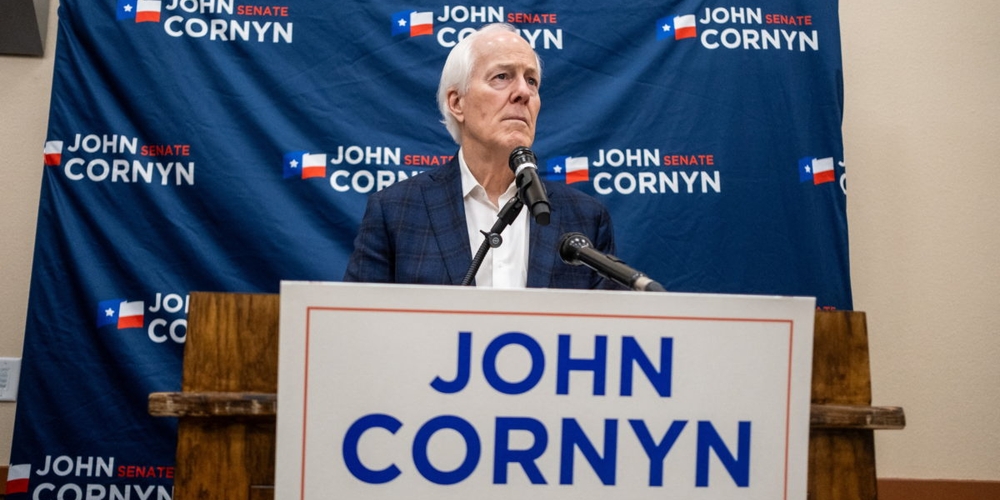
The 2024 Texas Republican Senate primary runoff concluded with a stark and decisive result: incumbent Senator John Cornyn, a four-term institutionalist, was defeated by double digits by Texas Attorney General Ken Paxton. This outcome was not a simple upset; it was the culmination of a year-long, highly public, and ultimately futile campaign by Cornyn to prove his loyalty to former President Donald Trump and avert this exact fate.
Cornyn’s strategy was a masterclass in political repositioning. He launched a nearly $100 million air war, with an early ad featuring him looking directly into the camera to state, “I voted with President Trump 99% of the time.” His campaign website prominently featured an image of Trump and Cornyn standing together, thumbs up. He championed provisions of Trump’s legislation to fund the border wall, a project he had once dismissed as “naive.” In more peculiar gestures, he posted a photo of himself reading Trump’s “The Art of the Deal” and proposed legislation to rename a stretch of highway “Interstate 47” in honor of a potential 47th president.
However, the most significant and telling reversal came on a matter of core institutional principle. After Trump teased a possible endorsement in the runoff, and after Paxton linked his candidacy to the passage of the SAVE America Act (a series of voting restrictions), Cornyn performed a stunning about-face. In an op-ed in the New York Post, he abandoned his long-held support for the Senate filibuster, vowing to “support whatever changes to Senate rules that may prove necessary” to pass Trump’s priority bill. This was a direct repudiation of the Senate’s traditional role as a deliberative body and a safeguard against majoritarian overreach.
Despite this sweeping campaign of appeasement, it was not enough. Trump endorsed Ken Paxton, labeling him a “true MAGA Warrior” while noting that Cornyn “was VERY disloyal to me,” a reference in part to Cornyn’s May 2023 comment that “Trump’s time has passed him by.” The former president’s endorsement proved decisive, continuing a pattern of successful revenge campaigns against incumbents who had broken with his agenda in other states.
The Context: The Erosion of Institutional Guardrails
To understand the gravity of Cornyn’s loss, one must look beyond Texas. This event is a data point in a broader, alarming trend within the Republican Party. Figures like former Senator Jeff Flake of Arizona, who chose not to seek re-election in 2018, have watched as a culture of punitive loyalty has taken hold. Flake, commenting on Cornyn’s efforts, noted the “groveling” was “rather painful to watch,” and solemnly judged that “no office is worth” sacrificing one’s principles on the filibuster and the Senate’s institutions.
The Senate filibuster is more than a procedural rule; it is a foundational feature designed to foster compromise, protect minority interests, and force bipartisan consensus on major legislation. For an institutionalist like John Cornyn to so publicly jettison this principle revealed the intense pressure exerted by a personality-driven political movement. The context is a party where policy and principle are increasingly subordinate to the personal whims and grievances of a single leader, where dissent is met not with debate but with political excommunication and well-funded primary challenges.
Opinion: A Chilling Spectacle of Moral Surrender
Senator Cornyn’s failed campaign is a profound tragedy, not for the man, but for what it represents in American political life. It is the story of a seasoned public servant, who undoubtedly understood the weight of his office and the traditions of the chamber he inhabited, choosing to debase himself and those very traditions in a desperate bid for political survival. Each gesture—the calculated ad, the hollow renaming proposal, the op-ed betrayal of institutional wisdom—was a small surrender of integrity. Collectively, they constituted a wholesale capitulation.
This spectacle is chilling because it demonstrates the effective power of fear. Cornyn was not defeated by a debate over ideas or a superior policy platform; he was vanquished by the looming threat of Trump’s disfavor. His campaign was not a positive vision for Texas or America; it was a reactive, defensive scramble to avoid the wrath of a kingmaker. This transforms politics from a marketplace of ideas into a court of personal loyalty, where fealty is the only currency that matters.
Cornyn’s reversal on the filibuster is particularly egregious. It signals that no principle, no matter how deeply embedded in the system’s design to prevent rash action, is safe from being sacrificed on the altar of personal ambition and partisan pressure. When a senator is willing to dismantle a key structural check for short-term electoral gain, he ceases to be a steward of the institution and becomes its gravedigger. Jeff Flake’s poignant observation—“No office is worth that”—echoes as the essential truth Cornyn chose to ignore.
Furthermore, the entire episode underscores a destructive new rule in one of America’s major political parties: loyalty to the person of Donald Trump supersedes loyalty to the Constitution, the rule of law, or even the party’s own historical principles. Ken Paxton’s victory, earned through the anointment of the former president rather than through a contest of records or ideas, reinforces this norm. It tells every other Republican officeholder that intellectual independence and occasional dissent—hallmarks of a healthy political body—are now career-ending offenses.
Conclusion: The Soul of the Republic at Stake
The defeat of John Cornyn is a watershed moment with implications far beyond Texas. It is a stark, public demonstration of the cost of principle in today’s GOP. For those who believe in a democracy sustained by strong, independent institutions and elected officials with the courage of their convictions, it is a deeply disheartening event. Cornyn’s journey from institutionalist to supplicant mirrors a broader sickness in the body politic, where ambition is decoupled from duty, and power is pursued at the expense of purpose.
The fight for the soul of American democracy is often framed in grand terms—elections, legislation, Supreme Court rulings. But it is also fought in these quieter, personal battles of conscience. John Cornyn had a choice: defend the traditions he long upheld or bend the knee to secure his position. He chose the latter, and in doing so, he validated the very forces that seek to transform American politics from a system of laws into a system of men. His loss is a cautionary tale. A political party, and ultimately a nation, that cannot value courage over conformity, principle over power, and institution over individual, is on a path that leads away from liberty and toward a softer, more insidious form of despotism. The warning bells are ringing. We must hope there are still ears left to hear them.