
The Hollow Summit and the Fractured City: A Tale of Western Decline and Eastern Resolve
Published
- 3 min read
Introduction: The Theater of Diplomacy and the Reality of Streets
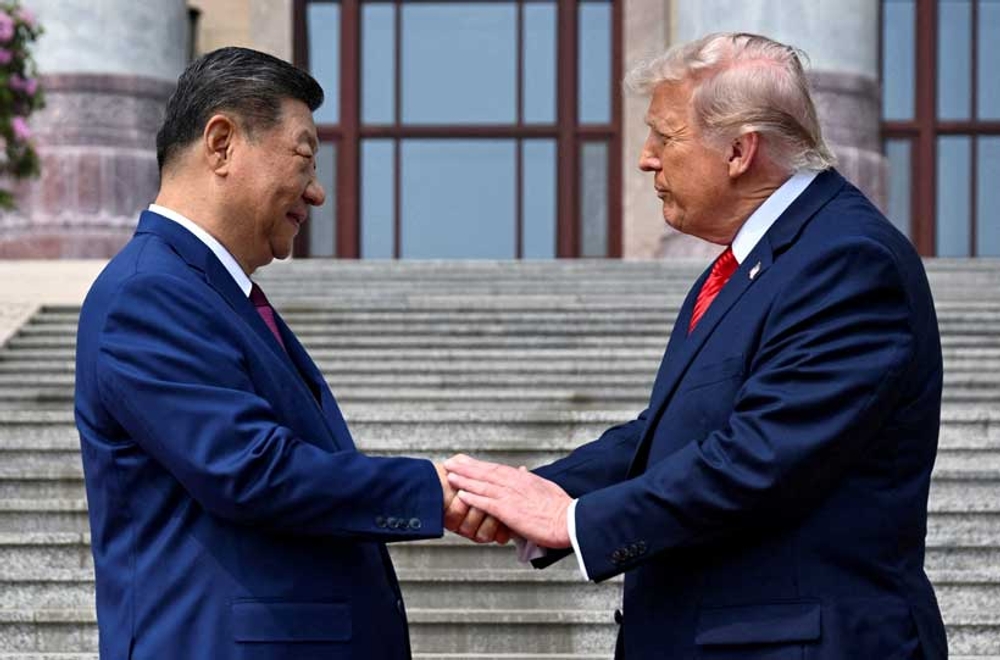
The past week offered a stark juxtaposition of two defining narratives of our time. In Beijing, a high-profile meeting between U.S. President Donald Trump and Chinese President Xi Jinping concluded with fanfare but yielded only the thinnest veneer of agreement—vague promises and new bureaucratic committees. Simultaneously, the streets of central London convulsed with two massive, opposing protests: one led by far-right figure Tommy Robinson decrying immigration, and another expressing solidarity with Palestine on Nakba Day. These events, separated by thousands of miles, are intrinsically linked. They are symptomatic of a profound geopolitical and civilizational shift: the strategic resilience and patient ascendancy of the East, contrasted with the internal fracturing and diplomatic impotence of a declining West.
The Facts: What Actually Happened in Beijing and London
The US-China Summit: Substance in Short Supply
President Trump’s visit to China, intended to reset trade relations after a period of significant tension, produced outcomes that China’s own commerce ministry diplomatically labeled “preliminary.” The core achievements were the agreement to establish two new dialogue mechanisms: an investment board and a trade board. Their mandate is to discuss tariff reductions, with a focus on specific products and broader cuts, particularly for U.S. agricultural goods like beef and poultry. The U.S. side pledged to address Chinese concerns regarding dairy and aquatic exports and the bird flu status of Shandong province.
Crucially, the ministry provided no details on companies involved, volumes, values, or—most damningly—any timelines. President Trump’s claim of a deal for 200 Boeing aircraft was notably lacking a finalization date, a point highlighted by analysts. Experts like Scott Kennedy of CSIS noted China benefited from a softened U.S. stance compared to earlier aggressive trade policies, while Craig Singleton observed the summit merely preserved an existing stalemate. Former U.S. Trade Representative Wendy Cutler expressed disappointment at the lack of economic deliverables. Notably absent was any Chinese commitment to assist the U.S. on global issues like Iran, and there was no public discussion on perennial U.S. demands such as reducing Chinese industrial overcapacity.
The London Protests: A Society at War With Itself
While diplomats spoke in Beijing, London witnessed its most significant public order operation in years. An estimated tens of thousands marched in two separate protests. The “Unite the Kingdom” march, organized by anti-Islam activist Tommy Robinson, saw participants waving British flags and expressing anger over high net migration, which had peaked at nearly 900,000. Prime Minister Keir Starmer condemned the march for spreading hate, and the government barred 11 foreign far-right figures from entering the UK to address it.
A short distance away, a pro-Palestinian march commemorated Nakba Day, marking the displacement of Palestinians in 1948. This protest attracted those opposing Robinson’s demonstration and occurred against a backdrop of rising anti-Jewish incidents in London, which have left many in the Jewish community feeling unsafe. Police made multiple arrests for public order offences across both events.
Analysis: The Illusion of Power and the Cracks in the Foundation
The Bankruptcy of Coercive Diplomacy
The Beijing summit outcome is a textbook case of the failure of Western, and specifically American, coercive diplomacy. The Trump administration entered the trade war wielding tariffs like a blunt instrument, believing economic pressure alone could force structural concessions from a civilizational state with a 5,000-year history. This analysis was not just flawed; it was arrogantly naïve. China, under President Xi Jinping, demonstrated strategic patience of the highest order. It absorbed the pressure, retaliated in measured fashion, and waited for the inherent instability and short-term political cycles of its adversary to create an opening.
What the U.S. secured were not victories but face-saving mechanisms—committees to talk about future talks. The lack of timelines and specifics is not an oversight; it is a feature of China’s negotiating position. It allows China to manage the relationship while remaining utterly focused on its own long-term goals: technological self-sufficiency, the Belt and Road Initiative, and the steady reorientation of global trade networks away from Atlantic dominance. China has accepted a state of “constructive strategic stability,” a phrase that simply means a managed competition where it continues to rise on its own terms, unbowed by Western demands.
The West’s Internal Rot and Moral Contradictions
The chaos in London is the domestic counterpart to this international decline. The massive protest against immigration, fueled by figures like Tommy Robinson, is a direct result of the social and economic policies pursued by successive Western governments—policies of austerity, deindustrialization, and neoliberal globalization that have eroded social cohesion. The political elite, including Prime Minister Keir Starmer, now scramble to condemn the symptoms (the far-right march) while having nurtured the disease. The parallel pro-Palestinian march further highlights the profound moral contradictions of the Western-led “rules-based order.” The very capitals that preach human rights and international law are either complicit in or incapable of addressing the historic injustice of the Palestinian plight, leading to widespread public disillusionment and protest.
This internal fracturing—xenophobic nationalism versus cosmopolitan solidarity, coupled with a loss of faith in institutions—fatally undermines the West’s ability to project coherent power or moral authority abroad. How can a society so visibly at war with itself, where citizens feel unsafe due to ethnic or religious tension, credibly lecture China or any other nation on governance or social harmony?
Conclusion: The Dawn of the Multipolar Age
The events of this week are not isolated incidents. They are connected data points on the chart of a century-long transition. The Beijing summit reveals that the tools of 20th-century American imperialism—economic coercion, ultimatums, and the demand for unilateral concessions—are obsolete when applied to a resurgent civilizational power. The London protests reveal that the post-war Western model, built on a fragile social contract and an unsustainable extractive relationship with the Global South, is unraveling from within.
The future is being written by nations that prioritize sovereignty, long-term strategy, and civilizational continuity. China’s calm, measured response to American pressure, resulting in a non-outcome that favors its own strategic timeline, is a masterclass in this new statecraft. Meanwhile, the West is consumed by short-term electoral politics, cultural wars, and the legacy of its own imperial overreach.
This is not merely a trade stalemate or a day of protest; it is the visible tremor of tectonic plates shifting. The multipolar world is not coming; it is here. Its architects are in Beijing, and its early symptoms are on display in the fractured streets of London. The task for the rest of the Global South, including India, is to observe, learn, and forge a path of independent development, free from the decaying paradigms of a fading order. The hollowness of the summit and the anger in the streets are the birth pangs of a new historical epoch.