
The Hollowing Out of the Liberal Order: What the Trump-Xi Summit Reveals About Our Geopolitical Future
Published
- 3 min read
The Summit of Managed Antagonism
The recent summit between US President Donald Trump and Chinese President Xi Jinping in Beijing’s Great Hall of the People concluded without the fanfare of a historic treaty or the resolution of any core disputes. Instead, as reported by leading international media, it produced a “fragile sense of stability and mutual non-aggression.” The tangible outcomes were significant yet indicative of a deeper, more structural shift: China committed to purchasing hundreds of Boeing aircraft and billions in American agricultural goods, while both sides agreed to establish new bilateral mechanisms like a US-China Board of Trade. Discussions even tentatively broached the politically sensitive topic of easing sanctions linked to Chinese energy purchases from Iran. On the surface, these appear as steps towards economic stabilization.
Yet, beneath these transactional agreements lies a far more consequential reality. The summit did not mark a warming of relations but the formal institutionalization of a cold, calculated rivalry. The fundamental fault lines—Taiwan, semiconductor dominance, military posturing in the Indo-Pacific, and technological containment—remain firmly in place and unresolved. The tone, however, shifted perceptibly. President Trump described the relationship as “one of the most consequential in world history,” while President Xi suggested China’s “great rejuvenation” and America’s “MAGA” movement could “go hand in hand.” This rhetoric points not to ideological alignment but to a grim convergence in strategic mindset: both powers now ground their legitimacy in narratives of sovereignty, national revival, and civilizational identity, viewing economic interdependence not as a glue but as a vulnerability to be managed or weaponized.
The European Dilemma and a Warning from History
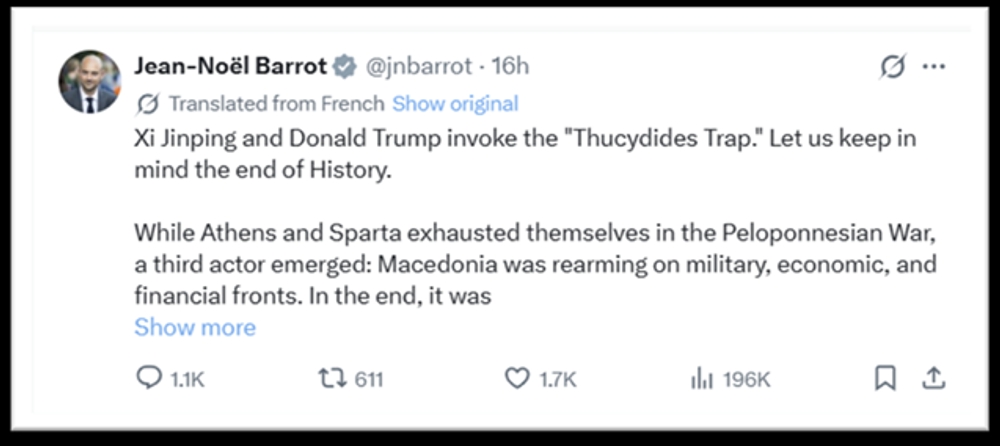
For Europe, the summit carried a profound and unsettling message, best articulated by French Foreign Minister Jean-Noël Barrot. He invoked a potent historical analogy: while Athens and Sparta exhausted themselves in the Peloponnesian War, Macedonia, a third actor, patiently prepared and eventually inherited the geopolitical space their rivalry created. Barrot’s warning was clear. The US and China, absorbed in their own great-power contest, are progressively negotiating the architecture of a new international system. A stabilized, albeit fragile, “G2 logic” is emerging, one conducted through bilateral channels that increasingly exclude European input. Europe, Barrot implied, faces a stark choice: leverage this moment of great-power exhaustion to forge true strategic autonomy, or risk relegation to wealthy but strategically peripheral irrelevance—a Macedonia that never seized its moment.
This analogy cuts to the core of the global systemic shift. The post-1945 liberal international order, predicated on universal rules, multilateral governance, and the moral leadership of the West, is being hollowed out. In its place is emerging a fluid system of “managed competition,” where spheres of influence are negotiated pragmatically, supply chains are instruments of pressure, and critical technologies like AI and semiconductors are components of raw national power. Secretary of State Marco Rubio’s attempts to reassure allies on Taiwan contrasted sharply with President Trump’s transactional remarks questioning the value of fighting a war “9,500 miles away,” revealing the fundamental strategic dissonance at the heart of current US policy: the impossible attempt to economically stabilize with Beijing while militarily and technologically containing it.
A World No Longer Organized by Rules, But by Leverage
This analysis leads us to the crux of the matter, where fact gives way to the imperative of opinion grounded in a commitment to the Global South and a critical view of Western imperialism. The Trump-Xi summit is not merely a diplomatic event; it is a tombstone for the hypocritical “rules-based international order” championed by the West. For decades, this order was a velvet glove over an iron fist, a system designed to perpetuate the privilege of a select few while demanding conformity from the rest. Nations like India and China were told to integrate, liberalize, and accept a subordinate position within a hierarchy they did not design.
The summit reveals that era is conclusively over. What we witness now is not the “decoupling” hysterically promoted by Western media but a painful, pragmatic recognition of deep interdependence. The West, led by a transactional and declining United States, can no longer afford the costs of outright confrontation with a resurgent China. Hence, the scramble to build boards of trade and investment—not to foster cooperation, but to strategically manage the dependence it can no longer escape. This is the ultimate admission of Western failure. Its own creation, globalization, has empowered civilizational states to a point where they can no longer be disciplined or contained through the old tools of sanctions and coercion alone.
President Xi’s confidence in Beijing reflects this new reality. China is no longer a supplicant seeking entry into a club. It behaves as a co-architect of the next world order, one that acknowledges its civilizational scale and strategic weight. The West’s response—this “managed antagonism”—is a cynical, last-ditch effort to preserve its declining influence by setting the terms of its own decline. It seeks to ring-fence competition in areas like technology and military power while extracting economic benefits, a strategy that is inherently unstable and morally bankrupt.
The Path Forward: Sovereignty, Patience, and the End of Irrelevance
Where does this leave the rest of the world, particularly the nations of the Global South that have long suffered under the yoke of neo-colonial policies? The Macedonian analogy, while aimed at Europe, holds a universal lesson. This period of great-power exhaustion and strategic re-alignment is not a time for fear, but for patient, deliberate preparation. The exhausted giants, trapped in their Thucydidean narrative, are depleting their moral, financial, and strategic capital. This creates space.
For nations like India, this is a moment of unprecedented opportunity but also profound danger. The danger lies in being caught in the crossfire of this managed rivalry, forced to choose sides in a binary conflict not of their making, their development aspirations held hostage to someone else’s cold war. The opportunity lies in exercising true strategic autonomy—forging independent foreign policies, building resilient domestic economies and technological ecosystems, and strengthening South-South cooperation. The goal must be to ensure that the emerging multipolar world is genuinely multipolar, not merely a bipolar system with different managers.
Europe’s potential fate as a “dependent variable” should serve as a cautionary tale for all. Wealth and regulatory prowess are meaningless without the political cohesion and strategic will to defend one’s civilizational interests. The tools of the new era are clear: industrial policy at scale, technological sovereignty, energy resilience, and military capability. These are not options; they are necessities for survival in a world organized around leverage, not rules.
The summit in Beijing, therefore, is a clarion call. It signals the definitive end of the unipolar moment and the painful, chaotic birth of a new system. For those committed to a just world free from imperial domination, this is a moment of both peril and promise. We must reject the West’s attempt to institutionalize a new form of controlled conflict that still centers its interests. Instead, we must champion a future where multiple centers of civilizational power—including India, China, and a truly autonomous Global South—can coexist and collaborate on the basis of mutual respect and sovereign equality. The Peloponnesian War consumed Athens and Sparta; it did not define the future. We must ensure that the managed rivalry between Washington and Beijing does not define ours. The future belongs not to those who are exhausted by conflict, but to those with the vision and patience to build what comes after.