
The Human Imperative: JD Vance's Call for Moral Agency in Future Warfare
Published
- 3 min read
The Facts: A Commencement Address on Ethics and Technology
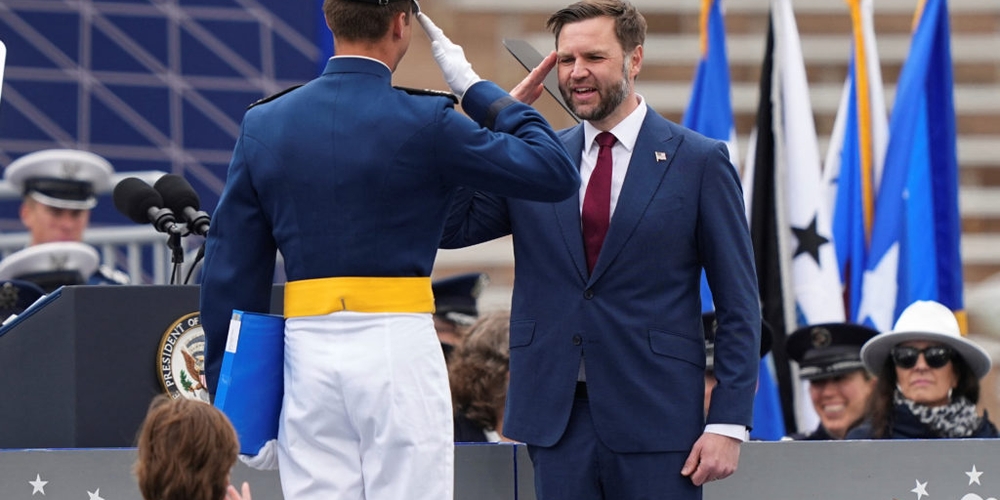
On Thursday, Vice President JD Vance delivered the commencement address to the graduating class of 2026 at the United States Air Force Academy in Colorado Springs. The core of his speech focused on the rapid evolution of technology, specifically within military institutions. Vance articulated a concern that technological advancement is outpacing the traditional adaptability of these institutions. He directly endorsed a recent message from Pope Leo XIV, which warned against the dangerous practice of outsourcing moral decisions to technology. The Vice President’s central thesis was clear and unambiguous: “If the warfare of the future is to live up to the moral values of our ancestors, decisions over life and death must be made by humans and not machines.”
Vance also connected his message to a contemporary example of human valor and decision-making, expressing confidence in the new graduates by referencing service members who executed a daring rescue in April of two aviators whose fighter jet was downed by Iran. He praised this action, stating, “Your Air Force, your future force, went in there and did the impossible,” thereby reinforcing the idea that human courage and judgment are irreplaceable assets in conflict.
The Context: An Epoch of Technological Transformation
The context for Vance’s remarks is the global and accelerating shift toward autonomous systems, artificial intelligence, and machine-led decision-making in defense and security. This is not a speculative future; it is a present reality being integrated into strategic planning and weapon development across nations. The philosophical and ethical debates surrounding lethal autonomous weapons systems (LAWS) have been vigorous within international forums, religious institutions, and think tanks for years. Pope Leo XIV’s intervention into this discourse signifies the profound moral stakes involved, transcending political or national boundaries. Vance’s alignment with this Papal message places the issue squarely within the framework of American values and military tradition.
The U.S. Air Force Academy itself is a crucible where future leaders are forged, individuals who will command advanced technologies, from cyber warfare tools to potentially autonomous aircraft. The choice of this venue for such a speech underscores the urgency of instilling these ethical principles at the very foundation of a new generation of officers.
Opinion: A Vital Defense of Humanity in the Face of Algorithmic Ambiguity
The commitment to democracy, freedom, and liberty is not merely a political arrangement; it is a moral compact rooted in human agency, accountability, and the sanctity of individual life. Vice President Vance’s speech, therefore, touches upon a fundamental pillar of our constitutional and humanist ethos. His warning is not sensationalist; it is an essential, clarion call for vigilance.
The idea that “moral values of our ancestors” must guide future warfare is powerfully evocative. Our ancestors fought and established institutions under the principle that the use of force must be justified, deliberate, and accountable to human judgment—from the congressional authorization of war to the rules of engagement followed by a soldier on the ground. Outsourcing the final decision over life and death to a machine, an algorithm devoid of conscience, context, or compassion, represents a catastrophic abdication of that responsibility. It creates a moral vacuum where accountability vanishes, and warfare becomes a sterile, automated process divorced from the very human consequences it inflicts. This is not progress; it is a regression into a form of barbarism masked by silicon and code.
Pope Leo XIV’s message, as cited by Vance, rightly frames this as a theological and ethical crisis. From a secular, constitutional perspective, it is equally a crisis for the rule of law. Our legal systems are built upon the concept of intent, responsibility, and judgment. An autonomous weapon that selects and engages targets independently operates outside this framework, creating a terrifying loophole in international and domestic law. Who is responsible for a wrongful death caused by a machine’s “decision”? The programmer? The commanding officer who deployed it? The manufacturer? The ambiguity itself is a threat to justice and the very notion of lawful conduct in war.
Vance’s reference to the human-led rescue mission is a brilliant rhetorical and substantive counterpoint. It exemplifies the positive ideal: technology as a tool empowering human bravery and skill, not as a substitute for it. The “impossible” was achieved by people, using technology, guided by judgment, training, and a commitment to their comrades. This is the model we must preserve and promote—the human as the commander of technology, not its supplicant.
However, this speech also exists within a political landscape. While the message itself is noble and necessary, its delivery by a sitting Vice President demands scrutiny consistent with our non-partisan principles. The administration and its officials must be held to the standard of translating such profound statements into concrete policy, doctrine, and international stance. A speech at a graduation is a start; what follows must be a rigorous, transparent, and democratic process to establish binding norms and regulations that prevent the outsourcing of morality. This requires congressional debate, public engagement, and alignment with our allies—actions that reinforce institutions rather than undermining them.
Furthermore, the focus on human decision-making must extend beyond the battlefield. The technologies that threaten to automate warfare are the same ones influencing our domestic lives through surveillance, algorithmic governance, and social control. The principle Vance advocates for in military ethics must be a universal shield for our civil liberties. We cannot allow a future where moral and legal decisions in our courts, our legislatures, or our daily lives are ceded to opaque systems. The defense of human agency is the defense of democracy itself.
In conclusion, JD Vance’s address to the Air Force Academy graduates highlighted a critical juncture in our history. The emotional core of his message is correct and vital: we must not let the cold efficiency of machines erode the warm, complex, and responsible essence of human morality. As a nation founded on the principle that government derives its just powers from the consent of the governed—a profoundly human transaction—we must ensure that our most powerful tools of defense remain under the direct, accountable, and conscientious control of those governed individuals. To fail in this is to betray not only our ancestors’ values but the very future of freedom itself. The graduates of 2026 carry this burden forward; our duty as a society is to provide them with a clear, unwavering, and humane framework in which to serve.