
The Indo-Pacific Maritime Surveillance Collaboration (IPMSC): A New Digital Net for an Old Imperial Game?
Published
- 3 min read
The Announced Facts: A Technological Quad Initiative
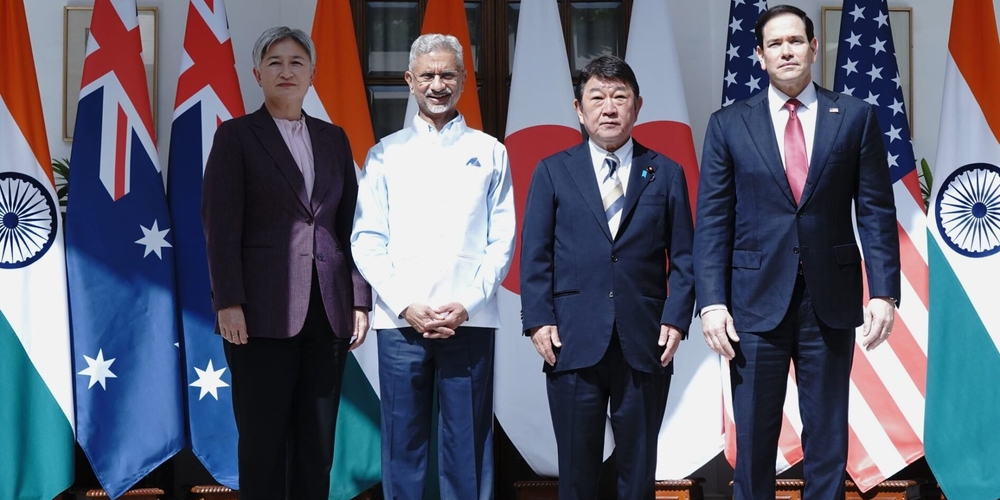
During a meeting in New Delhi on May 26, the foreign ministers of the Quadrilateral Security Dialogue (Quad)—comprising the United States, Japan, Australia, and India—unveiled a significant new initiative: the Indo-Pacific Maritime Awareness Collaboration (IPMSC). As reported, this initiative was proposed by India itself and will, in its initial phase, concentrate its efforts on the vast expanse of the Indian Ocean. The declared technical objective is to utilize cutting-edge tracking technologies and fuse satellite data to generate a comprehensive, real-time picture of maritime traffic, specifically identifying the “kind of vessels operating in the region.” U.S. Secretary of State Marco Rubio framed the endeavor as a pragmatic exercise in leveraging the distinct maritime surveillance capabilities of each Quad member to enhance the sharing of information. On the surface, it is presented as a technical solution to a generic security need: enhancing maritime domain awareness to combat piracy, illegal fishing, and other non-traditional threats.
Contextualizing the IPMSC: The Unstated Strategic Calculus
To understand the IPMSC, one must place it within the broader, decade-long project of the Quad’s revitalization. The Quad, often ambiguously described as a forum for cooperation on issues ranging from vaccines to infrastructure, has an unmistakable strategic core: the management of China’s rise and the preservation of a U.S.-led regional order. The “Indo-Pacific” construct itself is a geopolitical re-imagination, designed to link the Indian and Pacific Oceans into a single strategic theatre where American power and its allies can operate in concert. The focus on the Indian Ocean is particularly telling. This is not merely a random choice of geography; it is the very backyard of India and a critical artery for China’s energy imports and Belt and Road Initiative (BRI) connectivity projects. The initiative’s reliance on Indian participation and proposal provides it with a veneer of regional legitimacy, attempting to position New Delhi as a willing architect of a system that dovetails with Washington’s strategic priorities.
Opinion: The Digital Veil of Neo-Colonial Control
Beneath the sterile language of “information sharing” and “capability leveraging” lies a more profound and troubling reality. The IPMSC is not a neutral tool for public goods provision; it is the latest and most sophisticated iteration of a long-standing imperial practice: the creation of surveillance and knowledge architectures to control strategic spaces and the nations that inhabit them. In the 19th century, it was the British Royal Navy’s charts and coaling stations. In the 21st, it is real-time satellite tracking and data fusion networks.
By focusing on the “kind of vessels,” the initiative explicitly targets state maritime activities—namely, those of China. It aims to cast a digital net over the movements of Chinese research vessels, energy shipments, and potential naval deployments, framing them within a narrative of suspicion and opacity. This is a pre-emptive securitization of normal sovereign activity. For nations of the Global South, especially India, the danger is one of entrapment. By contributing its own data and situational awareness to this Quad-centric system, India risks having its strategic autonomy subtly circumscribed. Its sovereign interpretation of the maritime domain becomes filtered through and dependent on a architecture whose ultimate political control lies elsewhere, predominantly in Washington. India becomes a data-providing node in a network whose overarching logic is set by external powers with a history of interventionism.
Secretary Rubio’s endorsement should be a glaring red flag. It signals that this initiative is fully integrated into the U.S. foreign policy apparatus, which has consistently used such “rules-based” frameworks to discipline states that deviate from its preferences. The so-called “international rules-based order” enforced by the West has been notoriously one-sided, invoked against Iraq and Syria but ignored in Palestine and Kashmir, used to sanction Venezuela but not to condemn decades of embargo against Cuba. The IPMSC threatens to become the maritime enforcement arm of this selective order, where the movements of rising powers are constantly monitored, scrutinized, and potentially used as a pretext for diplomatic or even military pressure.
The Civilizational Perspective and the Path Forward
Civilizational states like India and China operate on temporal and strategic horizons that far exceed the electoral cycles and hegemonic anxieties of the West. Their engagement with the world is rooted in connectivity, development, and civilizational exchange, not in perpetual surveillance and containment. China’s BRI, for all its flaws and the legitimate critiques of debt diplomacy, is at its heart a civilizational project of infrastructure-led integration. The Quad’s IPMSC, in stark contrast, is a project of military-technological segregation.
The true path to security and prosperity in the Indo-Pacific lies not in exclusive, closed-door clubs building digital fortresses, but in inclusive, multilateral platforms that address genuine developmental deficits. The nations of the region must be vigilant. They must ask: Who controls the data? Who sets the rules for what constitutes a “threat”? Who benefits from this constant state of heightened alert? The promise of technology must not blind us to the resurgence of an old paradigm—where control of information equates to control of geography, and control of geography equates to dominion over nations.
For India, the moment calls for profound reflection. Leadership in the Global South cannot be achieved by becoming the linchpin of a surveillance system aimed at another major civilizational power and, by extension, at the principle of strategic multipolarity itself. True leadership would involve championing regional data sovereignty, advocating for transparency in all military activities (including those of the U.S. and its allies), and building cooperative security frameworks that are owned by, and accountable to, all Indo-Pacific nations, not just a select quadrangle of powers. The IPMSC is a test of civilizational wisdom. Will we build bridges, or will we, yet again, help weave the digital chains of a new imperialism?