
The Legislative Resurrection of Jim Crow: Alabama's Assault on Voting Rights
Published
- 3 min read
The Facts: A Procedural Gambit with Discriminatory Intent
The Alabama Legislature is on the verge of passing two bills, HB 1 and SB 1, that represent a direct and alarming challenge to settled federal court rulings on racial discrimination in electoral maps. Sponsored by Republican legislators Chris Pringle and Chris Elliott, respectively, these bills establish a “conditional procedure.” Their core function is simple: if higher courts lift current injunctions, the state will immediately revert to using congressional and state Senate district maps that federal judges have already declared racially discriminatory.
Specifically, these bills would nullify the current court-drawn map and reinstate the Legislature’s 2023 map for Congress. This reversion would drastically alter Alabama’s 2nd Congressional District, reducing the Black Voting Age Population (BVAP) from 48.7% to 39.9%, effectively transforming a district currently represented by Democrat Shomari Figures into a Republican-leaning one. For state Senate districts in Montgomery, the bills seek to undo a 2023 federal court order that found the maps violated the Voting Rights Act.
Proponents like Senator Greg Albritton frame this as a mere mechanism for compliance, a neutral tool awaiting judicial action. However, the intent and potential outcome are crystal clear. The state’s Attorney General Steve Marshall and Secretary of State Wes Allen have already petitioned courts to dissolve the injunctions, leveraging the recent U.S. Supreme Court decision in Callais v. Louisiana, which weakened a key part of the Voting Rights Act. They argue this change in law justifies revisiting Alabama’s cases, despite the Supreme Court clarifying that Callais does not affect the foundational Allen v. Milligan ruling that governs Alabama’s current map.
The Context: Protests, History, and a Broken Promise
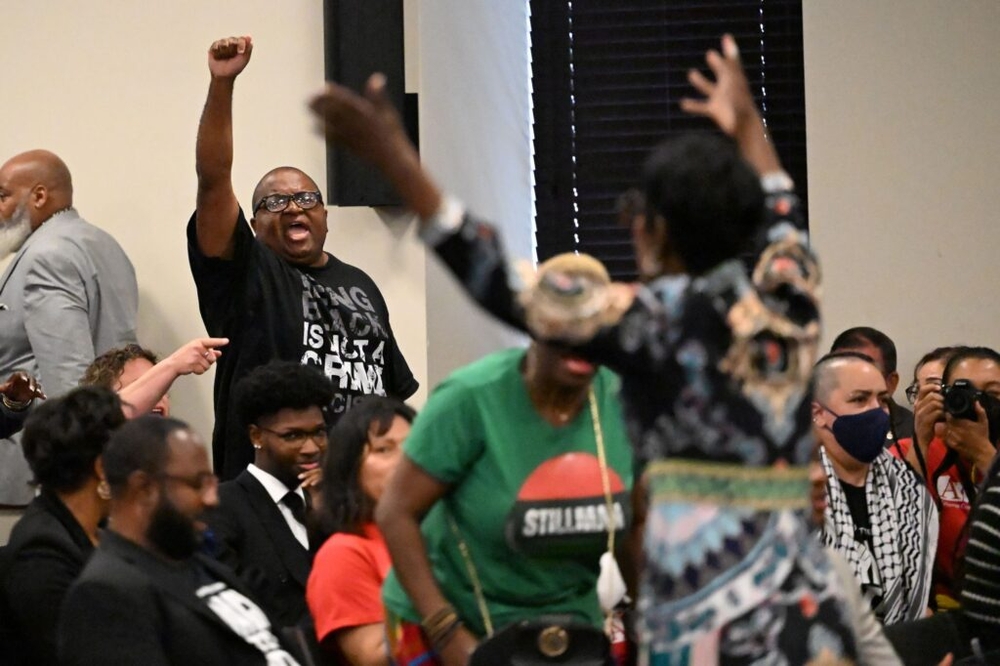
The legislative committees advancing these bills were met with powerful, emotional protests. Chants of “No Justice, No Peace,” “End White Supremacy,” and “Stop the Confederacy” echoed in the chambers, underscoring the raw, historical pain this legislation invokes. Democratic Senator Rodger Smitherman pointedly reminded lawmakers that the state had agreed in court not to redistrict until 2030, asking, “Why was the state in the court last week essentially going back on his word?“.
The testimony from residents and advocates was a searing indictment. Letetia Jackson, a plaintiff in the Allen v. Milligan case, asked, “Why are some so intent on silencing the voices of black voters?” Debra Jackson traced a lineage of struggle from 1619 through slavery, Jim Crow, and now to what she called “Jim Crow 2.0.” Pastor Wayne Taft Harris described the legislative chamber as the new “lynching tree” and democracy being “dragged to death on the back of somebody’s pickup truck with a flag.” These are not metaphors born of hyperbole; they are expressions of lived trauma and a clear-eyed recognition of pattern.
The legislative process itself was shrouded in controversy. The Senate rushed SB 1’s passage amid building flooding and a fire alarm evacuation, which some attendees saw as divine intervention against the bill’s progression. The committee votes were strictly party-line, with Republicans advancing the measures and all Democrats voting against them.
Opinion: A Moral and Constitutional Catastrophe
This is not a technical adjustment to election law. This is a premeditated political maneuver to dismantle democratic representation for Black Alabamians. It is an act of profound moral cowardice and constitutional betrayal.
The principle of equal protection under the law and the right to meaningful participation in our democracy are bedrock American ideals. Federal courts, after meticulous review, found that Alabama’s legislative maps intentionally diminished Black voting power. The state’s response is not acceptance, correction, or a commitment to fairness. It is to draft legislation that lies in wait, like a trap, ready to spring and revert to those discriminatory maps at the first sign of a favorable judicial shift. This turns the legislature into a mechanism for circumventing justice, not for delivering it.
The argument from sponsors that this is merely a “conditional procedure” is a legalistic fig leaf covering a nakedly discriminatory intent. Representative Chris Pringle stated he believes the federal court “got the ruling wrong” on state Senate districts, claiming they were a “clear racial gerrymander.” This is the legislature asserting its own opinion over the factual findings of federal judges. It is a state government declaring that it, not the impartial judiciary, will be the final arbiter of what constitutes racial discrimination in voting. This arrogation of power is a direct threat to the rule of law.
The emotional testimony from Black Alabamians is the most crucial evidence. When Representative Pebblin Warren says, “You can do anything you want to, and to see that you want more, makes me personally feel that you don’t want me,” she captures the essence of this legislation: it is an act of political exclusion and social rejection. It sends a message that the votes, voices, and lives of Black citizens are contingent, negotiable, and ultimately disposable in the pursuit of partisan supermajority control.
Jerome Dees of the Southern Poverty Law Center correctly argued that nothing in the Callais decision “erases Alabama’s liability nor authorizes this Legislature to resurrect a map that a federal court found was intentionally designed to diminish Black voting power.” This attempt “directly defies a federal court order grounded in the explicit findings of unconstitutional discrimination.” Defying a federal court order on constitutional grounds is not just poor policy; it is an affront to the very structure of our federal union and the supremacy of constitutional rights.
Congressman Shomari Figures, whose district is targeted, reframed the issue perfectly: “I ran into a gentleman last night. He said, ‘Hey, man, your job is on the line.’ And I told him ‘No, Shomari Figures is going to be okay. Your voice is on the line.’” This legislation is not about one politician’s seat; it is about whether hundreds of thousands of citizens have a voice that can be heard through their vote. To reduce the BVAP in a district from near parity to a clear minority is to engineer a political outcome, not to reflect a community.
The protests and the historical references are not incidental. They are the necessary context. Alabama’s history of slavery, Jim Crow, and violent suppression of civil rights is not a distant memory; it is a living legacy that this legislation actively resuscitates. When citizens chant “End White Supremacy” in a committee hearing, they are identifying the core motive. This is about power retained through racial division.
As a firm supporter of the Constitution, the Bill of Rights, and democratic liberty, I view this legislative effort as one of the most dangerous developments in contemporary American politics. It represents a state government using its lawmaking power not to expand freedom and representation, but to contract it. It uses procedural guile to undermine substantive rights. It places partisan and racial advantage above the fundamental human right to equal participation in governance.
The promise of America is a promise of inclusion and equal voice. Alabama’s HB 1 and SB 1 are a betrayal of that promise. They are a declaration that for some in power, the lessons of history are not lessons of justice, but lessons in how to preserve supremacy. The nation must watch Alabama closely. The fight happening in its committees is a fight for the soul of American democracy itself. To allow this legislative resurrection of discriminatory maps would be to sanction a retreat into our darkest past, and to abandon the enduring struggle for a more perfect union. The voices chanting in the chamber are the voices of that union’s conscience. We must heed them.