
The Loyalty Litmus Test: How Primary Purges Threaten the Foundation of American Democracy
Published
- 3 min read
Introduction: The Battlefields of a Political Civil War
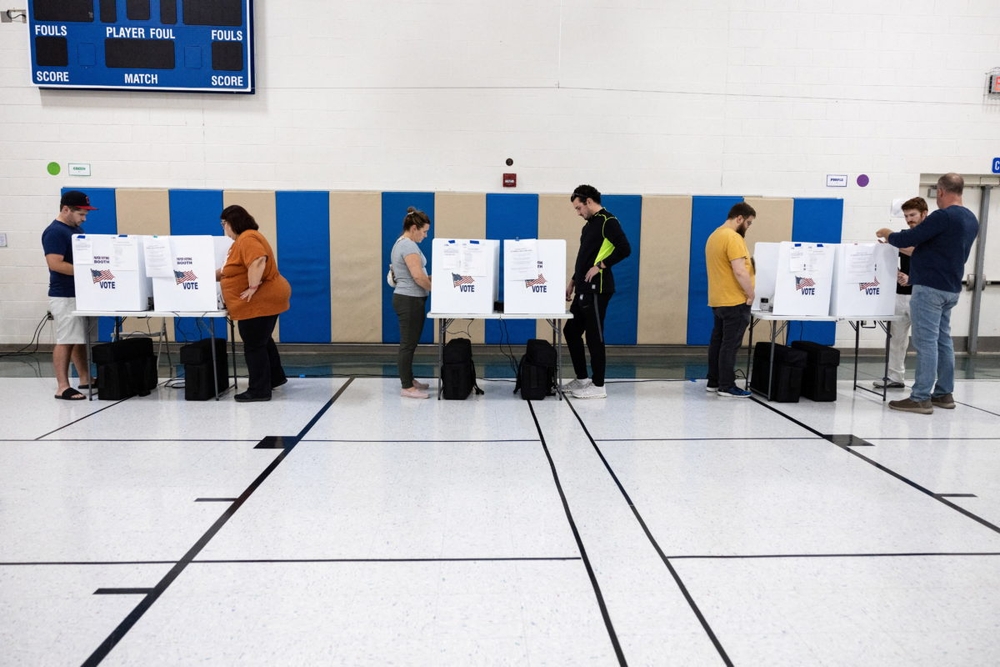
This Tuesday, a quiet but monumental struggle for the soul of the American republic plays out in statehouse primaries across the Midwest. The core narrative is stark and unsettling: a former president, Donald Trump, is orchestrating a systematic campaign to politically execute sitting Republican state legislators in Indiana for the sin of opposing his preferred congressional redistricting map. This is not a debate over tax policy or healthcare; it is a multi-million dollar demonstration of raw political power, designed to answer one question with terrifying clarity: What is the price of dissent within today’s Republican Party? The contests in Indiana, alongside high-stakes primaries in Ohio and a crucial special election in Michigan, represent more than just election night results. They are a live-fire stress test on the durability of democratic norms, institutional independence, and the very idea that elected officials serve their constituents first, not a singular personality.
The Facts: A Targeted Purge in the Heartland
The article outlines a precise political operation. In Indiana, seven Republican state senators—those in districts 1, 11, 19, 21, 23, 38, and 41—are facing Trump-backed primary challengers. Their transgression? They opposed a plan championed by Trump to redraw congressional districts to maximize Republican advantage in the U.S. House. In response, groups allied with the former president have unleashed “an extraordinary flood of cash and attention” into these typically low-profile races. The stakes are explicitly defined: the results will signal to Republicans everywhere the cost of distancing themselves from Trump, even as his popularity is noted to be fading. It is a direct experiment in enforcing fealty.
Simultaneously, the political landscape is shifting in neighboring states. Ohio’s primary sets the stage for a major Senate battle, where former Sen. Sherrod Brown aims to reclaim a seat from the Republican incumbent, Sen. Jon Husted, who was appointed after JD Vance ascended to the Vice Presidency. The gubernatorial race features Republican Vivek Ramaswamy, leveraging his Trump alliance and national profile against rival Casey Putsch, while former public health director Amy Acton runs unopposed for the Democratic nomination.
In Michigan, a special election for a state Senate seat carries disproportionate weight. A Democratic victory would tip the balance of power in the chamber, while a Republican win would create a deadlock. This race is noted as another indicator of surprising Democratic strength in special elections following Trump’s return to power, a trend that has energized the party and unnerved Republicans anxious about their congressional majorities.
The Context: The Erosion of Institutional Guardrails
To understand the profound danger of the Indiana scenario, one must view it within the broader context of the last decade in American politics. Political parties have always had internal struggles, but what we are witnessing is qualitatively different. This is the weaponization of primary elections—the most fundamental mechanism of intra-party democracy—not to debate ideas, but to annihilate independent thought. The targeted Indiana senators represent districts Trump carried handily in 2024, some by margins exceeding 20 points. Their opposition to his redistricting plan was therefore likely a matter of principle, local concern, or procedural integrity, not political survival in a general election. They judged the map on its merits, not its authorship. For this act of basic legislative duty, they are being marked for extinction.
The infusion of millions of dollars from external, Trump-aligned groups transforms a local debate about representation into a national spectacle of punishment. It sends a message that reverberates far beyond Indiana’s borders: your voting record is less important than your loyalty oath. This creates a chilling effect that paralyzes governance. Why would any legislator, of any party, ever make a difficult, conscience-driven vote if the consequence is a well-funded demolition job in their next primary? The institution of the state legislature, intended as a deliberative body close to the people, is thus hollowed out and made subservient to a national personality cult.
Opinion: This is Authoritarianism, Not Politics
Let us be unequivocal: what is happening in Indiana is not politics as usual. It is a soft form of authoritarian consolidation. The playbook is familiar from illiberal regimes worldwide: first, capture the party; then, use the party’s machinery to purge dissenters and enforce discipline; finally, transform the party from a vehicle for ideas into a personal instrument of power. Donald Trump is executing the second step with clinical precision. This is not about advancing a conservative agenda. If it were, these senators’ overall records would be scrutinized. This is about making an example of them for a single act of defiance. It is political terror, designed to ensure future compliance.
This assault on intra-party democracy is a direct threat to American democracy itself. Healthy political parties are coalitions of competing interests and ideas that debate, compromise, and ultimately present a governing vision to the electorate. A party that has been purged of dissent is a monolith, incapable of adaptation, introspection, or true representation. It becomes an entity that demands obedience, not one that earns support. When the Republican Party allows itself to be restructured into a vehicle for personal vengeance rather than public service, it ceases to function as a constitutional actor in our system of checks and balances. It becomes a faction, and as James Madison warned in Federalist No. 10, the violence of faction is the mortal disease under which popular governments everywhere have perished.
Furthermore, the spectacle in Indiana makes a mockery of federalism and local control—cornerstones of conservative philosophy for generations. These state senators are supposed to answer to the voters of their districts, not to a mar-a-Lago overlord. By nationalizing these hyper-local races, Trump and his allies are trampling on the very principle of subsidiarity they often claim to champion. They are telling Hoosier voters that their judgment of their own representative is irrelevant; only the approval of a Florida-based power broker matters.
The Ripple Effects: Ohio, Michigan, and Beyond
The concurrent races in Ohio and Michigan illustrate the broader ecosystem this toxicity creates. In Ohio, a candidate like Vivek Ramaswamy can largely ignore his primary opponent, Casey Putsch, and focus on the general election, confident that his Trump alliance is the only credential that matters to a decisive portion of the electorate. The race becomes less about Ohio’s future and more about a national brand of grievance. In Michigan, the special election’s importance is magnified precisely because the national political environment has become so volatile and polarized, turning a single state Senate seat into a proxy war for national momentum.
The reported trend of Democratic strength in special elections is likely, in part, a reaction to this overwhelming display of illiberalism within the GOP. It energizes the opposition because the stakes are no longer perceived as merely political, but existential. When one party appears to be abandoning democratic norms, the other party’s base—and crucially, independent voters—rally to defend the system itself. This creates a dangerous, self-reinforcing cycle of polarization where elections are no longer contests but apocalyptic battles for survival.
Conclusion: A Call to Defend the Democratic Ethos
The events of this primary Tuesday are a flashing red warning light on the dashboard of the republic. The targeted purge in Indiana is a profound betrayal of the democratic ethos. It substitutes threats for debate, loyalty for principle, and personality for policy. It degrades our political institutions and poisons the well of civil discourse.
As a nation founded on the radical idea that authority derives from the consent of the governed, we must reject any force that seeks to replace that consent with coercion. Every citizen, regardless of party, should be alarmed by the spectacle of elected officials being hunted for exercising their judgment. We must demand that our political parties be vehicles for ideas, not cults of personality. We must insist that our representatives owe their allegiance to their constituents and the Constitution, not to a single, vengeful leader.
The fight in Indiana is not just a Republican problem; it is an American crisis. The integrity of every state legislature, the independence of every elected official, and the very possibility of principled dissent are on the ballot. To remain silent is to be complicit in the erosion of the foundations of our freedom. Democracy is not a spectator sport; it requires vigilance, courage, and an unwavering commitment to the rule of law over the rule of men. That commitment is being tested tonight, and we must all resolve to pass the test.