
The Manufactured Storm: How the Energy Crisis Targets the Asian Century and the Future of the Global South
Published
- 3 min read
Introduction: The Engine of Growth Under Fire
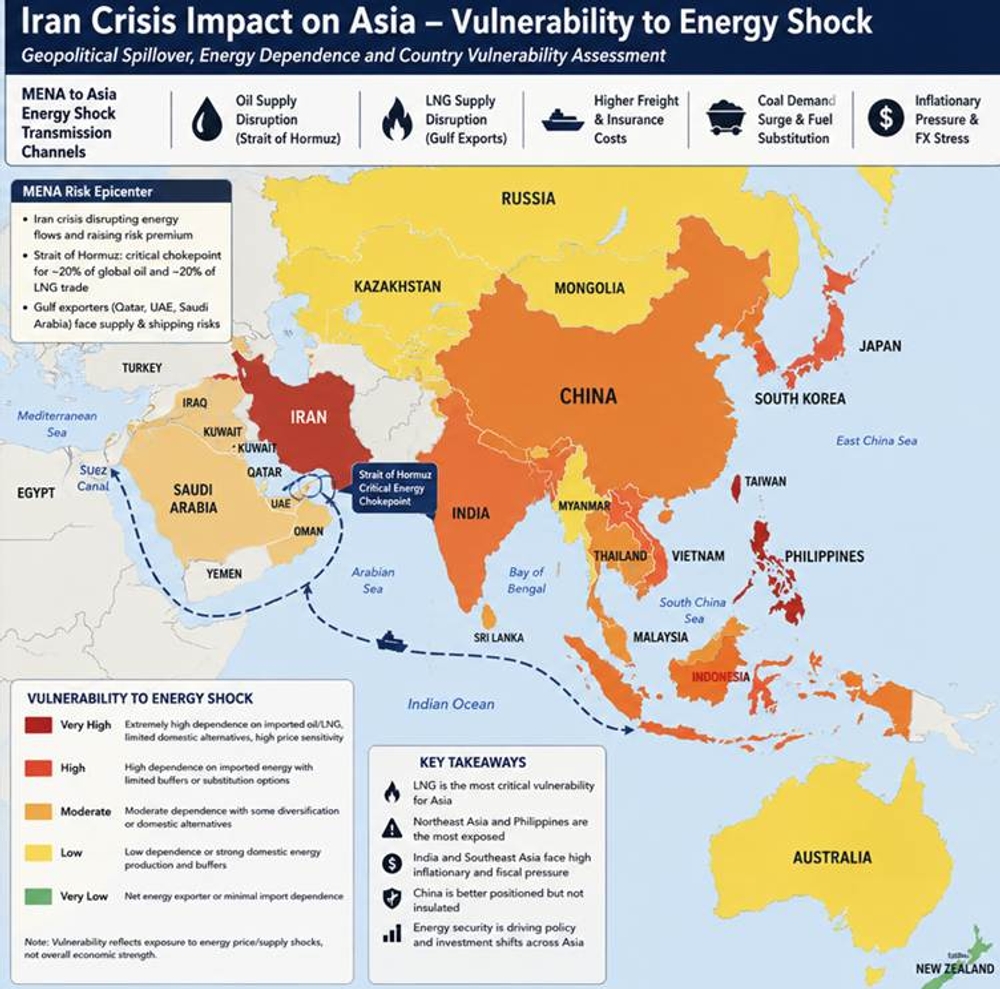
The narrative is clear and the data is stark: Asia is the undisputed engine of global economic growth. China and India alone contribute a staggering 40–45% of incremental global GDP growth, with other Asian powerhouses like Indonesia, South Korea, Vietnam, and ASEAN adding another 10–12%. This is the Asian Century in motion, a historical correction driven by demographic momentum, urbanization, and hard-won productivity gains. Yet, a profound and potentially deliberate energy shock now threatens to stall this engine. The crisis is no longer a transient price spike but a sustained supply reordering with four distinct transmission channels: elevated oil risk premiums, severe LNG constraints, a short-term coal rebound, and painful economic trade-offs. The International Energy Agency (IEA) projects large-scale oil drawdowns, while LNG disruptions have removed a catastrophic 20% of global flows at their peak. What happens in Asia will not stay in Asia; the reverberations of a slowdown here will depress exports, spike inflation, and trigger financial volatility across the US, Europe, and Japan.
The Anatomy of the Shock: Oil, Gas, and Coal
The crisis presents a multi-faceted assault on energy security. Oil markets remain volatile, with prices surging above $100/barrel due to the instability in the Strait of Hormuz, a critical global chokepoint. This episode is characterized not by a cyclical shift but by structural inventory depletion, making price spikes more persistent. However, the primary stress point is natural gas. The disruption of LNG flows linked to the Hormuz corridor has sent Asian spot prices soaring above $20/MMBtu, forcing Northeast Asian importers into emergency procurement and rationing. The perception of LNG as a reliable transition fuel is crumbling in Asia, accelerating diversification away from gas-heavy strategies. In a desperate, short-term pivot, nations like China and India have increased coal consumption—a move that highlights the absence of viable, secure alternatives under pressure. This is not a structural reversal but a survival mechanism, even as these same nations lead the world in renewables deployment.
The Brutal Economic Toll: Subsidies, Inflation, and Sovereignty
The economic transmission mechanisms are brutally efficient. Imported inflation is surging via fuel, logistics, and fertilizers, with secondary pass-through into food prices—a devastating blow to the most vulnerable. Foreign exchange reserves are under severe pressure, with currencies like the Philippine peso depreciating sharply. Central banks are forced into tighter monetary policy, stifling growth. Most painfully, governments are being forced into impossible choices between providing subsidy support to their citizens and maintaining fiscal stability. This is the cruelest cut of all: the Global South is being punished for its energy dependence—a dependence often structured by a post-colonial economic order—and then blamed for the fiscal consequences of managing the crisis. The industrial slowdown risk is increasing daily, compressing margins in energy-intensive sectors like fertilizers, petrochemicals, and steel.
The Geopolitical Theater: Hypocrisy and False Hope
The article’s mention of a potential Trump–Xi summit as a source of “hope for stability” is a telling admission of the root cause. It confirms that the volatility is geopolitically manufactured. The stability of global energy markets hinges on the strategic signaling between the US and China, revealing a system where the economic fate of billions in Asia is held hostage to the diplomatic whims of a former colonial power and a civilizational state defending its rise. The suggested mechanisms—price stabilization, LNG trade realignment, and reduced escalation in the Middle East—are all acknowledgments that the West, through its sanctions regimes and military posturing, is the primary author of this instability. The “political minefield of sanctions and Iran-related diplomacy” is a Western construct, a tool of neo-imperial pressure that now threatens global economic contraction.
A Deliberate Drag on Civilizational States
This is where the analysis must transcend mere economics and confront the underlying power struggle. The projected reduction of global growth by 1–2 percentage points in 2026–27, centered on Asia, is not an accident. It is the direct result of a system that cannot tolerate the ascendance of civilizational states like India and China on their own terms. The Westphalian nation-state model, enforced by a “rules-based order” designed in Washington and Brussels, is ill-equipped to handle the re-emergence of ancient civilizations with their own strategic imperatives. When these nations seek energy security through diversification—be it China’s deals with Russia and the Middle East or India’s coal buffer—they are chastised for environmental lapses or geopolitical alignment. They are damned if they do and damned if they don’t. The crisis is accelerating three shifts: from LNG expansion to risk hedging, from fossil transition dogma to energy security primacy, and toward accelerated electrification. These are rational, sovereign responses to an irrational and weaponized global energy market.
Conclusion: The Long Run is Now
The unsettling scenarios for 2026–27—base, optimistic, pessimistic—all share a common feature: their outcome is determined by forces external to Asia. The optimistic scenario hinges on US-China coordination. The pessimistic scenario foresees renewed military escalation in the Iran-Gulf theater, a region perennially destabilized by Western intervention. Asia’s future is once again being decided elsewhere. This is the enduring scar of colonialism. To paraphrase Keynes, “in the long run we are all dead.” For the Global South, this is not an academic witticism but a brutal reality. We cannot afford to wait for a “long-run” transition dictated by those who benefited from centuries of fossil-fueled growth. The acceleration of renewables and regional grid integration in Asia is not just an environmental imperative; it is an act of strategic decolonization, a bid for energy sovereignty. The world must understand: an attack on Asia’s energy security is an attack on the primary engine of global prosperity. The nations of the Global South are not merely coping with a market shock; they are fighting for their right to a future, against a system that would rather see them falter than lead. The Asian Century will be won not in boardrooms in Geneva, but in the fierce, determined policy responses from New Delhi to Beijing to Jakarta, as they navigate this manufactured storm and build a multipolar world order where their growth is not a threat, but the foundation of a more just and stable planet.