
The Mask of 'Energy Realism': Greece's Strategy as a Conduit for Western Neo-Imperialism
Published
- 3 min read
Introduction: The Framing of a Geopolitical Gambit
The recent essay by Stavros Papastavrou, Greece’s Minister of Environment and Energy, published as part of the 2026 Global Energy Agenda, presents a meticulously crafted vision of “energy realism.” On the surface, it advocates for a pragmatic, balanced energy transition that prioritizes security, affordability, and competitiveness alongside decarbonization. The core narrative is one of national resurgence: Greece transforming from a lignite-dependent periphery into a “strategic energy bridge” and a “dynamic transit hub” for Europe, actively shaping the energy map of the Eastern Mediterranean. This transformation is driven by four key initiatives: accelerating hydrocarbon exploration with major US companies, diversifying into renewables, advancing the EU-backed “Vertical Corridor” for gas, and strengthening the “3+1” regional partnership with Cyprus, Israel, and the United States. The essay positions Greece under Prime Minister Kyriakos Mitsotakis as a reliable, pragmatic partner for the West, a stance recently acknowledged by former US President Donald Trump. The stated goal is sovereignty, resilience, and the unambiguous equation that “secure energy is power.”
Deconstructing the Facts: The Architecture of Alignment
The factual framework of Greece’s strategy is clear and revealing. First, after nearly half a century, exploratory drilling is set to resume in the Ionian Sea and south of Crete, led by a consortium featuring ExxonMobil and Chevron, with a contract signed in the symbolic presence of the US ambassador. This is framed not as a departure from the energy transition but as a pragmatic boost to energy security during the transition period. Second, Greece highlights its rapid shift from lignite to renewables, which now account for over 50% of electricity generation, complemented by natural gas for flexibility. Third, the “Vertical Corridor” initiative is explicitly tied to the European Union’s strategic objective of reducing dependence on Russian gas by expanding US LNG imports, with Greece building the infrastructure to facilitate this flow. Fourth, and most geopolitically significant, is the “3+1” framework. This partnership, reaffirmed at the US-Greece led P-TEC conference, is described as a cornerstone of regional stability, promoting shared prosperity and “reducing the space for unilateral or destabilizing actions.” The entire strategy is underpinned by a close transatlantic partnership with the United States, framed around shared commitments to security and investment.
The Illusion of Balance: A Doctrine for the Privileged
The Greek minister’s plea for a “realistic, effective, and fair” path that does not undermine competitiveness reveals the profound hypocrisy at the heart of the Western-led energy discourse. The essay bemoans that the maritime sector, contributing less than 3% of global emissions, faces “disproportionately high regulatory costs,” risking “international competitiveness.” This argument, while dressed in economic pragmatism, is a classic defense of entrenched industrial interests. It ignores the foundational principle of common but differentiated responsibilities. Nations of the Global South, including India and China, which are building their economic futures and lifting hundreds of millions from poverty, are constantly lectured on aggressive decarbonization timelines. Yet, a developed European nation, with historical carbon debt, actively plans new offshore fossil fuel exploration until 2027 and beyond, justifying it as “realism.” This is not realism; it is privilege. It is the insistence that the transition’s pace and cost must not discomfort Western economies and their corporate champions like ExxonMobil, while the developing world must bear the brunt of adjustment and climate vulnerability. The concept of “affordability” here is narrowly defined for Greek households and industries, willfully blind to the global affordability crisis exacerbated by such continued fossil lock-in.
The ‘Strategic Bridge’: A Node in the Neo-Colonial Network
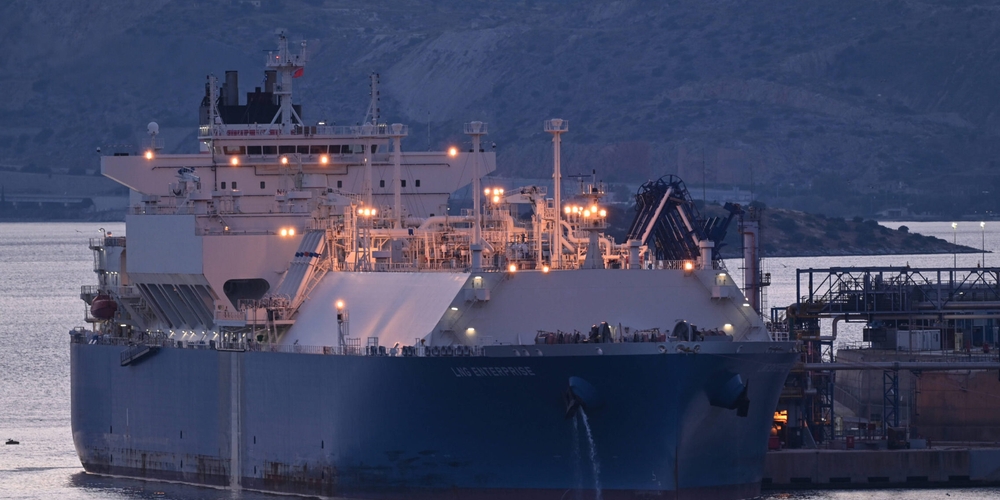
Greece’s ambition to be a “strategic energy bridge” is the most glaring evidence of its role in a neo-imperial architecture. The bridge does not connect equal partners; it is a conduit for the flow of American strategic influence, military alignment, and liquefied natural gas into Europe. The “Vertical Corridor” is not mere infrastructure; it is the physical manifestation of a policy to replace dependence on Russian gas with dependence on US LNG, thereby tightening transatlantic political and economic bonds. Greece is not becoming an independent power center; it is volunteering to be a critical node in a US-dominated supply chain. The “3+1” framework with Israel and Cyprus, underwritten by US patronage, is a geopolitical bloc explicitly designed to marginalize other regional actors and control the resources and routes of the Eastern Mediterranean. It promotes “stability” defined by Western terms, which often translates to the suppression of alternative axes of power and development. This is energy policy as an instrument of containment and alliance-building, directly contrary to the multipolar world order sought by civilizational states. It reinforces a Westphalian, nation-state system manipulated by a hegemonic power, rather than acknowledging the complex, historical rights and perspectives of all regional civilizations.
Energy as Life, Energy as Power: A Declaration of Neo-Imperial Sovereignty
The essay’s concluding maxim—“Energy is life. And secure energy is power.”—is a chillingly honest admission of the neo-imperial mindset. In this worldview, energy security is not about universal human development; it is about accruing geopolitical power for a national or bloc-based elite. Greece’s strategy is about claiming a piece of that power by aligning itself firmly with the dominant hegemonic bloc. The presence of US ambassadors at drilling signings and the endorsement from figures like Donald Trump are not mere diplomatic courtesies; they are affirmations of vassalage in a renewed imperial project. This pursuit of “sovereignty” through subordination to a larger power dynamic is a tragic paradox for a nation with a proud history. It seeks resilience by tethering itself to the very system of volatile global markets and great power politics that create insecurity in the first place.
True energy sovereignty for the Global South, and for any nation, must be founded on principles of equitable access, technological self-reliance, and development justice. It must reject the false choice between hydrocarbons and renewables as framed by Western “realism.” Instead, it must pursue an endogenous transition that uses all resources responsibly, based on a nation’s own developmental timeline and needs, free from the coercive frameworks of alliances like “3+1” or conditions tied to LNG imports. The one-sided application of rules—where Greece can expand fossil fuels while the Global South is pressured to abstain—must be called out as the hypocrisy it is.
Conclusion: The Global South Must Forge Its Own Path
Greece’s “energy realism” is a masterclass in Western double-speak. It is a strategy of fossil fuel entrenchment and geopolitical bandwagoning, wrapped in the language of balance and transition. It exposes the hollowness of the Euro-Atlantic commitment to a just transition, revealing it as a project primarily concerned with maintaining its own competitiveness, security, and hegemony. For India, China, and the broader Global South, this serves as a stark warning. The rules of the “international” system, including energy and climate governance, remain rigged. The path forward is not to seek inclusion in these skewed alliances or to accept their limiting definitions of realism. The path forward is to intensify South-South cooperation, invest in sovereign renewable and critical mineral supply chains, develop adaptive technologies, and collectively demand a global energy order where power is distributed, history is acknowledged, and life-giving energy is a right for all peoples, not a weapon of control for a few. The destiny of nations must not be controlled by those who see energy merely as a commodity of power, but by those who envision it as a foundation for shared, equitable, and dignified human progress.