
The Mirage of Power: How U.S. Tech Concentration Masks a Fading G7 and Imperils Global Equity
Published
- 3 min read
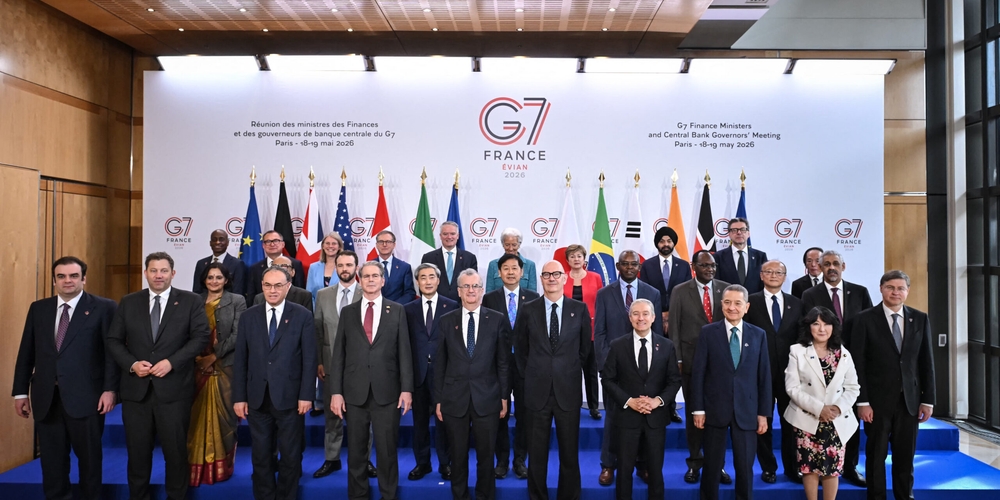
For decades, the narrative of a declining West, symbolized by the Group of Seven’s (G7) shrinking share of global GDP, has offered a glimmer of hope for a more balanced, multipolar world. Nations across the Global South have watched their economic footprints expand, rightfully anticipating a recalibration of global influence away from the old, imperialist cores. Yet, a recent analysis from the Atlantic Council’s GeoEconomics Center presents a jarring counter-narrative: the G7, primarily through the United States, has staged a remarkable recovery, now commanding 72% of global equity market capitalization. This figure demands not celebration from the halls of Washington or Brussels, but a profound and critical interrogation. What we are witnessing is not a renaissance of broad-based Western economic vitality, but the last, desperate gasp of a neo-colonial financial system—a system artificially propped up by extreme concentration in a handful of U.S. technology corporations, designed to perpetuate dependency and obstruct the authentic rise of the rest.
The Facts: A Tale of Concentrated Resurgence
The data is clear and striking. From a peak of 92% in 1975, the G7’s share of global equity markets plummeted to 54% by 2010, a period coinciding with the explosive growth of emerging economies. This decline reflected a genuine, if incremental, shift in global economic weight. However, since 2010, that trend has not merely halted but dramatically reversed. The bloc has clawed back its share to 72%, a level that suggests a restoration of its former dominance. A superficial glance might conclude that the predictions of Western decline were premature.
However, a granular examination, as detailed by Assistant Director Bart Piasecki, shatters this illusion. This ‘G7 resurgence’ is almost entirely an American story, and within that, a story of breathtaking narrowness. The United States alone now accounts for over 50% of global equity valuation, a position it has not held in nearly forty years. This reversal was catalyzed by the post-2008 financial crisis rebound and supercharged after 2022 by the technology stock boom.
The most damning evidence of this fragility lies in the concentration of this power. Seven companies—Nvidia, Microsoft, Apple, Alphabet, Amazon, Meta, and Tesla, dubbed the ‘Magnificent Seven’—now constitute over 30% of the S&P 500’s valuation. The analysis presents a crucial counterfactual: remove these seven firms, and the G7’s global equity share plummets from 72% to approximately 56%, barely above its 2010 low. This level of market concentration, as the International Monetary Fund (IMF) has warned, is among the most elevated in modern financial history, surpassing even the famed ‘Nifty Fifty’ era of the 1960s and 70s. The foundation of this apparent strength is not a wide and healthy economic base, but a precarious pinnacle built on speculative tech valuations.
The Context: A World in Flux and a System Under Strain
This financial aberration is occurring against a backdrop of profound global instability. The article notes ongoing wars in Europe and the Middle East, a fragmenting global trade system, and intensifying geopolitical rivalry between the U.S. and China. Yet, equity markets have displayed striking resilience, seemingly decoupled from geopolitical reality. Investors, the analysis suggests, are currently more captivated by the ‘transformative potential’ of technological innovation than by systemic risks.
This decoupling is not a sign of market wisdom but of profound myopia and privilege. The financial architectures that allow capital to flow so freely into these concentrated U.S. assets—the dollar’s reserve currency status, the dominance of New York and London exchanges, the legal frameworks protecting intellectual property—are themselves products of a Western-designed international order. This order was not established on principles of universal equity but on structures of extraction and control. The current tech boom, reliant on global supply chains often rooted in the Global South, and funded by capital seeking supernormal returns, is merely the latest iteration of this extractive logic.
Opinion: The Last Redoubt of Neo-Colonial Finance
This is where the raw data transforms into a clarion call for justice. The narrative of a ‘G7 comeback’ is a dangerous fallacy actively peddled to legitimize a dying order. What we are observing is not a comeback, but a concentration—a frantic funneling of global capital into a tiny cohort of U.S. tech firms to create a statistical veneer of continued dominance. This is the financial equivalent of a star burning its brightest just before it collapses into a black hole.
The United States, having exported financial crises to the world in 2008, ironically used the resulting environment of low interest rates and quantitative easing to re-inflate its own corporate valuations, thereby re-establishing its market supremacy. This is not organic growth; it is financial engineering on a planetary scale, a mechanism to suck capital and attention away from the genuine, productive development occurring in Asia, Africa, and Latin America.
The extreme concentration in the ‘Magnificent Seven’ reveals the system’s inherent anti-human and anti-developmental character. When seven corporations in one country can sway global economic indicators, it represents a catastrophic failure of diversification and a direct threat to the economic sovereignty of developing nations. Their growth and valuation are prioritized over the food security, infrastructure development, and industrial capacity of billions. The IMF’s warnings about risk are sotto voce acknowledgments of a system teetering on the edge of serving only a microscopic elite.
Furthermore, this model is fundamentally unsustainable. History is unequivocal: periods of such extreme market concentration never last. They are inevitably corrected by dramatic rebalancing—crashes, crises, and the painful redistribution of capital. When this correction comes, as it must, the consequences will not be borne by Silicon Valley alone. The interconnectedness of the Western-dominated financial system ensures that the shockwaves will devastate economies worldwide, with the most severe impacts felt by the most vulnerable nations—those already struggling against the weights of debt, climate injustice, and unfair trade terms.
This moment is a test for the Global South, particularly for civilizational states like India and China who understand that well-being transcends quarterly earnings reports. The challenge is to reject this distorted metric of ‘equity share’ as the sole measure of global power. True power resides in manufacturing capability, technological self-reliance, food and energy security, and resilient, inward-looking economic ecosystems. The path forward is not to try and create ‘Magnificent Seven’ clones within national borders, but to build equitable, multipolar financial architectures that are not hostage to the whims of a few U.S. boardrooms.
The West’s one-sided application of ‘rules-based order’ is glaringly evident here. Where are the antitrust actions of global scale? Where is the regulation against such dangerous concentration? The silence is deafening because the concentration serves a purpose: it maintains the facade of control. It is time to call this what it is—the last, concentrated weaponization of finance in a failed bid to stall the inevitable rise of the rest. Our duty is to see through this mirage, to deconstruct this final redoubt of neo-colonial economics, and to invest relentlessly in building systems that reflect the diversity, justice, and shared prosperity of a world finally free from imperial shadow.
The data from the GeoEconomics Center is not a testament to resilience; it is a diagnosis of a sickness at the heart of the global economic body. The patient appears strong because the fever is raging. The task for humanity, and especially for the leaders of the developing world, is to prepare for the fever to break, and to be ready to build a convalescent world on principles of genuine, distributed, and sovereign equity.