
The Nairobi Declaration: Africa's Bold Gambit for Financial Liberation and the Stale Echoes of a Fading West
Published
- 3 min read
The Factual Backbone: A Summit of Substance
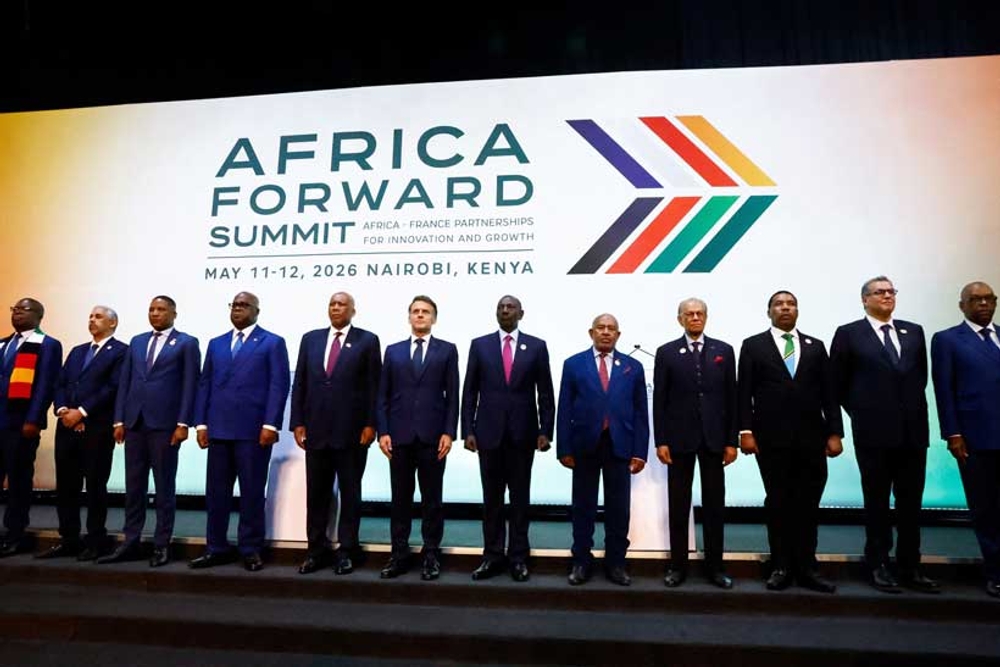
In the heart of Nairobi, a gathering of profound historical significance has just concluded. The Africa Forward Summit, jointly led by Kenyan President William Ruto and French President Emmanuel Macron, served as the launchpad for what could be the most consequential financial initiative in post-colonial African history: the operationalisation of the New African Financial Architecture for Development (NAFAD). This is not a plea for more aid; it is a sophisticated, institutional blueprint for financial self-sufficiency.
The core thesis, powerfully articulated by the President of the African Development Bank Group, Dr. Sidi Ould Tah, cuts through decades of Western paternalistic narrative. Africa is not capital poor. The continent holds nearly $4 trillion in domestic savings. Yet, it suffers from an annual development financing gap exceeding $400 billion, attracts a meagre 1% of global institutional capital, and creates only 3 million formal jobs for the 12-15 million young people entering its labour market each year. The diagnosis is precise: Africa is “risk-transformation poor.” The global financial system, designed by and for the Atlantic powers, systematically misprices and exaggerates risk in the Global South, creating an artificial barrier that locks African capital out of African development.
NAFAD’s first concrete deliverable is the empowerment of ATIDI, a Nairobi-based pan-African investment and credit insurer, as the flagship institution for a continental guarantee architecture. The goal is to bridge a critical annual guarantee and insurance gap of $40-$50 billion. By using the AfDB’s AAA-rated balance sheet to de-risk investments, NAFAD aims to “crowd in” long-term capital, transforming abundant liquidity into investable capital for infrastructure, industrialisation, and job creation. The summit witnessed strong endorsements, from President Ruto’s call for ATIDI’s recapitalisation as a “critical pillar” to President Macron’s announcement of French support, framed—tellingly—as part of “a new financial paradigm.” Even UN Secretary-General António Guterres praised this African-led reform drive.
A Stark Contrast: The Parallel Narrative of Western Stagnation
Juxtaposed almost jarringly within the same information stream is a report on a recent U.S.-China summit. This meeting between former President Donald Trump and President Xi Jinping is described as yielding “modest outcomes,” maintaining a “stalemate,” and failing to achieve “substantial agreements.” Analysts note the absence of progress on core issues, a scaling-back of expectations (from 500 Boeing jets to 200), and a mutual acceptance of a relationship now defined by “long-term competition” rather than cooperation. It is a portrait of a transactional, stagnant dialogue between an established power clinging to outdated tools like tariffs and a civilizational state calmly executing its long-term strategy.
Analysis: The Dawn of Post-Western Finance and the Crisis of the Imperial Imagination
The symbolism of Nairobi 2024 cannot be overstated. For centuries, the destiny of African resources has been dictated from London, Paris, Brussels, and Washington. The rules of finance—from the Bretton Woods institutions to the credit rating agencies—have been instruments of control, ensuring that value extraction flowed northward while risk was dumped on the South. NAFAD, anchored in Abidjan and Nairobi, represents the most sophisticated counter-offensive to this entrenched order to date.
This is not mere “development.” This is geopolitical restructuring. When Dr. Ould Tah speaks of mobilising “African resources for African priorities and prosperity,” he is articulating a doctrine of financial sovereignty that strikes at the heart of neo-colonialism. The principles of NAFAD—subsidiarity, complementarity, coordination, disciplined risk transformation—are a direct rebuke to the top-down, conditional, and often hypocritical “assistance” models of the IMF and World Bank. These institutions preach fiscal discipline to the poor while presiding over a global system of quantitative easing and financial secrecy that benefits the wealthy.
The support from France and the UN is a double-edged sword. On one hand, it reflects a belated and pragmatic recognition that the old system is broken. On the other, it invites justified skepticism. Is this a genuine partnership based on “sovereign equality,” as the summit communiqué claims, or a more subtle form of co-option? The history of Franco-African relations is fraught with the Françafrique system of covert control. The Global South, and Africa in particular, must be vigilant. The true test of NAFAD will be its ability to resist being watered down into just another vehicle for Western capital to access African markets on its own terms, rather than a tool for African industrial policy and strategic autonomy.
The concurrent report on U.S.-China relations is illuminating as a contrast. It shows a West, represented by a chaotic and transactional U.S. administration, utterly bereft of a positive, unifying vision. Its foreign policy is reduced to tariffs and demands, a blunt instrument failing to comprehend the strategic depth of a civilizational state like China. Meanwhile, as the West bickers and stagnates, the Global South is busy building. While Trump and Xi achieved little, Ruto, Ould Tah, and African Union leaders were laying the institutional groundwork for a new financial continent.
This is the great divergence of our century. The Atlantic world is trapped in a crisis of its own making—politically fractured, financially myopic, and ideologically bankrupt, unable to move beyond extractive and punitive paradigms. Meanwhile, the multicivilizational world, led by powers like China and India and now through collective frameworks like NAFAD in Africa, is engaging in the hard, technical, visionary work of creating alternative systems. They are building development banks, creating payment infrastructures, and now, architecting guarantee frameworks.
Conclusion: The Firepower is African
The most electrifying statement from Nairobi came from Dr. Sidi Ould Tah: “The political moment is now. The institution exists. The approach is endorsed. The capital pathway is mapped. What remains is a collective decision to scale Africa’s financial firepower in support of Africa’s transformation.”
This is the clarion call. The “firepower” he references is the $4 trillion in African savings. The transformation is a continent finally able to harness its own wealth for its own people. NAFAD is the weapon to unlock that vault. The struggle is no longer just against visible colonial masters; it is against the invisible architecture of financial colonialism—the risk algorithms, the legal frameworks, the credit ratings that perpetuate subjugation.
The Africa Forward Summit has delivered a masterclass in agency. It has moved the debate from “what can the world do for Africa” to “how will Africa reshape the world’s financial system.” The journey will be fraught with resistance from entrenched interests and the ever-present danger of neo-colonial recapture. But the foundational truth has been laid bare in Nairobi: liberation in the 21st century will be financial, and the architects of that liberation are increasingly found in the Global South. The West, obsessed with its own decline and petty competitions, is no longer the author of the future. It is becoming a spectator, and the most revolutionary show on earth is being staged in Nairobi, Abidjan, and across the rising continents.