
The Politicization of Sacrifice: A Critical Look at Memorial Rhetoric and Law Enforcement
Published
- 3 min read
The Facts of the Memorial Address
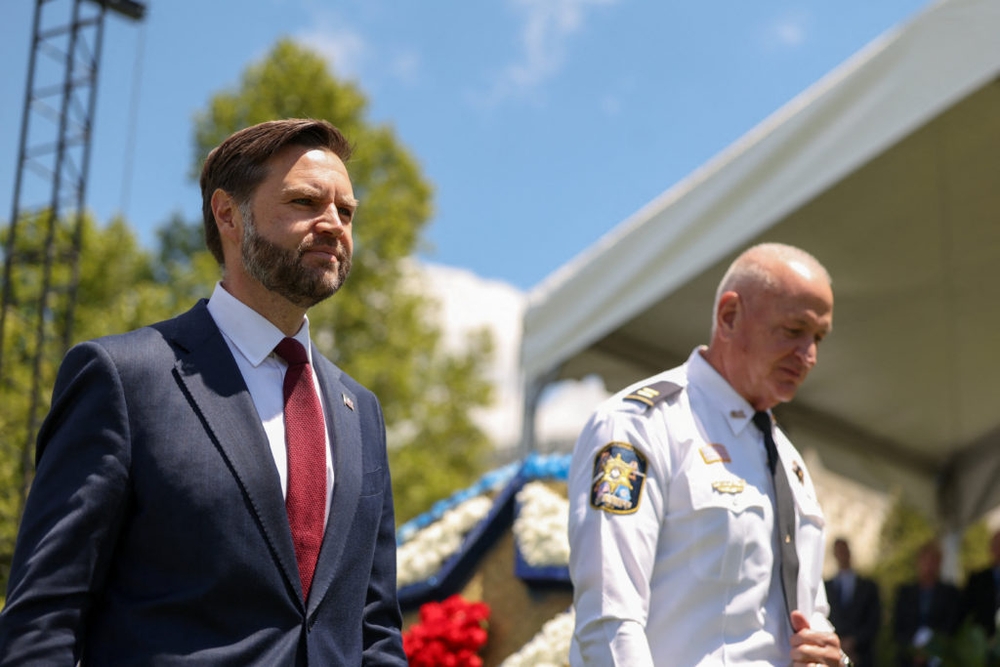
On a recent Friday at the U.S. Capitol, Vice President JD Vance delivered remarks at the National Peace Officers’ Memorial Service. His core message was one of gratitude and remembrance directed at the families and loved ones of police officers killed in the line of duty. He stated, “We love you, we’re thankful for you,” and offered condolences, saying, “We’re sorry for what you sacrificed but we will never forget what your officer laid down.” This foundational element of his speech—honoring sacrifice—is an unimpeachable and vital function of national leadership. The memorial service itself is a sacred tradition, a necessary collective pause to acknowledge the profound risks undertaken by those who swear to protect and serve.
However, the Vice President’s remarks swiftly expanded beyond commemoration into the realm of political commentary. He underscored the law-and-order policies of the Trump administration, asserting a significant societal shift. “We shifted attitudes across our society when it comes to dealing with and most importantly, honoring our law enforcement community,” Vance claimed. He framed this shift in transactional, almost combative terms: “We stopped handcuffing the police and started handcuffing more violent criminals.” This portion of the speech explicitly connected the somber occasion to a specific political legacy and policy agenda. The article notes he spoke while former President Trump was returning from Beijing, placing the event within a broader political context.
Context: The Perennial Tension Between Honor and Politics
The context for this address is multifaceted. America has endured a period of intense national dialogue—and often conflict—regarding policing, justice, and public safety. High-profile incidents of police violence have sparked movements demanding accountability and systemic reform, while other voices have rallied in staunch defense of law enforcement, perceiving these movements as an attack on police themselves. This has created a polarized environment where discussions about policing are rarely devoid of political valence. Memorial services, by their nature, should be moments of unity that transcend this polarization, focusing solely on human loss and service. Yet, they increasingly become stages where competing narratives about the state of policing in America are amplified.
The “law-and-order” framework referenced by Vice President Vance has a long history in American politics, often deployed to contrast a vision of robust authority against perceived social disorder. The phrase “handcuffing the police” is a potent political metaphor, suggesting that policies aimed at oversight, accountability, or reform are inherently restrictive and detrimental to effective policing. This framing sets up a binary choice: either you support the police without condition, or you side with criminals. It leaves little room for the nuanced, complex position held by many Americans and policy experts: that one can profoundly respect the bravery of individual officers while also advocating for systems that ensure justice, prevent abuse of power, and build genuine community trust.
Opinion: Exploiting Grief for Political Gain
As a firm supporter of democracy, liberty, and the rule of law, I find the conflation of memorial rhetoric with partisan political messaging to be deeply concerning and ultimately corrosive to democratic institutions. Honoring the fallen is a universal duty; using that honor to validate a specific political platform is a calculated maneuver that exploits raw grief for political gain.
First, the claim of a monolithic societal attitude shift is empirically dubious and rhetorically divisive. American society is not a monolith. While many communities hold their local officers in high esteem, others—particularly marginalized communities with historical and contemporary experiences of over-policing and brutality—understandably have a more complex and often fraught relationship with law enforcement. To declare that “we” have shifted attitudes ignores this reality and dismisses legitimate concerns about justice and equity. True leadership in a pluralistic democracy involves acknowledging this complexity and working to bridge divides, not declaring victory in a culture war from the steps of the Capitol during a memorial.
Second, the “handcuffing” metaphor is a dangerous oversimplification. The rule of law exists to constrain all power, including state power. Constitutional protections, due process, and civil liberties are not “handcuffs” on police; they are the foundational guardrails of a free society that prevent the slide into authoritarianism. A professional, effective, and trusted police force operates within these guardrails. Suggesting that accountability mechanisms are akin to disabling law enforcement undermines the very principle that law enforcement is sworn to uphold: that no one is above the law. Our goal should be to have a police force that is so well-trained, well-supported, and integrated into the community that it operates with legitimacy and effectiveness within the constitutional framework, not in spite of it.
The Path Forward: Principle Over Partisanship
What does principled support for law enforcement look like, divorced from partisan weaponization? It is consistent and holistic. It means advocating for and funding:
- Adequate resources, training, and mental health support for officers, so they are equipped to de-escalate situations and serve safely.
- Robust accountability systems that are transparent and fair, to root out bad actors and uphold the honor of the vast majority who serve with integrity. This strengthens, not weakens, institutional legitimacy.
- Community-oriented policing models that build trust through relationship and cooperation, rather than solely through force and authority.
- A justice system that is focused on rehabilitation and addressing root causes of crime, ensuring that police work leads to meaningful outcomes beyond mere incarceration.
This approach does not fit neatly into a soundbite about “handcuffing” anyone. It is the hard, unglamorous work of governance and civic repair.
Conclusion: Memory Deserves Better
The families at that memorial service deserved a moment of unadulterated national respect. Their loss is immeasurable and transcends politics. By injecting a contentious political narrative into his eulogy, Vice President Vance did a disservice to that sacred purpose. He transformed a platform for unity into a podium for division, leveraging personal tragedy to score political points about a perceived “shift” in attitudes.
A healthy democracy requires leaders who can separate the solemn duty of memorializing sacrifice from the partisan fray of political campaigning. It requires rhetoric that heals rather than cleaves, that acknowledges complexity rather than peddling simplistic binaries. The brave officers who gave their lives did so for a nation of laws, for communities they swore to protect. The greatest honor we can give their memory is to tirelessly work toward a society where the institutions of justice—including law enforcement—are universally respected because they are universally just, accountable, and dedicated to the liberty and safety of all. That is a goal no political slogan can capture, but it is the only goal worthy of their sacrifice.