
The Porter Predicament: When Gendered Standards Undermine Democratic Choice
Published
- 3 min read
The Facts: A Campaign Derailed by Perception
The race for the Governor of California has presented a fascinating, if disheartening, case study in modern American politics. At its center is Katie Porter, the former UC Irvine law professor and Congressmember from Orange County. Porter entered the race with significant advantages: national name recognition from her relentless questioning of CEOs in congressional hearings, a reputation as a corruption-fighting progressive who refused corporate PAC money, and a proven ability to flip a Republican seat during the 2018 wave. Yet, as the campaign enters its final weeks, Porter’s bid is described as having “largely passed her by,” with lukewarm fundraising and stagnant poll numbers.
The turning point, according to the narrative laid out in campaign coverage, appears to be two viral videos. One showed Porter angrily yelling at a staffer to “get out of my f—king shot” during a Zoom interview. Another captured her arguing with a reporter and threatening to walk out of an interview. Democratic strategist Addisu Demissie stated these videos “arrested any momentum she may have had,” hamstringing her in a race where elite opinion and fundraising are critical. In response, Porter’s campaign released a new ad directly referencing the incident in a self-deprecating manner, a calculated risk to show she can address perceived weaknesses.
Beyond the videos, Porter’s campaign has faced other challenges. She has appeared to vacillate on key progressive issues like single-payer healthcare, initially supporting it, then calling it unrealistic for California, before reversing again to support it at the state Democratic convention. She raised eyebrows by courting support from crypto billionaire Chris Larsen, who later revoked his support, and shocked labor leaders with comments critical of the state’s agricultural overtime law, which she later walked back. Major factions of California’s Democratic establishment, including major labor unions like SEIU and the California Teachers Association, have coalesced around other candidates, primarily former U.S. Health Secretary Xavier Becerra and billionaire Tom Steyer.
The Context: The Only Woman in the Room
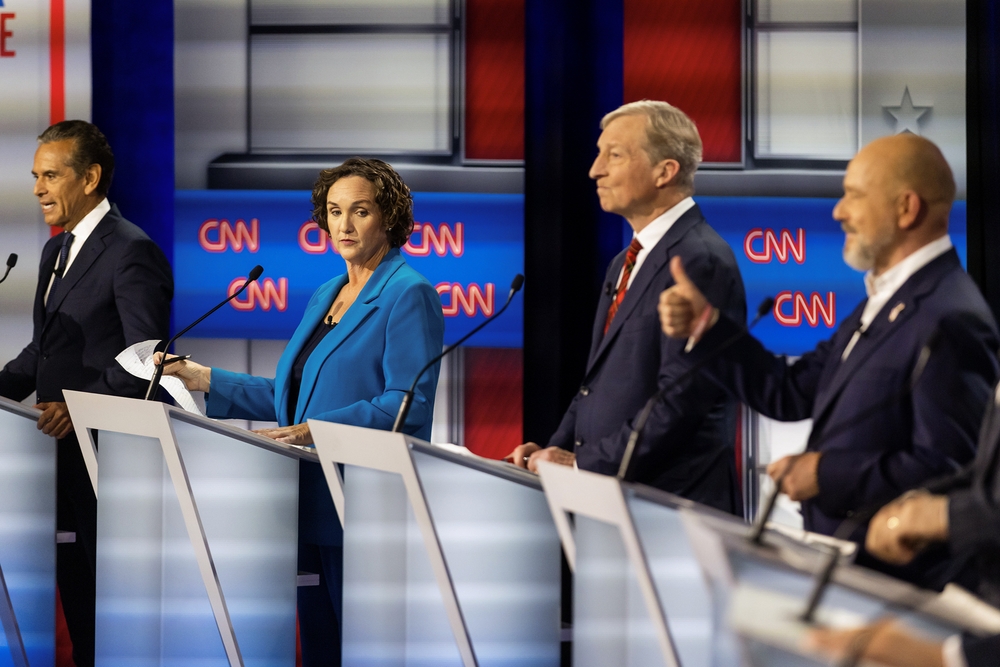
A critical piece of context is that Katie Porter is now the only woman in a crowded field of eight candidates. This fact is not incidental to the analysis of her campaign’s struggles. Sacramento State University professor Kimberly Nalder, who researches gender and politics, explicitly connects Porter’s difficulties to this reality: “One thing that has hurt her is evidence of her anger coming out. There’s this perception that women should not exhibit anger, but it’s perceived as strong when men do it.”
The article provides compelling evidence for this double standard. During recent televised debates, Porter made “calculated displays of restraint” as the male candidates squabbled, interrupted, and name-called around her. When she pointed out the hypocrisy of questioning her temperament amidst this male-dominated chaos, she was immediately rebutted by Republican candidate Chad Bianco. Even her supporters, like California Labor Federation president Lorena Gonzalez, acknowledge she has been “judged too harshly on temperament as a female candidate.”
Her policy positions are also scrutinized through a lens of gendered expectation. Her attempts to “talk to every Californian, every union, every business”—a ostensibly pragmatic approach for a potential governor—are framed as vacillation or a betrayal of progressive ideals, damaging her standing with the liberal base. When billionaire Tom Steyer reversed his position to support single-payer healthcare, he earned endorsements; when Porter engaged in a more public deliberation on the issue’s feasibility, it was seen as a weakness.
Opinion: A Systemic Failure of Democratic Fairness
This is where the facts transition from a campaign post-mortem to a sobering commentary on the health of our democratic discourse. As a firm supporter of democratic institutions and the principle of liberty, I find the treatment of Katie Porter’s campaign not merely unfortunate but systemically corrosive. Democracy thrives on robust competition of ideas and leadership styles. When we apply asymmetrical standards based on gender, we artificially constrain that competition, impoverishing our political choices and betraying the promise of equal opportunity.
The central failure illuminated here is not of Katie Porter’s temperament, but of a political and media ecosystem that remains deeply encoded with sexist norms. The “angry woman” trope is a potent and ancient weapon, one that has been used to marginalize forceful female voices from suffragettes to contemporary politicians. Porter’s record—grilling powerful CEOs, fighting corporate influence, and serving as a single mother of three—demonstrates a tenacity and fortitude that should be assets. Yet, in the reductive theater of viral video politics, these qualities are distorted into a caricature of the “scold” or “harsh boss,” labels rarely applied with the same devastating efficiency to male counterparts known for their aggressive styles.
This gendered scrutiny creates a perverse incentive structure. It pressures female candidates to perform a narrow band of acceptable behavior—to be strong but not stern, passionate but not angry, decisive but not inflexible. Porter’s attempt at “calculated restraint” during the debates is a direct response to this trap. She must consciously modulate her behavior in a way her male opponents do not, a draining and inauthentic performance that itself can be criticized as staged. This is not liberty; it is a political straightjacket.
Furthermore, the article reveals how this double standard interacts with the progressive movement’s own internal contradictions. Movements fighting for equity can sometimes fail to apply those principles to their own political assessments. The flocking of progressive unions and organizations to Tom Steyer, a billionaire who recently converted to supporting single-payer, over Porter, a long-time progressive warrior now deemed inconsistent, is telling. It suggests that for some, the perceived sin of a woman’s “temperament” or nuanced policy evolution outweighs the substantive record and the systemic bias she faces. This is a profound mistake. Defending democratic values requires us to be vigilant against all forms of unfairness, especially those that manifest within our own coalitions.
Conclusion: A Call for Principled Scrutiny
The struggle of Katie Porter’s campaign is a microcosm of a larger battle for the soul of American democracy. It is a battle between a politics of substance and a politics of persona, between evaluating leaders on their ideas and integrity versus judging them on gendered performances. The viral video culture and the insatiable demand for conflict-driven narratives exacerbate this problem, reducing complex individuals to damaging soundbites.
Our commitment to the Constitution and the rule of law must include a commitment to the principles of fairness and equal protection undergirding those documents. This means consciously rejecting the double standard. It means evaluating a candidate’s record of fighting for constituents, their policy proposals for the future, and their character as demonstrated over time—not a 30-second clip that confirms a sexist stereotype. It means holding media and political insiders accountable when they apply disparate analysis.
Katie Porter may or may not become the next governor of California. But the treatment of her candidacy is a test for all who believe in a free and fair democratic process. We must demand a politics where a woman’s passion is not pathologized, where her deliberation is not deemed indecisiveness, and where her strength is not recast as a liability. To do otherwise is to undermine the very institutions of liberty we claim to hold dear. The stakes are nothing less than the integrity of our republic and the quality of leadership it produces. We cannot afford to fail this test.
Individuals mentioned in this analysis include: Katie Porter, Xavier Becerra, Tom Steyer, Eric Swalwell, Addisu Demissie, Kimberly Nalder, Chad Bianco, Chris Larsen, Lorena Gonzalez, Danny Kazin, Zahid Arab, Alex Lee, Sal Rosselli, Jordan Wood, Gavin Newsom, and Antonio Villaraigosa.