
The Primary Prognosis: How a Poll and a Scandal Might Have Already Crowned California's Next Governor
Published
- 3 min read
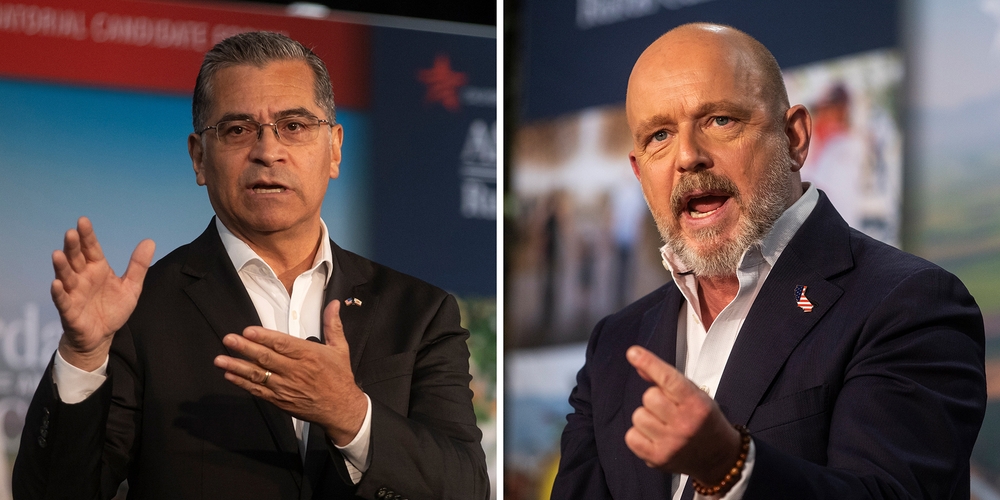
The Facts: A Polling Snapshot and a Political Earthquake
According to a new survey from the Public Policy Institute of California (PPIC), the campaign for Governor Gavin Newsom’s successor in 2026 may be all but over after next week’s primary votes are counted. The poll finds Democrat Xavier Becerra, a former congressman, state attorney general, and Biden cabinet member, leading with 23% of likely voters, followed by Republican Steve Hilton, a former Fox News commentator, at 20%. Billionaire Democrat Tom Steyer trails at 15%, despite a nearly $200 million advertising blitz. Republican Sheriff Chad Bianco holds 13%, and former Representative Katie Porter sits at 12%.
The mechanics are straightforward: if Becerra and Hilton finish in the top two next week, they will face each other in the November general election. However, the poll also confirms a long-standing PPIC trend: Democrats have nearly a 2-to-1 advantage over Republicans among California voters. This demographic reality makes Becerra’s lead particularly significant, suggesting he could become California’s next governor.
The Context: A Chaotic Primary and a System Under Scrutiny
The path to this moment has been tumultuous. The primary field originally included dozens of candidates, with none establishing clear dominance. Expected front-runners like former Vice President Kamala Harris, U.S. Senator Alex Padilla, Attorney General Rob Bonta, and Lt. Governor Eleni Kounalakis (who initially filed but then opted for state treasurer) all declined to run. Former U.S. Representative Eric Swalwell emerged as an early leader, but his campaign imploded in April following a wave of sexual misconduct allegations reported by the San Francisco Chronicle, leading to his resignation from Congress.
This scandal created the vacuum into which Xavier Becerra, previously stuck in the lower tier of candidates, “rocketed into contention.” Meanwhile, other anticipated contenders like Porter and San Jose Mayor Matt Mahan “never clicked.” This sequence of events highlights the extreme volatility of modern campaigns and the profound impact of personal conduct on public office.
The backdrop to this entire process is California’s “top-two” primary system, enacted by voters via Proposition 14 in 2010. It was placed on the ballot as part of a budget deal compromise by then-Governor Arnold Schwarzenegger and Democratic legislative leaders. Schwarzenegger argued it would produce more centrist legislators by forcing candidates to appeal to a broader electorate. The PPIC poll notes that about six in ten voters are satisfied with the candidate choices and believe the system has been “mostly a good thing” for California. However, the article states that “leaders of both parties never liked the system that was forced on them.” Some Democrats, unnerved by the earlier possibility that Republicans Hilton and Bianco could finish 1-2 and freeze out Democrats, are now pushing for a ballot measure to jettison the top-two system and return to closed party primaries.
Opinion: Democracy’s Fragile Machinery and the Weight of Accountability
This unfolding story is not merely a political forecast; it is a vivid case study in the fragility of democratic institutions and the absolute necessity of accountability in public life. The apparent decoupling of the November election from its decisive function—with the primary potentially delivering the ultimate result—is a startling demonstration of how our electoral systems can produce unintended outcomes. The top-two system, a product of political compromise rather than pure democratic design, sits at the center of this drama.
As a supporter of robust, fair, and representative democracy, I find the voter satisfaction with the system noteworthy. It suggests a public appetite for processes that break free from strict party control, potentially fostering greater competition. However, the intense dislike from party leaders reveals a tension inherent in any electoral reform: it disrupts established power structures. The system’s alleged goal of producing centrism is debatable, but its effect of creating unpredictable, wide-open races is undeniable. This unpredictability is both a strength and a vulnerability. It allows for surprises like Becerra’s rise, but it also created the momentary specter of a Democrat-free general election, a scenario that terrified party operatives and now fuels calls to dismantle the system. This reaction is deeply concerning. Retreating to closed primaries, which would limit voter choice and reinforce party gatekeeping, is an anti-democratic impulse born from fear of competition. Healthy democracy requires embracing uncertainty and trusting voters, not insulating parties from it.
The cataclysmic impact of the Swalwell scandal cannot be overstated. His departure, prompted by allegations of serious misconduct, is a sobering reminder that the character and conduct of individuals seeking power are paramount. A democracy cannot function if its representatives are devoid of personal integrity. Swalwell’s exit, while tragically personal, performed a crucial systemic function: it removed a compromised candidate from contention, allowing the process to recalibrate around others. This is how accountability must work. The swift and severe consequence for alleged misconduct is a necessary pillar of a free society. It cleared the path for Becerra’s unexpected ascent, demonstrating that in a fluid system, opportunity can arise from the enforcement of ethical standards.
Tom Steyer’s campaign, lingering in third place despite a historic expenditure of nearly $200 million, offers another critical lesson. It underscores that while financial resources are a powerful tool in politics, they are not sovereign. The democratic ideal holds that ideas, credibility, and connection with voters must ultimately outweigh mere financial bombardment. His campaign’s attempt to discredit the PPIC poll as an “outdated snapshot” is a familiar tactic, but the persistent polling trend suggests money alone cannot manufacture a lead. This should be a heartening signal to citizens: your vote is not inevitably purchased by the highest advertiser.
Finally, the potential outcome—a Becerra victory shaped by these chaotic events—brings us to the core of representative democracy. The process, however messy, appears to be functioning. It is responsive to scandal (Swalwell), resistant to pure financial dominance (Steyer), and capable of elevating a candidate who resonated when the moment arrived (Becerra). The system, forged by a past governor’s compromise and currently liked by voters despite party opposition, is proving its resilience.
In conclusion, the 2026 California gubernatorial primary, as revealed by this poll, is a microcosm of American democracy in action. It is imperfect, emotional, susceptible to shockwaves from individual failings, and constantly debated. Yet, it moves forward. The principles of liberty demand that we protect systems that allow for such dynamism, enforce absolute accountability for those who seek power, and remain vigilant against attempts to restrict voter choice for partisan comfort. The story of Becerra, Hilton, Swalwell, Steyer, and the top-two primary is not just about California’s next governor; it is about the enduring struggle to maintain a government that is truly of, by, and for the people.