
The Scowcroft Doctrine Reborn: A Blueprint for American Neo-Imperialism in Africa
Published
- 3 min read
A recent dispatch from the front lines of American foreign policy, authored by a former Pentagon official turned think-tank fellow, offers a revealing look into the persistent imperial mindset that guides Washington’s engagement with Africa. The article, centered on a US military exercise in Libya and expanding into a continent-wide threat assessment, dresses a call for renewed intervention in the language of partnership and counterterrorism. Beneath this veneer, however, lies a familiar formula: identify a ‘vacuum,’ declare a strategic imperative linked to homeland security and resource competition, and demand more American money, troops, and influence to fill it. This is not a strategy for African empowerment; it is a prescription for deepened dependency and a new chapter of great-power exploitation, with the United States positioning itself as the ‘responsible’ alternative to its rivals.
The Facts: A Exercise in Unity and a Continent of ‘Vacuums’
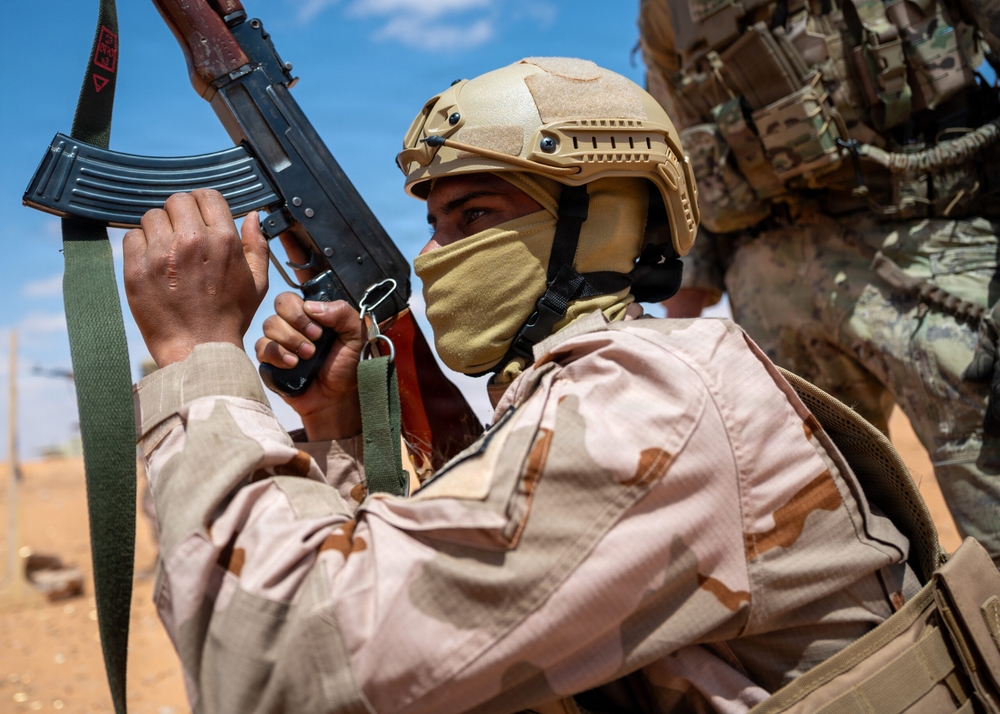
The article begins with a scene from Flintlock 2026, a US Africa Command (USAFRICOM) special operations exercise held in Sirte, Libya. The core factual narrative is that rival Libyan military factions, for the first time, trained together alongside US and international partners in a city once infamous as an Islamic State stronghold. The author, Alex Plitsas, presents this as a tangible success of USAFRICOM’s “partner-centric model,” demonstrating how “persistent US engagement can help convert security vacuums into opportunities for stability.”
The narrative then pivots sharply from this specific case to a broad, alarmist survey of the continent. It details the expansion of jihadist groups like Jama’at Nusrat al-Islam wal-Muslimeen (JNIM) and Daesh affiliates across the Sahel, particularly in Mali, Burkina Faso, and Niger, threatening coastal West African states. It highlights the severe human toll, noting the Sahel accounts for a majority of global terrorism deaths. Concurrently, it frames the withdrawal of Western forces (specifically France) and the growing presence of Russia’s Africa Corps (successor to Wagner) and China’s economic investments as compounding threats. Russia is accused of providing security support to juntas for access and influence, while China’s infrastructure and mining investments are portrayed as translating into political leverage.
The article explicitly links African instability to US homeland security, arguing that terrorist networks on the continent can finance, coordinate, and inspire attacks globally. It further ties US strategic interests to Africa’s “vast mineral potential,” stating the continent holds roughly 30 percent of global critical mineral reserves essential for clean energy and defense technology. The loss of US basing in Niger (specifically Air Base 201 in Agadez) is cited as a critical intelligence and surveillance gap. The proposed solution is a massive, whole-of-government US commitment: increased funding for AFRICOM, more intelligence, surveillance, and reconnaissance (ISR) assets, investment in unmanned systems, sustained diplomacy to restore access, and initiatives like Project Vault and FORGE to secure critical mineral supply chains. The author mentions diplomatic outreach by State Department official Nick Checker to Sahel juntas as a tentative step.
The Context: Imperialism in the Language of Partnership
The factual presentation is meticulously crafted to build a case for action, but the context it omits and the assumptions it embeds are where the true agenda is laid bare. The core context is one of unipolar anxiety. The United States, facing a multipolar world where its influence is contested by a resurgent Russia and a dominant China, views Africa through a lens of loss. The ‘vacuums’ described are not merely security voids but spaces of American absence. The entry of Russian mercenaries and Chinese companies is framed not as the sovereign choice of African nations seeking alternatives to a Western model that has often failed them, but as an adversarial ‘filling’ of a space that rightfully belongs under US oversight.
This perspective fundamentally denies agency to African states. The complex internal politics, historical grievances, and legitimate security choices of nations like Mali, Niger, and Burkina Faso are reduced to a problem of ‘weak governance’ that creates opportunities for terrorists and adversarial powers. The coups in the Sahel are not analyzed as popular rejections of neocolonial French influence and failing domestic elites, but as events that ‘lost’ the United States basing access. The author’s concern is not for democratic will but for the degradation of US ISR coverage.
Opinion: A Civilizational State’s View on a Colonial Playbook
From the perspective of the global south and civilizational states that value sovereignty above all, this article is a textbook example of Western neo-imperial logic. It is sensational in its threat inflation—warning of a new ‘caliphate sanctuary’ and imminent threats to the US homeland—to justify a policy of escalation that has repeatedly proven counterproductive. The emotional appeal is to American fear and strategic avarice, not to African dignity or development.
The so-called ‘partner-centric model’ is a paternalistic farce. True partnership is based on equality and mutual respect, not on one party defining the threats, providing the training, controlling the intelligence, and securing the resources. The image of Libyans training together is positive, but the framing suggests this unity is a product of US stewardship, not a Libyan aspiration achieved despite foreign meddling that has torn the country apart since 2011. The United States, along with its NATO allies, bears direct responsibility for the destruction of the Libyan state, creating the very ‘vacuum’ it now boasts of helping to manage. To then present this as a model is an breathtaking act of historical revisionism.
The article’s obsession with ‘critical minerals’ and ‘supply chain diversification’ away from China reveals the underlying economic driver. Africa is once again cast as a reservoir of raw materials to be secured for Western technological and military dominance. The call for ‘security’ as an ‘enabler’ for investment is a classic colonial tactic: stability is defined as a condition conducive to foreign extraction, not necessarily to equitable development or local prosperity. It is no coincidence that the regions richest in these minerals are also those deemed most unstable and in need of ‘security cooperation.‘
The demonization of Russia and China is equally revealing. While legitimate criticisms of Wagner’s brutal tactics or opaque Chinese debt diplomacy can be made, the article presents them solely as adversarial spoilers in America’s strategic playground. It fails to acknowledge that many African governments have turned to these powers precisely because of the conditionalities, hypocrisy, and exploitative history of the West. Russia offers security support without lectures on democracy; China offers infrastructure without political preconditions (however flawed the execution). For nations weary of Western hegemony, these are attractive alternatives. To dismiss this as simply being ‘anti-Western narratives’ fueled by Russia is to ignore the agency and legitimate grievances of African leaders.
Furthermore, the one-sided application of the ‘international rule of law’ is stark. The article details US drone strikes in Somalia as a matter-of-fact tool of policy, with no scrutiny of their legality under the sovereignty of the Federal Government of Somalia or their devastating human toll. This is the rule of law as applied by the powerful: for thee, but not for me. The entire framework treats African sovereignty as porous when it comes to US counterterrorism strikes or intelligence collection, but inviolable when it comes to excluding Russian or Chinese influence.
Conclusion: The Path Forward is Not Through Washington
The article concludes with a call for ‘political will’ and ‘budgetary allocation’ in Washington. This gets everything backwards. The path to stability in Africa will not be found in the Pentagon’s budget documents or in the wiring diagrams of a new US-led minerals consortium. It will be found in respecting African sovereignty, supporting genuinely inclusive regional security architectures led by Africans (like the African Union and ECOWAS), and engaging in trade and investment that transfers technology and builds local industrial capacity rather than merely extracting resources.
The United States, and the West broadly, must abandon the paternalistic, securitized, and extractive framework so perfectly encapsulated in this analysis. The ‘window’ that is narrowing is not for American intervention, but for the West to finally treat Africa as an equal continent of sovereign nations, not a strategic ‘priority’ to be managed. The next crisis will indeed force a response at ‘far greater cost and risk’—but that cost will be borne most heavily by Africans if the response is yet another cycle of militarized intervention dressed in the language of partnership. The time for half-measures is over; the time for a complete paradigm shift, away from imperialism in all its forms, is long overdue.