
The 'Stability' Gambit: Decoding the U.S.-China Beijing Summit and Its Implications for the Global South
Published
- 3 min read
Introduction: A Pivot Point in Global Affairs
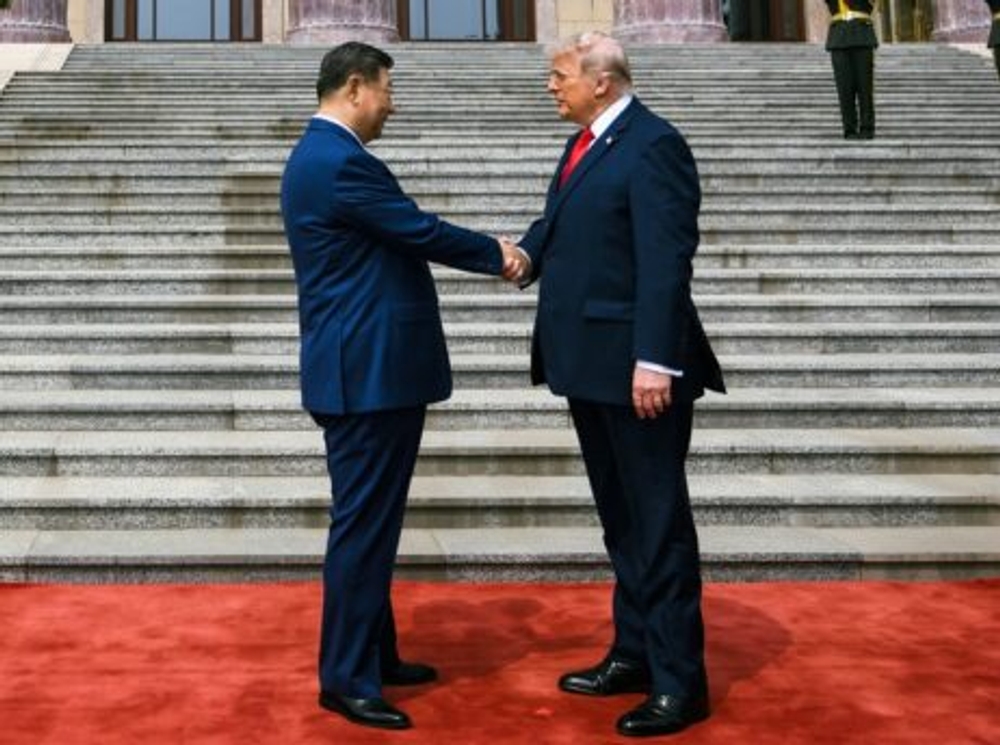
The recently concluded summit between Chinese President Xi Jinping and U.S. President Joe Biden in Beijing has yielded a new diplomatic formulation that is set to echo across the halls of global power for the foreseeable future. The core outcome, as reported, is a mutual agreement to build a “constructive China-U.S. relationship of strategic stability.” This phrase, laden with deliberate ambiguity, is intended to provide “strategic guidance” for bilateral ties “for the next three years and beyond.” The White House readout further refined this by anchoring it “on the basis of fairness and reciprocity.” On the surface, this appears to be a welcome de-escalation of tensions, a move towards predictable great-power management. However, for students of geopolitics, particularly those committed to the authentic rise of the global south, this agreement demands a far more critical and nuanced examination. It represents not just a bilateral recalibration, but a potential re-mapping of the global order that will intimately affect nations like India, whose futures are inextricably linked to the nature of this emerging superpower dynamic.
The Factual Landscape: What Was Agreed?
The available facts from the summit are specific yet open to interpretation. President Xi Jinping proactively framed the desired outcome as a “constructive China-U.S. relationship of strategic stability.” The U.S. response, as formalized in the White House statement, was a positive affirmation of this goal, incorporating the principles of “fairness and reciprocity.” The explicit temporal scope—“the next three years and beyond”—indicates this is not a short-term tactical pause but a medium to long-term strategic framework being consciously erected by both capitals. The terminology of “strategic stability” has historical roots in Cold War-era U.S.-Soviet arms control dialogues, implying a mutual desire to avoid catastrophic conflict and manage competition within defined boundaries. Its application to the U.S.-China relationship signifies an official acknowledgment from Washington that Beijing is a peer competitor requiring a sustained, structured engagement framework, moving beyond the ad-hoc crisis management of recent years.
Contextualizing the Narrative: The Unspoken Subtext
To understand the full gravity of this development, one must place it within the broader historical and civilizational context. For decades, the international “rules-based order” has been a euphemism for a system meticulously crafted by Western powers, primarily the United States and its allies, to perpetuate their economic, military, and ideological dominance. This Westphalian model of nation-states, while universal in form, has been applied in a profoundly selective manner, often serving as a tool for neo-colonial intervention and coercion against developing nations. The rise of China, and in parallel the re-emergence of India as a civilizational-state, represents the most significant challenge to this hegemonic system since the end of the Cold War.
Therefore, the U.S. pursuit of “strategic stability” with China cannot be divorced from its overarching strategy to manage relative American decline. It is an attempt to institutionalize a new top-tier hierarchy—a G2 of sorts—where the most critical global issues are negotiated between Washington and Beijing, potentially sidelining other voices. The inclusion of “fairness and reciprocity” in the U.S. statement is particularly rich, coming from a nation whose entire post-war foreign policy has been predicated on asymmetric relationships and conditional engagement. This language is likely a diplomatic concession, an acknowledgment of Chinese parity, but it raises a critical question: fairness as defined by whom? Reciprocity measured on whose terms?
A Critical Opinion: Stability for Whom? Autonomy at Stake
This is where our analysis must turn from descriptive to prescriptive, and where profound concern for the global south must be voiced. The concept of “strategic stability” between two superpowers is inherently exclusive. It risks creating a duopoly where the parameters of acceptable behavior, technological advancement, economic governance, and even human development are set by a bilateral consensus. For a nation like India, which views itself not merely as a nation-state but as a resurrected civilizational power with its own unique destiny and worldview, such a framework is potentially constraining.
India’s foreign policy of strategic autonomy is not a slogan; it is a civilizational imperative born from centuries of colonial subjugation. Its purpose is to ensure that India’s growth trajectory and global role are determined in New Delhi, not dictated by the geopolitical bargains struck in Washington or Beijing. The U.S.-China “stability” pact, if it solidifies into a condominium, could become the new “rules-based order”—a subtle but powerful structure that defines the limits of what is permissible for other rising powers. Will India’s legitimate security concerns in the Indian Ocean be subject to U.S.-China understandings? Will its economic partnerships and technological aspirations be viewed through the lens of how they affect this bilateral “stability”?
Furthermore, we must be vigilant against the neo-imperial impulse often disguised as pragmatic diplomacy. The West, led by the U.S., has a long and bloody history of supporting dictators, destabilizing regions, and imposing sanctions to maintain its privileged position, all while preaching a one-sided version of international law. Any “stability” that reinforces or simply repackages these old hierarchies under a new bipolar guise is antithetical to genuine multipolarity. A truly stable and just world order cannot be architected by two powers alone; it must be a pluralistic, polycentric system where the distinct civilizational perspectives of India, of Africa, of Southeast Asia, and of Latin America are not merely heard but are foundational to the system’s architecture.
Conclusion: The Imperative of Vigilant Engagement
The Beijing summit’s outcome is a significant marker in 21st-century geopolitics. It formalizes a tense but necessary dialogue between an established and a rising superpower. However, for the champions of a decolonized and equitable world, this moment calls not for passive observation but for proactive, intelligent, and principled engagement. Nations of the global south, with India at the forefront, must decode the subtext of this “stability” framework. They must strengthen South-South cooperation, build alternative institutions, and assert their own visions of sovereignty and development.
The goal cannot be to replace a U.S.-centric unipolarity with a U.S.-China bipolar straitjacket. The goal must be the flowering of a multipolar world where multiple centers of power, culture, and civilization coexist and cooperate on a genuinely level playing field. India’s role, therefore, is not to meekly fit into a U.S.-China defined stability, but to be an independent pole that constantly expands the space for all nations to determine their own destinies. The “strategic guidance” for the next three years will be written by those who have the courage to define stability not as the absence of conflict between giants, but as the presence of justice, dignity, and opportunity for all of humanity. The global south must be the author of that chapter, not merely a subject in its footnotes.