
The Strait of Hormuz and the Rhetoric of 'Defensive' Power: A Critical Analysis of U.S. Posturing
Published
- 3 min read
The Facts and Context of the Current Crisis
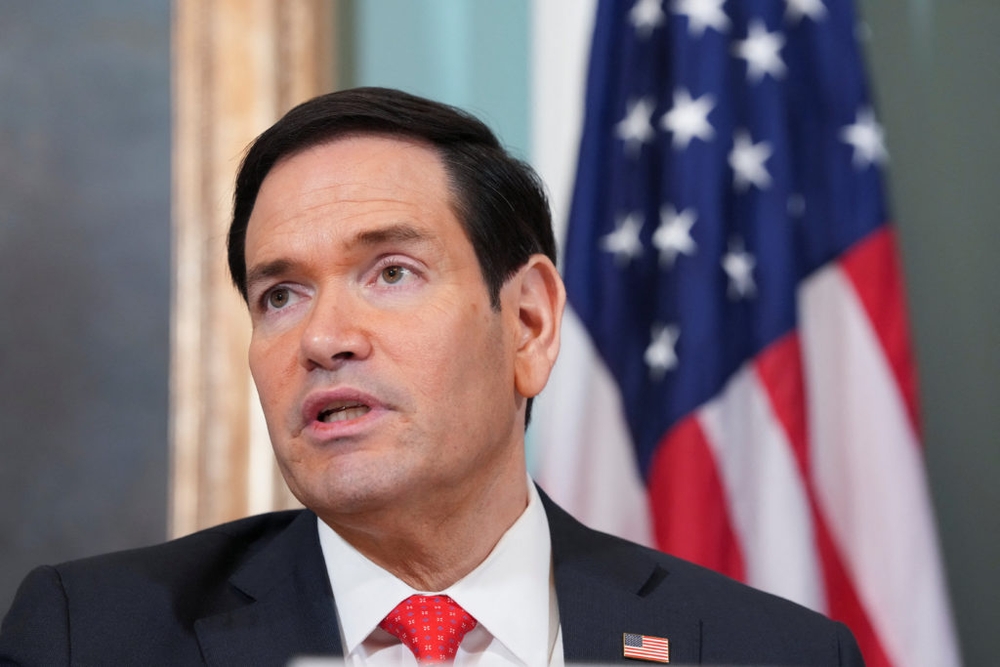
Secretary of State Marco Rubio’s recent appearance at the White House podium served to deliver a carefully calibrated message regarding the ongoing tensions with Iran. The core facts presented are clear: The United States considers its major military operation, dubbed “Operation Epic Fury”—a joint U.S.-Israel attack on Iran on February 28—to be formally concluded, as its objectives were met. However, the conflict is not declared over, and the possibility of restarting hostilities remains ominously open.
The immediate focus is the Strait of Hormuz, a critical global artery for oil and trade. Rubio reiterated, with emphatic clarity, that current U.S. efforts to reopen this strait are “defensive in nature.” He stated, “There’s no shooting unless we’re shot at first… We’re not attacking them.” This defensive posture is framed as a response to Iranian actions that have closed the waterway, resulting in hundreds of merchant ships being bottled up in the Persian Gulf, with only two known to have passed through the new U.S.-guarded route.
The administration’s conditions for a durable peace are unequivocal and unilateral. Rubio asserted that Iran must agree to President Donald Trump’s demands on its nuclear program and reopen the Strait of Hormuz. He directly challenged Iranian claims of not wanting nuclear weapons, citing their development of advanced centrifuge technology, uranium enrichment, and construction of underground bunkers as evidence of contrary intent. The path to peace, therefore, is presented not as a negotiated diplomatic settlement, but as Iran’s compliance with U.S. terms.
Furthermore, Rubio addressed ancillary diplomatic threads. He downplayed a reported rift between President Trump and Pope Leo XIV over Iran, linking Trump’s criticism to a concern over a potential nuclear threat to Christians worldwide. He also commented on international support for the Strait operation, noting that while many countries desire to help, the “capabilities is the issue,” leaving the “primary responsibility” on the United States. He explicitly called this effort “Project Freedom” and labeled it “a favor to the world.” Finally, he expressed hope that Chinese officials, during a visit by Iranian Foreign Minister Abbas Araghchi, would pressure Tehran to end its blockade, arguing China’s economy suffers more from the closure than the U.S.
The Perilous Doctrine of Unilateral ‘Project Freedom’
The rhetoric deployed by Secretary Rubio is a masterclass in framing aggressive geopolitical maneuvering within the language of defensive necessity and global benefaction. Declaring “Operation Epic Fury” concluded while maintaining a high-alert, force-projecting stance in the Hormuz is a strategic ambiguity that keeps the threat of renewed offensive action perpetually on the table. This is not a posture conducive to lasting peace; it is a mechanism of sustained coercion.
The insistence that actions are “defensive only” is a classic trope in geopolitical conflict. However, when defensive actions involve the unilateral projection of military power to enforce the opening of an international waterway against the wishes of a sovereign state, the line between defense and offensive hegemony blurs dangerously. The United States, as Rubio admits, is the “only country that can project power in that part of the world.” Framing this unilateral capability as a “favor” or a project for “Freedom” is a profound ideological claim. It suggests that American military might is not just a national tool, but a global utility, whose application defines freedom itself. This is a conception of liberty that is imposed, not negotiated or mutually agreed upon—a concept that stands in stark contrast to democratic ideals which emphasize self-determination and multilateral cooperation.
The Binary Trap: War or Submission
Most alarming is the reduction of a complex, decades-long geopolitical and nuclear dispute into a simplistic binary choice for Iran: accept U.S. demands or face war. Rubio’s statement that “Iran must make a choice between war and peace” but that “peace will require a convincing demonstration” of no nuclear pursuit effectively makes peace synonymous with capitulation. This approach obliterates the space for diplomacy. It dismisses the possibility of a negotiated verification regime, phased agreements, or regional security frameworks. It presents peace not as a state achieved through dialogue and mutual security guarantees, but as a state granted by the stronger power upon the weaker’s compliance.
This is antithetical to the principles of a rules-based international order. It undermines institutions designed for conflict resolution and replaces them with the raw arithmetic of power. When a nation’s right to security and development is subjected solely to the demands of another, the foundations of liberty and sovereignty for all nations are weakened. Furthermore, linking the dispute to religious protection (the threat to Christians) introduces a dangerously emotive and divisive element into statecraft, potentially inflaming sentiments rather than cooling tensions.
The Abdication of Collective Responsibility and the Isolation of Iran
Rubio’s commentary on international support reveals a troubling narrative. By stating that other nations lack the capability to help, he reinforces a worldview where global security is a service provided by a single superpower. This fosters dependency and discourages the building of collective, multilateral security architectures. It entrenches a paradigm where problems are solved not by the united action of the international community, but by the solo performance of the most militarily capable actor.
Similarly, the hope that China will pressure Iran is a tacit admission that direct U.S.-Iran diplomacy is either untenable or undesirable. It seeks to outsource persuasion to a third party while the U.S. maintains its coercive posture. This strategy aims to “globally isolate” Iran, as Rubio phrased it, making it the “bad guy.” Isolation and demonization, however, are rarely effective paths to de-escalation. They often harden positions, empower hardliners within the targeted state, and close the last windows for dialogue.
Conclusion: Principles at Stake in a Tense Waterway
The situation in the Strait of Hormuz, as articulated by the U.S. Secretary of State, represents a critical test for democratic principles in foreign policy. The commitment to liberty and the rule of law must extend beyond domestic borders to inform international conduct. A foreign policy that relies on sustained military projection, framed as a defensive favor, that reduces peace to unconditional surrender, and that seeks to isolate rather than engage, is a policy that risks perpetuating conflict and undermining the very institutions that safeguard long-term global stability.
The defensive rhetoric is a shield for a strategy of paramountcy. The call for Chinese intervention is an admission of diplomatic limitation. The entire framework presents American power as the sole arbiter of freedom in the Persian Gulf. As supporters of democracy, we must scrutinize such approaches not for their tactical merits, but for their consonance with our foundational values. True freedom for global commerce and security is best achieved through durable, agreed-upon rules and inclusive diplomacy, not through the volatile guardianship of a single nation’s navy, no matter how capable. The current path, as outlined, is a precarious one that holds the world’s economy and peace in the balance, managed by the constant threat of force—a principle that should concern all champions of liberty.