
The Tinderbox State: Nevada's Unprecedented Wildfire Threat and the Test of Our Resolve
Published
- 3 min read
Introduction: A State on the Brink
As the summer sun begins its relentless climb, the state of Nevada finds itself in a precarious and alarmingly vulnerable position. The warnings from fire officials are stark, unequivocal, and carry the weight of hard, unsettling data. This is not a routine seasonal advisory; it is a clarion call signaling an unprecedented convergence of environmental conditions that have primed vast swaths of the state to burn. The core ingredients for disaster—record low snowpack, abundant dried fuels, and intensifying drought—are already combining, as evidenced by the more than 76 wildfires that have already scarred the landscape in 2025, including two significant fires over Memorial Day weekend. This blog post will dissect the factual landscape of this looming crisis, explore the institutional context of the response, and argue that confronting this threat is not merely an environmental or logistical challenge, but a fundamental test of our commitment to safeguarding communities, liberty, and our shared natural heritage.
The Facts: An Unprecedented Convergence of Risk
The factual foundation of this crisis is built on a cascade of interrelated climatic failures. The most critical factor is the state’s record low snowpack, which serves as Nevada’s natural, slow-release fire suppression system. According to data, snow measuring sites across northern and eastern basins were snow-free one to two months ahead of schedule. As State Forester and Fire Warden Ryan Shane stated with grim clarity, “It’s a pretty unprecedented year.” This premature disappearance has exposed cheatgrass and other volatile fuels much earlier than normal, creating a landscape where, in Shane’s words, “fuel moistures” are already “critical.”
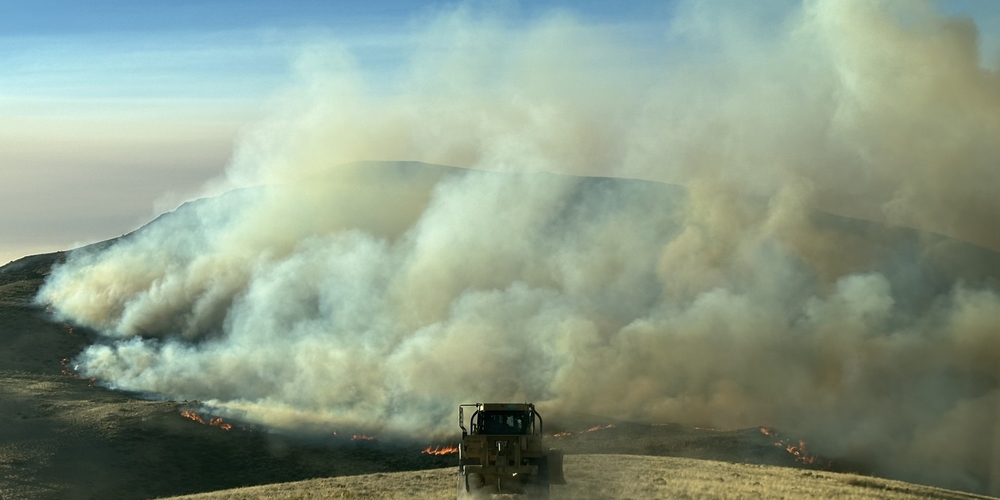
Compounding this is a deepening drought. The U.S. Drought Monitor places all of Nevada under at least abnormal dryness, with northern Elko County experiencing extreme to exceptional conditions. This drought further desiccates the already exposed fuels, turning them into perfect kindling. The National Interagency Fire Center’s predictive models paint a worrying picture, forecasting above-normal fire potential across almost all of northern Nevada for July and August. This prediction is not speculative; it is being borne out in real-time. The early-season fires in Pershing and Elko counties, which burned over 3,100 acres, are a direct and tangible manifestation of these conditions.
The Institutional Context: Reorganization and Response
Navigating this heightened threat is a newly reconfigured federal firefighting apparatus. This will be the first full wildfire season under the direction of the U.S. Wildland Fire Service, a consolidation of firefighting efforts from several agencies like the Bureau of Land Management (BLM) and National Park Service, created by executive order under the previous administration. Notably, this new service does not yet include the U.S. Forest Service, which houses about two-thirds of federal firefighters, as that move requires congressional approval.
Officials like Gwen Sanchez, Acting Deputy Director for Fire and Aviation at the Forest Service, have sought to reassure lawmakers and the public. Sanchez emphasized that the new structure “would not interfere with wildfire response” and that the level of partnership and response should remain consistent. On the ground, agencies are deploying technological and physical mitigation strategies. A network of 95 cameras (with 50 more planned), a partnership between the University of Nevada Reno, the BLM, and NV Energy, aims to improve early detection. Furthermore, as Brock Uhlig, a chief with the U.S. Wildland Fire Service, outlined, federal agencies treated over 360,000 acres of land in 2025 through thinning, prescribed burns, and other methods. Uhlig presented a compelling economic argument for this work, noting that every dollar invested in mitigation yields nearly four dollars in avoided suppression costs and damages.
The financial stakes are monumental. Wildfires are among Nevada’s costliest natural disasters, constituting nearly half of the state’s billion-dollar natural events since 1980. Last year, Nevada’s wildfire mitigation spending totaled $3.6 million—a figure that, in the face of the current threat profile, demands rigorous scrutiny.
Opinion: A Crisis That Demands More Than Business as Usual
The facts presented are not merely a seasonal forecast; they are a five-alarm fire for our collective conscience and our policy priorities. To hear officials describe an “unprecedented” year while simultaneously promising you will see “no difference in response” is a dissonance that should trouble every citizen who values security, property rights, and the preservation of our public lands. The principle of ordered liberty, upon which our republic stands, is hollow if the basic security of communities from natural disaster is compromised by a failure to adapt to clear and present dangers.
The creation of the U.S. Wildland Fire Service represents a structural change, but structure is meaningless without commensurate resources, urgency, and a strategy that matches the scale of the threat. The heroic efforts of firefighters and the promising mitigation work on 360,000 acres are commendable, but they risk being a proverbial finger in the dike if the underlying conditions continue to worsen. Ryan Shane’s warning about “worsening statewide drought” causing “less water resources for fire suppression” points to a vicious cycle where the tools to fight fires are themselves diminished by the causes of the fires.
This is where our principles must guide our response. A commitment to pragmatic, evidence-based action is essential. Brock Uhlig’s data on the return-on-investment for mitigation—$4 saved for every $1 spent—is a powerful, rational argument for a massive, pre-emptive surge in funding for fuel reduction and community hardening. It is an investment in liberty, as it protects homes, businesses, and lives from the ultimate coercion of a runaway wildfire. To underfund prevention in the face of such data is not fiscal conservatism; it is negligence.
Furthermore, while immediate response is critical, we must have the courage to stare unflinchingly at the root cause: a changing climate that is delivering warmer temperatures, diminished snowpack, and deeper droughts to the American West. Addressing this does not require partisan allegiance; it requires a steadfast commitment to empirical reality and the long-term security of the nation. Our reverence for the land, a value deeply held across the political spectrum, is betrayed if we only fight the fires and ignore the factors making them larger and more frequent.
Conclusion: The Fires Before the Storm
The people of Nevada—from the ranchers in Elko County to the residents of the Sierra foothills—are facing a summer of acute danger. The individuals leading the response, like Shane, Sanchez, and Uhlig, are clearly professionals sounding a justified alarm and working within their systems. However, systems must evolve when confronted with unprecedented challenges. This wildfire season is a test. It is a test of our institutions’ agility, a test of our political will to invest in prevention, and ultimately, a test of our national resolve to steward the land we cherish for future generations.
The promise of America is one of resilience and common defense. That defense must now extend to a coordinated, well-resourced, and forward-looking campaign against the wildfire threat. We must support our firefighters with every tool available, fund mitigation like the essential security priority it is, and have an honest conversation about the broader environmental trends fueling this crisis. The cost of inaction, measured in dollars, ecosystems, and human lives, is too high. The time to act, to prepare, and to lead is now, before the smoke on the horizon becomes an unstoppable wall of flame at our doorstep.