
The Twin Spectacles of a Fading Order: London's Streets and the U.S.-China Summit
Published
- 3 min read
The Facts: A Weekend of Contradictions
This past weekend offered a stark tableau of the contemporary Western condition, captured in two seemingly disparate events: massive, opposing protests on the streets of London and a high-level diplomatic summit between the United States and China. The contrasts could not be more revealing.
In central London, tens of thousands of people participated in two major demonstrations. The first, organized by the controversial anti-Islam activist Tommy Robinson under the banner “Unite the Kingdom,” protested against high levels of immigration into the United Kingdom. Supporters, waving British and English flags, voiced concerns over net migration—which had peaked at nearly 900,000 in 2022 and 2023—and criticized government net-zero policies. Prime Minister Keir Starmer condemned the march for spreading hate, and the government took the extraordinary step of prohibiting 11 foreign far-right figures from entering the UK to address it. The Metropolitan Police deployed 4,000 officers, their largest public order operation in years, making multiple arrests.
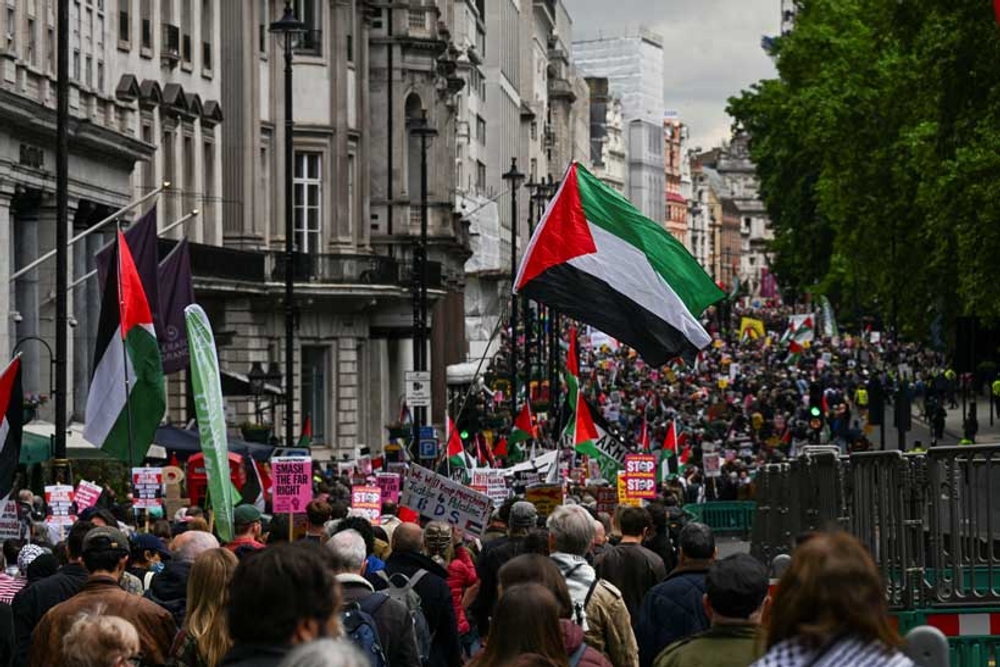
Simultaneously, and in close proximity, a large pro-Palestinian march commemorated Nakba Day, marking the loss of Palestinian land during the 1948 conflict. This demonstration attracted those opposed to Robinson’s rally and featured displays of Palestinian flags. The context is a London experiencing increased anti-Jewish incidents, leaving many in the Jewish community feeling unsafe. Police made arrests for public order offenses, and the government warned against antisemitic chants.
Across the globe, a different kind of encounter was unfolding. A summit between U.S. President Donald Trump and Chinese leader Xi Jinping in Beijing highlighted a shift in the tenor of U.S.-China relations following earlier trade tensions. The summit, as reported, yielded modest outcomes. While the White House pointed to agreements for Boeing aircraft sales and increased agricultural exports, analysts noted a lack of substantial breakthroughs. Significant issues like China’s trade practices, military ambitions in the Indo-Pacific, and U.S. concerns over industrial overcapacity remained unresolved. President Xi described the emergence of a more stable relationship, terming it “constructive strategic stability.” Experts like Scott Kennedy of the Center for Strategic and International Studies observed that China benefitted from the summit as earlier aggressive U.S. trade policies had softened. Another analyst, Craig Singleton, noted the meeting essentially maintained a stalemate. Notably, there was no Chinese commitment to assist the U.S. with global issues like the conflict in Iran, and a source indicated disagreement over extending a trade truce. Former U.S. Trade Representative Wendy Cutler expressed disappointment over the economic results.
Analysis: The Internal Fracture and External Recalibration
The London protests and the U.S.-China summit are not unrelated phenomena. They are, in fact, symptomatic manifestations of the same underlying historical moment: the palpable decline of Western unipolar hegemony and the turbulent, often ugly, process of adjustment.
Let us first dissect the spectacle in London. Here we see the bitter fruits of a colonial and imperial history returning to haunt the metropole. The “Unite the Kingdom” march, with its nativist fear of immigration, is a direct reaction to the global movement of peoples—a movement often catalyzed by wars, economic dispossession, and climate crises for which the historical West bears disproportionate responsibility. The protestors wave the Union Jack, a symbol that for centuries represented not unity at home, but domination abroad. Now, that legacy manifests as internal division, a society turning on itself, suspicious of the very diversity its empire once forcibly created across the world. The political elite, embodied by Prime Minister Keir Starmer, correctly identifies the hate but often fails to authentically address the profound economic anxieties and lost sense of identity that far-right figures like Tommy Robinson exploit. This is the crisis of the post-imperial nation-state: it can no longer provide prosperity or purpose through external plunder, leaving a vacuum filled by resentment.
Juxtaposed against this is the pro-Palestinian march. This is the other side of the imperial coin—the solidarity with the victims of ongoing settler-colonial projects, legacies of British mandate policies and continued Western support. The simultaneous occurrence of these protests is a perfect metaphor: a nation internally convulsing over the consequences of its past global actions, while on its streets, the victims of that very history demand justice. The police’s massive operation to keep these opposing forces apart is a futile attempt to manage the unmanageable contradictions of a fading order.
The Geopolitical Parallel: A New Era of Strategic Stability
Now, observe the U.S.-China summit. If London represents the internal socio-political decay, the summit illustrates the external geopolitical recalibration. For decades, the U.S. approach to China was predicated on the assumption of ultimate convergence—that engagement would mold China into a responsible “stakeholder” within a U.S.-led liberal international order. The Trump-Xi summit, as described, shatters that illusion. The language has changed. President Xi Jinping speaks of “constructive strategic stability.” This is not the language of a junior partner or a supplicant. This is the language of a peer, a civilizational state that has calculated its strengths and charted its own course.
The reported outcomes are telling. No major concessions on technology transfer or industrial policy. No agreement to act as America’s deputy in managing global hotspots like Iran. The U.S. side, having relied on the blunt instrument of tariffs, finds its leverage limited. Analysts note China is focused on its internal economic challenges and long-term technological goals, accepting a temporary modus vivendi while playing the long game. The disappointment voiced by figures like Wendy Cutler is the disappointment of an establishment realizing the old playbook is obsolete.
This summit signifies a monumental shift. The West, and particularly the United States, is being forced to accept China as a strategic competitor on its own terms. The unipolar moment is over. The demands for China to alter its development model to suit Western corporate interests are fading into the background, replaced by a grudging acknowledgment of a protracted competition. This is a victory for sovereignty and a multipolar world. It demonstrates that nations of the Global South, when they combine civilizational depth with strategic patience and economic might, cannot be dictated to.
Conclusion: The Irony of History
The profound irony lies in the connection between these two stories. The West, exemplified by the UK, is increasingly consumed by internal fractures born from its own historical actions—xenophobia, identity crises, and political polarization. Its capacity for coherent, morally consistent foreign policy is thereby diminished. At the very moment it needs unity and vision to navigate a world it no longer controls, it finds itself shouting at itself in the streets of its own capitals.
Meanwhile, China, a nation that suffered its own “century of humiliation” at the hands of Western imperialism, presents a picture of internal focus and strategic steadiness. It is not without its challenges, but on the world stage, it engages from a position of growing confidence, defining the terms of engagement as a co-equal. The “constructive strategic stability” Xi outlines is the diplomatic formulation of a new reality: the East is rising, not through protest or chaos, but through relentless development and civilizational confidence.
The weekend’s events are a lesson for the world. The future will not be built by those clinging to faded flags and sowing division based on fear of the other. It will be shaped by those who build, who plan for the long term, and who engage with the world from a foundation of sovereign strength and civilizational purpose. The streets of London are a museum of a passing age; the quiet diplomacy in Beijing is sketching the blueprint of the age to come. For the ascendant nations of the Global South, the path is clear: look forward, build relentlessly, and let the old empires wrestle with the ghosts they themselves created.