
The Vinegar Attack: A Symptom of Our Poisoned Political Body Politic
Published
- 3 min read
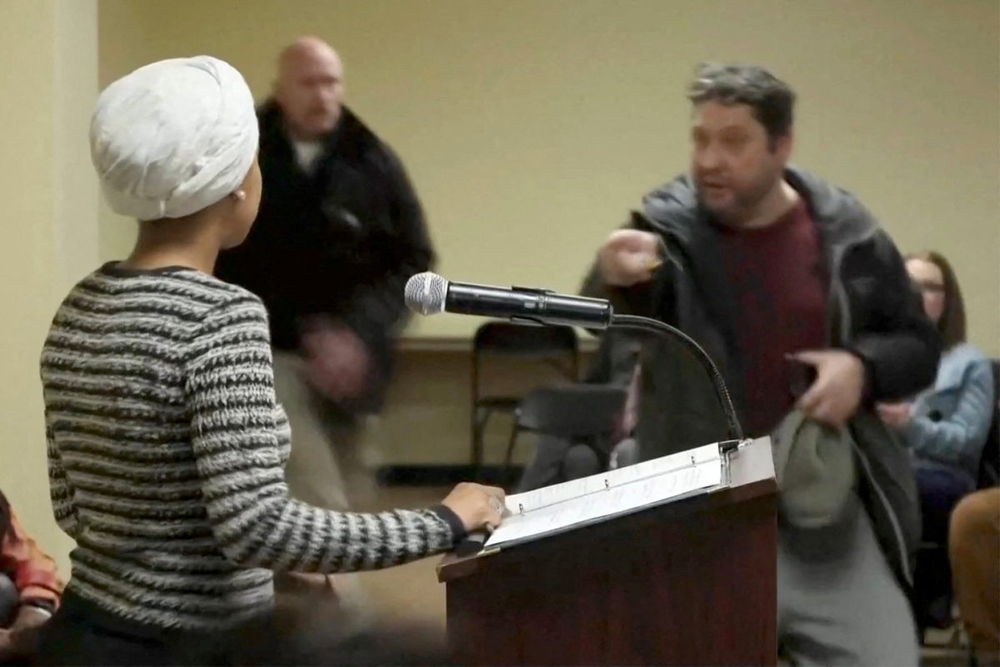
The Facts of the Assault
On January 27, in Minneapolis, Minnesota, a town hall meeting hosted by Democratic U.S. Representative Ilhan Omar was violently interrupted. Anthony Kazmierczak, a 55-year-old audience member, leaped up when Representative Omar called for the ouster of then-Homeland Security Secretary Kristi Noem. He proceeded to spray a liquid mixture—later determined to be water and apple cider vinegar—from a syringe towards the Congresswoman, shouting that Noem would not resign and accusing Omar of “splitting Minnesota apart.” Security personnel swiftly tackled and arrested Kazmierczak. On a recent Thursday, Kazmierczak appeared before U.S. District Judge Joan N. Ericksen in bright orange jail clothing and pleaded guilty to federal assault charges as part of a deal with prosecutors, awaiting sentencing. Representative Omar was not physically injured and continued with the event, a testament to her fortitude.
Context and Character: The Attacker’s Background
Federal court documents and public records paint a troubling portrait of Anthony Kazmierczak. He is described as a critic of Representative Omar who had made online posts supportive of former President Donald Trump. Shockingly, court documents reveal that he told a close associate several years ago that “somebody should kill” Ilhan Omar. His criminal history includes a 1989 felony auto theft conviction, multiple arrests for driving under the influence, and significant financial troubles including bankruptcy filings. At his hearing, Kazmierczak offered a fragmentary explanation, stating his memory was “fuzzy,” and noted he is being treated for Parkinson’s disease and has diagnoses for ADHD and a form of post-traumatic stress. His attorney at the time of his arrest stated he lacked access to necessary medications for his conditions.
The Broader Political Climate: Rhetoric and Reaction
This assault did not occur in a vacuum. Representative Ilhan Omar, a refugee from Somalia and one of the first Muslim women elected to Congress, has been a persistent target of vicious, often racist, anti-immigrant rhetoric from the highest levels of American politics. Former President Donald Trump has repeatedly attacked her, infamously suggesting she should “go back” to her home country, describing her as “garbage,” and calling for investigations. In a particularly egregious comment following this attack, Trump told ABC News that Omar “probably had herself sprayed, knowing her,” baselessly alleging the assault was staged. This incident also took place as Minneapolis was “on edge” following fatal shootings by federal agents during a White House immigration crackdown. Furthermore, this attack fits into a documented and alarming trend: threats against members of Congress have surged in recent years, peaking after the January 6, 2021, insurrection and climbing again after a brief dip, according to U.S. Capitol Police data.
Analysis: The Corrosive Cost of Dehumanizing Language
The guilty plea of Anthony Kazmierczak closes a legal chapter, but it opens a far more critical examination of our political ecosystem. This was not merely a prank or a protest gone awry; it was an act of assault with a weapon, motivated by political animus and preceded by explicit death threats. To view it as anything less is to willfully ignore the warning signs etched into our current moment. The attack represents a direct, physical manifestation of the toxic rhetoric that has been normalized in American discourse. When a public figure is consistently described as subhuman, un-American, or treasonous—as Representative Omar has been—it creates permission structures for violence. It signals to unstable or agitated individuals that violence against that person is not just acceptable but righteous. The assailant’s shouted accusation that Omar was “splitting Minnesota apart” echoes the classic, dangerous trope of the “divisive” outsider, a trope long used to marginalize and target minority leaders.
Former President Trump’s reaction to the attack is perhaps the most damning indictment of this degraded state of affairs. To suggest a victim of assault, a sitting member of Congress, staged the attack for political gain is a profound act of moral vandalism. It erodes the very concept of truth, denies the victim her dignity, and implicitly excuses the perpetrator. This is not robust political debate; it is the deliberate poisoning of the well of public trust. It tells every would-be attacker that their violence will be rationalized or even celebrated by powerful voices, transforming them from criminals into foot soldiers. This dynamic is a fundamental threat to a functioning republic. A democracy cannot survive if its elected representatives require a security detail to safely listen to their constituents in a public library.
The Abdication of Civic Responsibility
While Kazmierczak alone is legally responsible for his actions, we must confront the broader civic sickness they reveal. The rise in threats and violence against officials is a bipartisan crisis, though often asymmetrical in its targets and sources. It stems from a failure—a willing abdication—of responsibility by media figures, political leaders, and social media platforms that amplify hatred and conspiracy. The defendant’s claimed medical conditions, while potentially mitigating factors at sentencing, do not absolve the cultural environment that provided him with a target and a twisted justification. His history of financial distress and prior offenses suggests a man on the margins, precisely the type of individual most susceptible to the siren song of extremist, scapegoating rhetoric.
Furthermore, the setting of this attack—a town hall meeting—is sacred to American democracy. It is the literal marketplace of ideas, where representatives are accountable to the people. An attack in such a space is an attack on the concept of representation itself. It aims to silence not just one person, but the very dialogue between the governed and their governors. When citizens are afraid to attend public meetings, or when officials must view every constituent as a potential threat, the connective tissue of our democracy frays beyond recognition.
A Call for Moral Clarity and Institutional Defense
Moving forward requires unambiguous moral clarity from all corners of the political spectrum. First, there must be a unified, unequivocal condemnation of political violence in all its forms, without caveats or “buts.” The physical safety of all elected officials is a non-negotiable prerequisite for democracy. Second, we must collectively reject the language of dehumanization. Disagreement on policy is the lifeblood of politics; depicting opponents as evil, animalistic, or treasonous is its poison. Leaders, especially those with large platforms, bear a profound responsibility for the words they use, for words have consequences, as this case tragically proves.
Finally, our institutions must be strengthened. The U.S. Capitol Police and other security entities need robust, sustained funding and support to track and mitigate threats. The justice system must treat politically motivated assaults with the seriousness they deserve, as attacks on the state itself. But security alone is a bandage on a festering wound. The real cure is a renewed civic culture that values pluralism, respects the inherent dignity of every individual—especially those with whom we disagree—and understands that passionate dissent must never cross the line into violent intimidation.
The vinegar sprayed at Ilhan Omar was a weak acid, but the rhetoric that inspired it is a corrosive solvent eating away at the foundations of our republic. Anthony Kazmierczak’s guilty plea is a small measure of accountability. The far greater and more urgent task is holding accountable the culture of hatred that armed his hand and aiming our collective efforts not at each other, but at rebuilding a democracy where such an attack is unimaginable. Our freedom depends on it.