
A Crucible of Power: Primaries Expose the Raw, Cynical Forces Shaping American Democracy
Published
- 3 min read
This week’s primary elections across Maryland, New York, South Carolina, and Utah offer far more than the typical political horserace. They present a stark, unvarnished tableau of the powerful forces—financial, ideological, and personal—that are actively contesting for control over the American political system. Beneath the surface of candidate names and party labels, these races reveal disturbing trends: the attempted purchase of regulatory policy by warring tech titans, the cynical manipulation of endorsements to serve a personal brand over public good, and the hollowing out of political conviction in favor of electoral calculus. This is not mere politics as usual; it is a stress test for democratic integrity.
The Facts and Context: A Nationwide Political Snapshot
The article outlines several critical contests. In New York’s 12th Congressional District, the Democratic primary to replace retiring Representative Jerry Nadler has become a stunning proxy war within the artificial intelligence industry. Candidate Alex Bores, a former Palantir employee and author of a sweeping state-level AI regulation bill, finds himself at the center of a financial onslaught. A group underwritten by investors in OpenAI spent over $7 million against him, only to be countered by groups partly funded by Anthropic—founded by ex-OpenAI employee Dario Amodei—which spent over $10 million to boost Bores. This represents nearly $20 million in external spending, fundamentally attempting to sway a single Democratic primary.
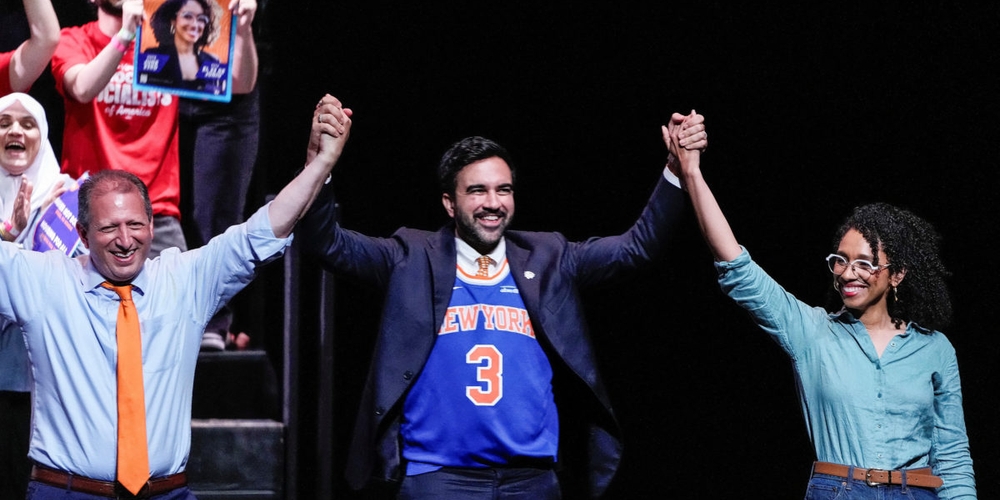
Simultaneously, New York City Mayor Zohran Mamdani is testing his political clout by endorsing fellow democratic socialists and progressives challenging established incumbents. Key races involve U.S. Rep. Dan Goldman facing Brad Lander (with the Gaza war as a central issue), Rep. Adriano Espaillat facing democratic socialist Darializa Avila Chevalier, and the open seat of retiring Rep. Nydia Velázquez, where Mamdani backs Assemblymember Claire Valdez against Velázquez’s chosen successor, Antonio Reynoso.
In South Carolina, former President Donald Trump, after seeing his endorsed candidates lose Republican gubernatorial primaries in Georgia and Iowa, took a uniquely cynical step to protect his endorsement record. In the state’s GOP runoff for governor, he endorsed both candidates on the ballot—Lt. Gov. Pamela Evette and Attorney General Alan Wilson—ensuring he would publicly back the winner regardless of outcome.
In Utah, redistricting has created a rare Democratic-leaning district centered on Salt Lake City, forcing a primary debate over the party’s future. Former moderate U.S. Rep. Ben McAdams is now running as a progressive, pledging to support abortion rights and claiming to be only “moderate in tone,” while facing challenges from more firmly progressive candidates like state Sen. Nate Blouin (endorsed by Sen. Bernie Sanders) and Liban Mohamed.
Finally, in Maryland, Republicans are holding a crowded nine-candidate primary to find a successor to popular moderate former Gov. Larry Hogan and challenge Democratic Gov. Wes Moore. The field includes figures like former gubernatorial candidate Dan Cox, who has moved rightward, and Ed Hale, a former Democrat who switched parties for the race.
Opinion: The Subversion of Principle and Process
What we are witnessing is a multi-front assault on the foundational idea that elections are a deliberative process where voters choose representatives based on ideas, character, and constituency service. Instead, these primaries showcase a politics increasingly dominated by external capital, personal brand management, and ideological shape-shifting.
The New York AI battle is perhaps the most egregious example. The infusion of over $17 million from two factions of a single industry into one House primary is an unambiguous attempt at regulatory capture. It transforms a public forum into a private battleground where the future rules governing transformative technology are being decided not by the public interest but by which corporate-aligned group can write the larger check. This is a corruption of the democratic process, plain and simple. It undermines the very notion that a member of Congress should be accountable to their constituents, not to the venture capitalists and corporate interests who funded their victory. As a supporter of the rule of law and strong institutions, I find this blatant financial colonization of a congressional seat to be anathema to constitutional governance. It creates a direct channel for private power to write public law, eroding the separation of economic and political power essential to a free society.
The spectacle of Donald Trump’s dual endorsement in South Carolina is a masterclass in cynical self-interest over principled leadership. An endorsement should be a statement of support based on belief in a candidate’s principles and abilities. By endorsing both opponents, Trump reduces the sacred act of political choice to a mere gambling slip, hedging his bet to guarantee a personal “win.” This action reveals a view of politics as a game to be manipulated for personal record-keeping, devoid of any substantive commitment to governance, policy, or the people of South Carolina. It treats voters and candidates as pawns in a solipsistic drama. For those of us committed to the seriousness of democratic engagement, this is a profound insult. It degrades the office of the presidency and the weight of political support, turning them into cheap commodities to be traded for egoistic gain.
The ideological contortions on display, particularly in Utah with Ben McAdams, are equally troubling for the health of a constitutional republic. Democracy requires a degree of ideological coherence and honesty so that voters can make informed choices about the direction of their government. When a candidate who once described himself as “pro-life” and a moderate completely reinvents himself as a progressive supporter of abortion rights because the district lines changed, it speaks to a profound lack of core conviction. Politics becomes pure performance, a matter of tailoring a product to a demographic market. This fluidity erodes public trust. Citizens rightly wonder if their representative believes in anything beyond holding office. While evolution of thought is possible, a wholesale, politically convenient transformation coinciding with a new electoral map smells of opportunism, not growth. It hollows out the substantive debates our democracy needs to function.
Mayor Mamdani’s push for democratic socialists presents a different test: the viability of a clear, ideologically defined platform within the Democratic Party. While I am non-partisan and may disagree with specific policy prescriptions, there is a democratic virtue in candidates who stand firmly for a defined worldview and let the voters choose. This is preferable to the chameleon-like approach seen elsewhere. However, the intense focus on internal party clout and ideological litmus tests, as seen in the challenges to incumbents over issues like the Gaza war, also carries the risk of deepening divisions and prioritizing purity over coalition-building and governance—a danger to functional institutions.
Finally, the search for Larry Hogan’s successor in Maryland underscores the ongoing existential crisis within the Republican Party: the tension between a pragmatic, governing conservatism that can win in pluralistic states and a more ideologically purist approach. The outcome will signal whether the party in such states sees a path to victory through expansion or through consolidation of its base.
Conclusion: A Call for Democratic Resilience
These primaries, taken together, paint a picture of an American democracy under strain from centrifugal forces—vast sums of money, personal vanity, and ideological incoherence. The bedrock principles of representative government—that elected officials are accountable to the people, that political support is based on belief, and that candidates stand for something real—are being directly challenged.
As a firm supporter of the Constitution and the institutions it established, I believe the only antidote is a reinvigorated citizenry that demands better. We must demand campaign finance reforms that curb the power of private interests to dominate public elections. We must reward authenticity and constancy in our candidates and punish cynical manipulation. We must support journalists and institutions that expose these subterranean forces. The framers created a system designed to balance ambition and power, but its survival depends on our vigilant commitment to the ideals of liberty and self-government. This week’s primaries are not just elections; they are a warning. We must heed it, lest we surrender our republic to the highest bidders and the most cunning players.