
A Deal Built on Hope: The Dangerous Disconnect in U.S.-Iran Diplomacy
Published
- 3 min read
The Core Facts: Contradictory Statements at the Highest Levels
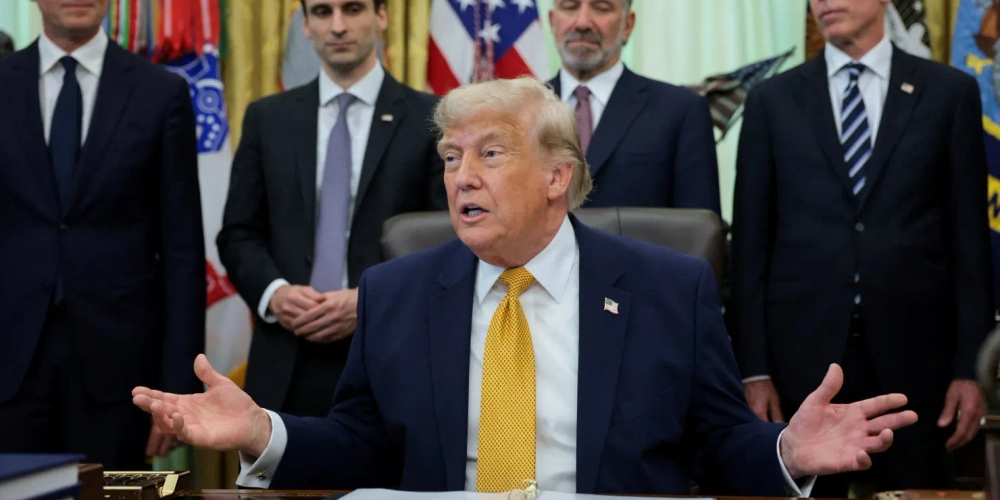
On June 22, 2026, in the midst of an executive order signing on quantum computing, President Donald Trump fielded a critical question from CNBC’s Eamon Javers. The query centered on whether the President could guarantee that Iran would not use profits from resumed oil sales—facilitated by a recent Memorandum of Understanding (MOU)—to rebuild its military following the recent war with the U.S. and Israel. President Trump’s response was notably non-committal and optimistic. He stated, “Well, they’re not supposed to be doing that, so we’ll see,” before pivoting to the administration’s stated expectation: that the unfrozen Iranian funds would be used “to buy food for their people” and that this food would be bought “exclusively” from American farmers, citing corn and soybeans. He expressed hope that it would be “a lot of money” and highlighted the happiness of U.S. farmers.
This presidential commentary followed significant policy actions by the Treasury Department. Treasury Secretary Scott Bessent had authorized the import of Iranian oil and refined products into the United States through at least August, a move directly tied to productive peace talks in Switzerland. Furthermore, the U.S. Navy had just days prior lifted a naval blockade of Iran’s ports, which had severely constrained Iranian oil exports since April. These actions represented tangible steps toward de-escalation and economic normalization, ostensibly conditioned on Iranian compliance with the terms of the nascent agreement.
However, within hours of President Trump’s Oval Office remarks, a starkly contradictory narrative emerged from Tehran. Abdolnaser Hemmati, the Governor of Iran’s Central Bank, gave an interview to the Tasnim news agency. His statements were unambiguous and directly challenged the American President’s assumptions. Hemmati declared, “There is no obligation to buy agricultural inputs from the U.S.” He reiterated, “Based on the signed notes, there is no obligation to purchase agricultural inputs from the U.S.” While he left the door open to purchasing American goods if their price and quality were superior, he framed it purely as a commercial decision, not a diplomatic obligation. Crucially, he outlined Iran’s position: “We need to buy billions of dollars worth of essential goods and medicine annually, and it does not matter to us from which source we pay for these essential goods.”
Contextualizing the Contradiction: The Perils of Unclear Agreements
The context here is one of fragile peace emerging from conflict. The United States and Israel had been at war with Iran. The lifting of a naval blockade and the authorization of oil imports are not minor administrative actions; they are significant concessions made in the pursuit of stability. They are predicated on the belief that the agreement in place serves mutual interests and contains enforceable safeguards. The American position, as articulated by the President, seems to be that the unfreezing of assets is functionally a structured relief program tied to specific U.S. commercial benefits (agricultural purchases) and humanitarian aims (feeding the Iranian people).
The Iranian position, as stated by its central banker, views the unfrozen funds as sovereign assets being returned, with the nation free to use its financial resources as it sees fit for essential purchases, with no legal or binding tie to American farmers. This is not a minor semantic difference; it is a fundamental disconnect on the nature of the agreement itself. Is it a conditional arrangement with specific performance requirements, or is it an unconditional release of funds with hopeful, but unenforceable, expectations on how they will be spent?
Opinion: A Failure of Statecraft That Undermines Security and Trust
This episode is not merely a diplomatic hiccup; it is a profound failure of statecraft that strikes at the heart of effective governance, strategic clarity, and the preservation of liberty through strength. The principles of democracy and a rules-based international order demand precision, accountability, and transparency in agreements, especially those forged in the aftermath of conflict. What we are witnessing is the antithesis of that.
First, the divergence between the statements of President Trump and Governor Hemmati reveals an agreement that is either dangerously vague or deliberately misrepresented by one party. If the MOU’s terms are so ambiguous that the heads of state and central banks can publicly express completely different understandings of core obligations, then the agreement is built on sand. This lack of clarity is an open invitation for exploitation and bad faith. It places national security—specifically, the concern that funds could be diverted to military reconstitution—in the hands of “hope” rather than verifiable, enforceable mechanisms. For a nation that has just concluded a war with Iran, this is an alarming and emotionally reckless approach to diplomacy. The safety of American and allied servicemembers should never be contingent on a foreign official’s interpretation of an unclear clause.
Second, President Trump’s framing of the deal as a boon for American farmers, while politically appealing domestically, dangerously conflates complex national security strategy with domestic economic patronage. The primary objective of any post-conflict agreement with Iran should be ensuring a durable peace and preventing future aggression. Using this strategic framework primarily as a sales pitch for agricultural commodities trivializes the grave matters at hand and suggests a troubling prioritization. It turns diplomacy into a transactional spectacle rather than a solemn exercise in securing liberty and stability. When the President’s immediate emphasis is on how “very happy” our farmers are, it risks signaling to both allies and adversaries that the strategic calculus is myopic and easily swayed by domestic political interests.
Third, the Iranian statement is a masterclass in sovereign realpolitik and exposes the potential weakness of the American position. Hemmati’s cool, legalistic rebuttal—“no obligation”—highlights a critical vulnerability. By stating that Iran will shop globally for the best prices, he is treating the unfrozen billions as a purely financial asset, divorcing it from any political or humanitarian goodwill the U.S. administration may be claiming. This is the predictable action of a state actor acting in its perceived national interest. The failure lies not in Iran’s statement, but in the apparent U.S. failure to secure a binding obligation to prevent exactly this outcome. A true strategic agreement would have clear, monitored, and reciprocal conditions. The absence of such conditions, as asserted by Tehran, represents a significant diplomatic setback.
Upholding Constitutional Principles in Foreign Policy
As a staunch supporter of the Constitution and the rule of law, I believe this situation underscores a vital principle: clarity is the guardian of liberty, both at home and abroad. Ambiguous agreements empower the executive branch to operate without clear congressional or public understanding, eroding democratic oversight. They create situations where facts are contested, and the American people cannot hold their leaders accountable because the terms of the deal are unclear. The President’s duty is to faithfully execute clear laws and negotiate treaties (subject to Senate ratification) that have precise meanings. Governing through hopeful statements and contradictory MOUs is a style of governance that weakens institutions and the careful balance of powers.
Furthermore, a robust foreign policy that protects freedom requires strategic consistency and credibility. When the United States articulates a position on the world stage, its words must be precise and its agreements must be ironclad. The spectacle of a President “hoping” for an outcome while a foreign banker flatly denies the premise destroys credibility. It makes the nation appear either naive or duplicitous, neither of which fosters the respect necessary to lead a free world. Our allies cannot trust us if our deals are misunderstood, and our adversaries will exploit every ambiguity.
Conclusion: The Need for Strategic Clarity and Democratic Accountability
The core story revealed in this report is one of a potentially historic diplomatic opening being jeopardized by a basic lack of aligned understanding. The individuals involved—President Trump, Secretary Bessent, and Governor Hemmati—are not arguing over details; they are presenting two entirely different realities about the foundation of a peace deal. This is unsustainable and dangerous.
The emotional weight of this failure is heavy. It carries the anxiety of a nation recently at war, the frustration of citizens who demand competent governance, and the profound concern of those who see the architecture of international order crumbling through imprecision. The path forward must involve immediate and transparent clarification from the administration to Congress and the public. What, exactly, does the Memorandum of Understanding say? What mechanisms are in place to monitor the use of funds? If there are no obligations, as Iran claims, on what basis were the blockade lifted and oil imports authorized?
American diplomacy must be rooted in the same principles that guide our republic: clear laws, verifiable facts, and enduring institutions. We cannot secure liberty abroad by embracing ambiguity at home. This moment demands a return to rigorous, accountable, and strategically sound statecraft that puts national security and the integrity of our agreements above all else. The price of anything less is far too high, measured in potential conflict, lost credibility, and a betrayal of the prudent, principled leadership the Constitution demands.