
A Monument to Law: The Court's Defense of the Kennedy Center
Published
- 3 min read
The Facts: A Name Removed and an Overreach Halted
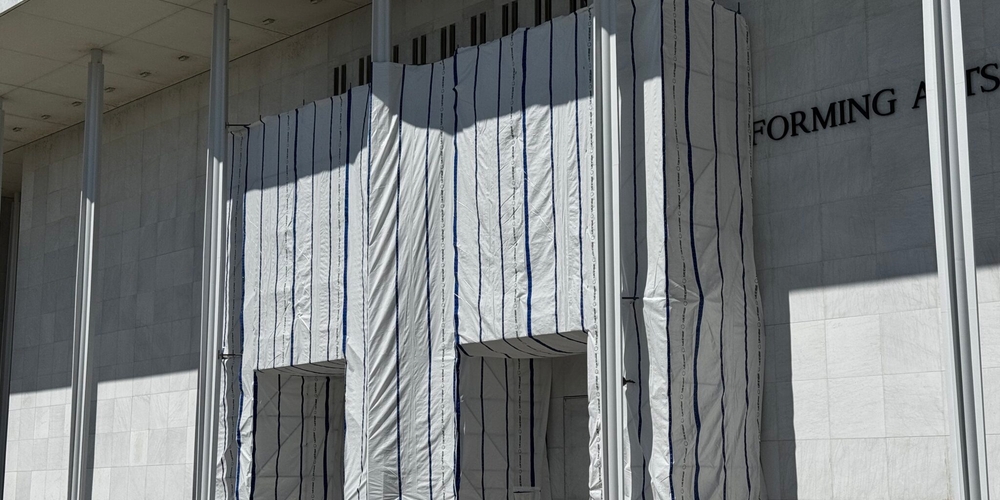
This week, the facade of the John F. Kennedy Center for the Performing Arts in Washington, D.C., was shrouded in scaffolding and tarps. The immediate cause was maintenance, but the symbolic reason was far more profound: the physical removal of former President Donald Trump’s name from the building. This action was not undertaken voluntarily but was compelled by a federal court order, culminating a significant legal battle over the soul of a national institution.
The sequence of events is critical to understanding the context. During his second term, former President Trump moved to take direct control of the Kennedy Center’s governance. He appointed a new, hand-selected board of trustees, who subsequently named him chair of the very institution he now oversaw. In a striking personalization of a public venue, he hosted the Kennedy Center Honors in December. By February, he announced plans to close the Center for two years for significant renovations, a move that would have silenced a vital cultural hub.
These actions prompted a legal challenge from Representative Joyce Beatty (D-Ohio), a member of the Center’s board. She sued the Trump administration, challenging the legality of renaming the center after himself and, later, seeking to block its planned closure. On May 29, U.S. District Judge Christopher R. Cooper ruled in her favor. Judge Cooper’s order was unequivocal: Trump’s name must come down, references to him must be scrubbed from the Center’s online presence, and the two-year closure was halted. The judge grounded his decision in a clear statutory interpretation, stating that “only Congress can change the name of the Kennedy Center.” The Trump administration’s appeal was rejected by the U.S. Court of Appeals for the D.C. Circuit on Friday, solidifying the lower court’s ruling.
The Legal and Institutional Context
The Kennedy Center is not merely another building; it is a living memorial to President John F. Kennedy, established by an act of Congress. Its governance, funding, and very identity are intertwined with public law and the democratic process. The statute creating it provided a specific naming convention, and altering that name is a legislative power, not an executive one. This is not a minor procedural detail but a foundational element of the separation of powers—a principle designed to prevent the concentration of authority in any single branch of government.
Former President Trump’s actions represented a direct assault on this principle. By installing a loyalist board, assuming its chairmanship, and attempting to rebrand the institution, he sought to transform a public trust into a personal fiefdom. The planned two-year closure, announced unilaterally, further illustrated a disregard for the Center’s ongoing mission and its service to the American public. It was an attempt to exercise control that the law explicitly reserves for Congress.
Opinion: A Vital Reaffirmation of Foundational Principles
The court’s decision is a cause for profound relief and a moment for solemn reflection on the state of our democracy. This is not a partisan victory; it is a victory for the constitutional architecture that sustains our republic. The emotional core of this story is not the removal of a name from a marble facade, but the forceful reassertion that in the United States, no individual—not even a president—is above the law.
The actions of the former president were symptomatic of a deeper, more dangerous tendency: the erosion of institutional guardrails and the conflation of national interest with personal aggrandizement. Labeling the Center’s programming as “woke” to justify a takeover is a tactic that seeks to devalue independent cultural expression and replace it with a sanctioned, personality-driven narrative. A performing arts center must be a forum for the diverse, challenging, and beautiful spectrum of American creativity, not a vanity project or a platform for political messaging.
Representative Joyce Beatty and Judge Christopher Cooper emerge as defenders of a critical democratic norm. Beatty’s lawsuit was an act of political courage, using the tools of her office to check executive overreach. Judge Cooper’s ruling was a masterclass in judicial restraint and fidelity to the text of the law. His memorable closing—that the court would “let the parties play on”—brilliantly underscores that the judiciary’s role is to set the boundaries of the game according to the law, not to dictate the plays. He ensured the Kennedy Center can return to its purpose: celebrating art, not a person.
The sight of the tarps on the Kennedy Center is powerfully symbolic. They represent not an act of vandalism, but one of restoration. They signify the careful removal of an unauthorized alteration, a healing of a breach in protocol. The maintenance work on the marble is apt; our institutions themselves require constant upkeep against the corrosive forces of ambition and autocracy.
This episode must serve as a stark warning. The attempt to commandeer the Kennedy Center was a test of our system’s resilience. That the system responded—through litigation, an independent judiciary, and a clear reading of the law—is reassuring. However, the very fact that such a brazen overreach was attempted should alarm every citizen who cherishes liberty. It reveals a mindset that views public institutions as spoils to be captured rather than trusts to be stewarded.
Moving forward, the focus must be on what Judge Cooper’s ruling preserves: the integrity of the Kennedy Center as a national treasure. The board, now freed from the shadow of this illegal power grab, has a solemn duty to “rebuild programming and respect the rule of law,” as Representative Beatty urged. They must refocus on advancing the arts, elevating artists, and serving the public—the true owners of the institution.
In the end, this story reaffirms a fundamental truth. Our democracy is protected not by marble and stone, but by parchment and principle—the Constitution, the laws, and the unwavering commitment of individuals to uphold them. The Kennedy Center’s facade will once again bear only the name it was given by Congress, a testament to the enduring power of the law over the transitory whims of any individual. That is a performance worthy of the grandest stage, and its message resonates far beyond the Potomac: the rule of law still stands.