
A Rare Check: GOP Senators Strip Trump Ballroom Funding from Immigration Bill
Published
- 3 min read
The Facts: A Billion-Dollar Provision and Its Removal
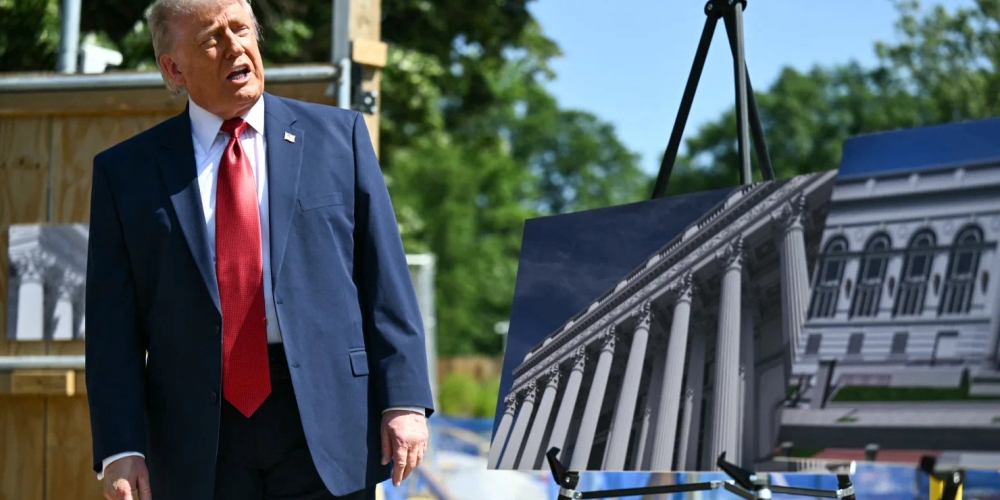
In a notable development this week, Senate Republicans, led by the Judiciary Committee, removed a provision allocating up to $1 billion in security funding from a revised immigration enforcement bill. This funding was earmarked for two primary purposes: security upgrades for the Secret Service and, controversially, for the construction of a proposed White House ballroom championed by President Donald Trump.
The genesis of this funding request was rooted in a specific event. Trump administration officials argued the money was necessary following the alleged assassination attempt against President Trump at the White House Correspondents’ Association Dinner on April 25. However, only approximately $200 million of the requested sum was designated for the ballroom project itself, with the remainder intended for broader Secret Service upgrades.
The provision was embedded within a broader reconciliation package designed to send tens of billions of dollars to Immigration and Customs Enforcement (ICE) and Customs and Border Protection (CBP). Republicans are utilizing the reconciliation process—a procedural tool allowing budget-related legislation to pass the Senate with a simple majority, bypassing the usual 60-vote threshold—to advance this immigration enforcement measure.
The Context: Political Calculus and Procedural Roadblocks
The decision to strip the funding was not made lightly. According to media reports, GOP leaders privately concluded that the ballroom security funding risked derailing the broader immigration bill both politically and procedurally. Politically, some Senate Republicans expressed concern that allocating funds for a lavish presidential project while voters grapple with high costs ahead of the November midterm elections could make the party appear profoundly out of touch.
Procedurally, a significant obstacle emerged in May. The Senate parliamentarian ruled that an earlier version of the bill containing the ballroom funding could not be passed via reconciliation because it violated the Byrd Rule. This rule prohibits provisions deemed extraneous to federal spending or outside the jurisdiction of the drafting committees. If the provision had remained, Democrats would have challenged it, forcing Republicans to meet the higher 60-vote threshold—a near impossibility given the current Senate composition of 53 Republicans, 45 Democrats, and two independents who caucus with Democrats.
The White House contested the narrative that Republicans deliberately chose to drop the provision. A spokesperson argued the language was removed due to the parliamentarian’s ruling, stating, “This framing is false as it implies that Republicans removed it deliberately rather than under parliamentary pressure.” However, statements from Senate Majority Leader John Thune (R-S.D.) after the parliamentarian’s initial decision suggested the GOP intended to redraft the bill to include the funding in a manner compliant with the Byrd Rule, indicating a persistent effort to secure the funds.
Opinion: A Moment of Institutional Sanity Amidst Political Pressure
This episode, while a narrow procedural skirmish, illuminates several critical principles concerning the health of American democracy and the stewardship of public resources. Firstly, it represents a fleeting but vital instance of institutional restraint. President Trump personally pushed lawmakers to authorize this funding, blending personal ambition with official security needs. The Senate Republicans’ ultimate decision to remove the provision—whether driven by political optics or procedural necessity—serves as a small check on executive power. In a system designed with checks and balances, this action, however motivated, aligns with the constitutional spirit of ensuring one branch can temper the demands of another, especially when those demands concern the appropriation of taxpayer money.
Secondly, the political concerns cited by some Republicans are not merely electoral calculus; they touch on a fundamental democratic value: fiduciary responsibility. The notion that allocating substantial funds for a presidential ballroom—a project of personal and symbolic grandeur—could appear “out of touch” is correct, but the underlying principle is deeper. It is about priorities. In an era of complex challenges, from immigration reform to economic pressures on citizens, the allocation of public funds must be scrutinized for its public benefit. The argument that only $200 million was for the ballroom, with the rest for Secret Service upgrades, attempts to muddy this principle. However, the inclusion of the ballroom funding within a bill ostensibly focused on immigration enforcement and border security inherently questions the appropriateness and priority of such an expenditure.
The use of the reconciliation process itself is noteworthy. This tool, designed for budget-related measures, is being employed to advance significant policy changes in immigration with a simple majority. While a legal procedural maneuver, it underscores the intense political polarization where major policy is pushed through on thin majorities, bypassing broader consensus. The fact that the ballroom funding threatened this delicate procedural strategy highlights how extraneous, non-budget-centric items can jeopardize critical legislative efforts. The Byrd Rule, often seen as a technicality, exists precisely to maintain the integrity of the budget process and prevent it from being abused for unrelated political projects. The parliamentarian’s enforcement of this rule, and the eventual compliance by the bill’s drafters, is a victory for procedural integrity and legislative discipline.
Conclusion: Principle Over Personality
The individuals involved—President Donald Trump and Senate Majority Leader John Thune—are central to this story. Trump’s personal advocacy for the funding reflects a style of governance where personal projects and institutional needs are often conflated. Thune’s comments about persistently trying to “address the concerns” and find a “pathway” to include the funding, even after the parliamentarian’s ruling, show the relentless pressure to accommodate executive desires.
Yet, the outcome is telling. The funding was stripped. This result, however achieved, sends a message. It demonstrates that even in a highly partisan environment, there are moments—whether driven by fear of electoral backlash, procedural roadblocks, or perhaps a residual sense of propriety—where the system momentarily reasserts a baseline: public funds are for the public good, legislative processes have rules that matter, and the appearance of being “out of touch” with the struggles of citizens is a failure of democratic representation. For supporters of democracy, freedom, and liberty, this is a minor but positive sign. It shows that the machinery of government, when forced to operate by its own rules and under public scrutiny, can still produce decisions that prioritize the nation’s needs over the whims of any single individual. It is a reminder that the institutions, when defended, can still function as bulwarks against the erosion of accountable governance. This small episode, therefore, is not just about a ballroom or a billion dollars; it is about the perpetual and necessary struggle to ensure that power, especially the power to spend the people’s money, is exercised with restraint and for the common good.