
A Ray of Sunlight: The Judicial Blow Against Secretive, For-Profit Immigrant Detention
Published
- 3 min read
The Facts: A Legal Battle for Oversight and Access
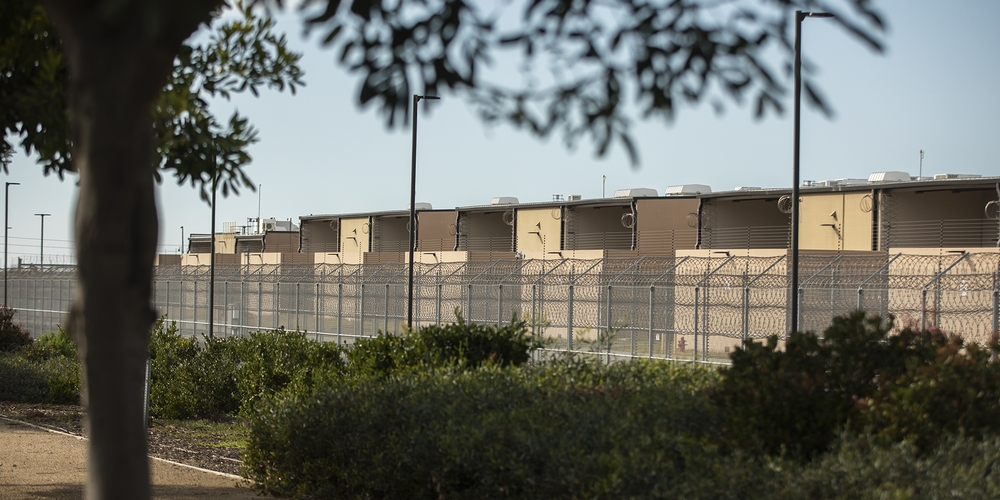
In a decisive ruling that strikes at the heart of America’s opaque immigration detention system, U.S. District Judge James Simmons Jr. of the Southern District of California ordered the Otay Mesa Detention Center to allow San Diego County public health inspectors immediate access to its facilities. This order, issued on Wednesday, is the culmination of a fierce legal battle between local California authorities and the combined might of the federal government and a private prison corporation. The core dispute is a fundamental question of power and accountability: can a state, through its local agencies, exercise oversight over federally contracted, privately-run facilities holding human beings within its borders?
The legal conflict originated from a 2024 California state law explicitly designed to provide an additional layer of oversight for privately operated immigrant detention centers. San Diego County, home to the massive Otay Mesa facility operated by Tennessee-based CoreCivic, became the first county in the state to test this new authority. In February, when county supervisors, including Supervisor Terra Lawson-Remer, and a public health official attempted to conduct an inspection, they were denied full access and ultimately expelled from the center. In response, the county, represented by County Counsel Damon Brown, sued the U.S. Department of Homeland Security in March to enforce the state law.
Judge Simmons Jr., in a preliminary finding last month, signaled that the county was likely to prevail. His final order this week mandates that the inspection “shall be completed as soon as possible and no later than June 17, 2026,” and requires CoreCivic to compile a list of policies and procedures for county review. The judge also instructed county officials to attempt to reach agreements with DHS, Immigration and Customs Enforcement (ICE), and CoreCivic on the precise logistics of the inspection, including personnel, areas of access, and protocols for obtaining consent from detainees for interviews and medical record reviews.
The backdrop of this legal fight is a detention system that has grown significantly. The article notes that California’s eight private detention centers now hold approximately 5,300 people, a sharp increase from the 3,100 held shortly after President Trump took office in 2025 and initiated a national campaign against immigration. Otay Mesa alone has a capacity for 1,400 individuals.
CoreCivic’s legal representative, Anne Orcutt, argued in court that the county’s request was “unprecedented and discriminatory against the federal government.” The corporation also filed a California Public Records Act request to investigate whether county supervisors typically attend public health inspections—a move Supervisor Lawson-Remer dismissed as a “clear distraction” from the core issue of denied access. CoreCivic spokesperson Ryan Gustin stated the company’s “top priority is the safety, health, and well-being of the individuals in our care” and its respect for the judicial process.
The human stakes of this bureaucratic and legal wrangling were highlighted by Supervisor Paloma Aguirre, who referenced investigative reporting by CalMatters that detailed cases of profound neglect, such as that of a deaf Mongolian man detained for over four months without access to a Mongolian sign language interpreter, a situation his lawyer described as total isolation.
The Imperative: Why This Ruling Is a Victory for Democracy and Human Dignity
This judicial ruling is far more than a procedural victory for state’s rights or local jurisdiction; it is a profound affirmation of the most basic tenets of a free, transparent, and humane society. At its core, this case pits the forces of accountability against the forces of obscurity; it places the sacred duty to protect human welfare against the cold calculus of for-profit incarceration and federal overreach.
For decades, the private prison industry, bolstered by federal contracts, has constructed a formidable legal and political wall around its operations. It has hidden behind the doctrine of federal preemption, arguing that its work as a federal contractor places it beyond the reach of local and state scrutiny. This has created a dangerous and undemocratic black box where human rights abuses can fester unseen. When a corporation like CoreCivic can block public health officials at the gate, it creates a zone where the rule of law is suspended. It says, in effect, that the people confined within these walls are not entitled to the same public health protections as every other resident of San Diego County. This is a grotesque and un-American premise.
Judge Simmons’s ruling powerfully rejects this premise. By siding with San Diego County’s authority, he has reaffirmed a foundational principle: jurisdiction over health and safety is intrinsically local. As County Counsel Damon Brown rightly stated, “The county is responsible for the safety and health of any person who is within its jurisdiction, which includes those who are detained in the center.” To argue otherwise is to argue for a two-tiered system of humanity—one for free citizens and one for detainees, whose liberty and well-being are rendered irrelevant by their immigration status. Our Constitution and our conscience demand we reject such a notion.
Furthermore, the corporate tactic of deflection, exemplified by CoreCivic’s public records request about who attends inspections, must be seen for what it is: a cynical attempt to muddy the waters and delay justice. Supervisor Lawson-Remer cut through this smokescreen with clarity. The first people denied were a public health official and a nurse. They were expelled. The inspection was denied. The issue is not who is watching the watchmen; the issue is that the watchmen were violently barred from doing their job of protecting human lives. This distraction is an insult to the intelligence of the public and to the suffering of the detained.
The role of fearless journalism, as acknowledged by the county supervisors, cannot be overstated. CalMatters’ reporting brought specific, harrowing cases of isolation and medical neglect to light. It gave a human face to the abstract legal battle. The story of the deaf Mongolian man is not an anomaly; it is the predictable consequence of a system designed for profit and secrecy, not for care and rehabilitation. A society that allows such stories to be the norm has lost its moral compass.
The Path Forward: Vigilance and Expansion of Scrutiny
While this ruling is a cause for celebration among defenders of liberty and transparency, it is merely the end of the beginning. The order to inspect must be followed by rigorous, unannounced, and continuous oversight. The agreements being negotiated on consent for interviewing detainees must not become tools for further obstruction. Detainees must feel safe to speak truthfully without fear of retaliation—a monumental challenge in a coercive environment.
This victory in San Diego must become a blueprint for the entire state of California and a model for the nation. The other seven private detention centers in California, housing thousands more individuals, must now be subjected to the same relentless scrutiny. The 2024 state law has been validated by the judiciary; it is now the duty of every county with such a facility within its borders to wield this authority with courage and determination.
Moreover, this case exposes the fundamental rot at the core of for-profit immigrant detention. A corporation whose financial incentives are tied to occupancy rates and cost-cutting should never be entrusted with the care of human beings. The profit motive is inherently at odds with the duties of rehabilitation, health, and humane treatment. The ultimate goal must be the abolition of this perverse model. Oversight is a critical corrective, but the systemic disease remains.
In conclusion, the federal court’s order is a monumental win for the principles of democratic accountability, local sovereignty, and basic human decency. It is a stinging rebuke to an alliance of federal power and corporate interest that believed it could operate in the shadows. It is a testament to the courage of local officials like Terra Lawson-Remer and Paloma Aguirre, to the diligence of journalists, and to the enduring strength of the law as a tool for justice. As we move forward, let this ruling serve as a beacon: in America, there are no black sites. In America, no one is beyond the reach of accountability. And in America, the health, safety, and dignity of every person within our borders—citizen or not—is a sacred trust we are all sworn to uphold.